A limestone structure near Tulum may preserve evidence of pre-Hispanic stingless-bee keeping. Forty stone discs and pottery fragments could clarify how Maya households produced and stored honey, although the proposed meliponary interpretation remains provisional pending residue and contextual analyses.
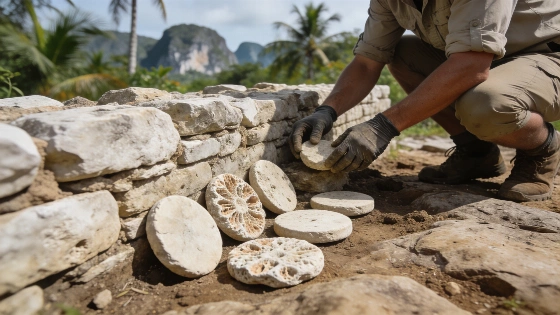
Forty limestone and coral discs found beside a stone structure near Tulum may be the clearest evidence yet from this excavation of how a Maya household kept stingless bees. Their size and position suggest that they could have sealed hollow wooden logs known as jobones, creating a physical link between the masonry remains and honey production. The interpretation is plausible, but it is not yet independently confirmed by residue analysis or a direct archaeological identification of a hive.
The structure was recorded as monument T5_23001 during archaeological rescue work on Section 5 of Mexico's Maya Train route. Excavated in 2022 near Aktun Chen Natural Park in Quintana Roo, it was described in further detail by Mexico's National Institute of Anthropology and History on 23 September 2026. The interpretation is important because the building appears to belong to a working homestead rather than an isolated production facility.
The discovery should also be understood within the present-day management of the Tulum region. The nearby archaeological zone is an INAH site that currently operates daily from 08:00 to 17:00, with last entry at 15:30, while recent visitor information lists admission at 80 MXN for Mexican visitors and 265 MXN for foreign visitors. These practical details do not authenticate the proposed beekeeping interpretation, but they show how archaeological research, public access and conservation now overlap around Parque del Jaguar and the wider Tulum landscape.
Recent local reporting has also described administrative changes around the archaeological zone, including the involvement of structures associated with the Ejército and the Olmeca-Maya-Mexica organization in entry and fee collection. A September 2026 registration effort reportedly listed about 150 tourism-service providers operating in Parque Nacional Tulum and Parque del Jaguar under the Tulum Renace plan. This wider regulatory setting is relevant because rescue archaeology along infrastructure corridors takes place within a landscape that is simultaneously protected, visited and actively reorganized.
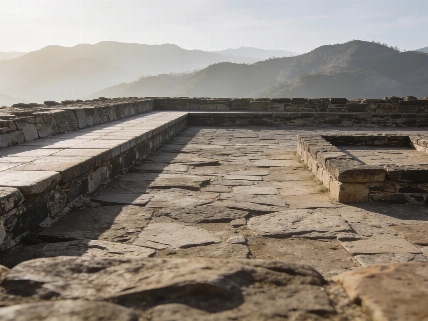
The structure and its finds. Archaeologist Marisela Salazar Carrillo documented an elongated limestone construction measuring 19.5 meters long, 3.9 meters wide and 1.2 meters high. Larger stones were laid horizontally while smaller stones were set vertically, with wedges strengthening walls made from two to six courses of masonry resting directly on bedrock. Its east-west alignment may have allowed several rows of hives to fit beneath a roof made from perishable materials.
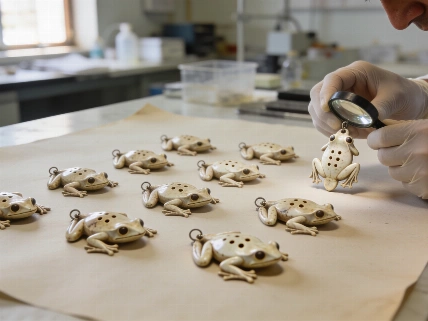
The 40 discs measure between 10 and 20 centimeters across. They were recovered near the structure's walls alongside pottery fragments thought to derive from vessels used to store honey. Stone objects that may have functioned as fishing-net weights and handstones associated with food grinding add evidence for a household where different forms of subsistence took place in close proximity.
The discs are suggestive rather than conclusive. Researchers plan to test their porous surfaces for beeswax, sediments and chemical residues. A positive residue signal would strengthen the interpretation that they were hive covers, while its absence would leave their function unresolved. A rigorous study would ideally report the number of sampled discs, controls, extraction procedures, detection thresholds and uncertainty around each chemical identification, because visual resemblance alone cannot distinguish hive covers from unrelated domestic or architectural objects.
A household economy. The wider archaeological setting gives the proposed meliponary its significance. Archaeologists identified additional stone walls, levelled ground and foundations that may have supported residences or storage areas. A possible shrine lay less than 100 meters away, and a cenote and cavern formed part of the surrounding landscape.
That arrangement is consistent with a Maya homestead combining living space, food processing, cultivation and specialized production. Luis Ernesto Narváez Mac told the excavation team's account that families commonly carried out several activities within one domestic complex, including raising bees, growing maize and beans, storing agricultural products and preparing food. The archaeological remains cannot show exactly how labor was divided within the household, but they do place beekeeping within a broader pattern of resource management.
Historical accounts from the 16th century, including those associated with Gonzalo Fernández de Oviedo y Valdés, have been used to support the interpretation of Maya beekeeping installations as parts of larger household complexes. That comparison is contextual evidence rather than direct proof that this particular structure operated in exactly the same way. Comparable structures along the eastern Yucatán Peninsula have generally been assigned to the Late Postclassic or Spanish contact periods.
The household evidence also fits a broader archaeological pattern in which productive tasks were distributed across domestic landscapes rather than separated into modern-style industrial zones. A recent excavation report from the Czech Republic similarly shows how rescue archaeology can reveal household and food-production systems through the relationship among structures, artifacts and worked ground, even though the sites belong to different periods and regions.
Archaeometric interpretation benefits from combining independent lines of evidence rather than treating one artifact class as decisive. Microscopy can characterize manufacturing traces and surface wear; residue chemistry can test for beeswax or food compounds; ceramic petrography can identify vessel production histories; and spatial analysis can assess whether the discs cluster in a pattern expected for repeated hive maintenance. These approaches reflect the broader evidentiary discipline associated with research programs at institutions such as MIT and the Max Planck Society, where material claims are separated from the strength of the measurements supporting them.
Dating the beekeeping site. Narváez Mac considers a Late Postclassic date between 1200 and 1521 CE most likely, while a Spanish contact-period date between 1521 and 1697 CE remains possible. This is a provisional chronological range, not a precise construction date. Pottery analysis will be needed to narrow it, and the current account does not report a direct radiocarbon measurement for the masonry or the proposed hive components.
The physical evidence also leaves several limits on interpretation. The wooden jobones and roof have not survived, so their presence is inferred from the structure's form and the discs' potential function. Pottery fragments may indicate honey storage, but vessels found near a building do not by themselves prove how every object was used. The nearby walls, shrine, cenote and cavern establish a meaningful landscape context without demonstrating that all features belonged to one moment or one household.
Soil samples have been sent to the Soil and Chemical Analysis Laboratory in Yucatán to investigate the environmental conditions that could have supported Melipona beecheii, the stingless bee traditionally kept by Maya communities. Pottery and stone artifacts are undergoing analysis in laboratories in Quintana Roo and Campeche. INAH also plans an ethnoarchaeological comparison with contemporary Maya meliponaries, an approach that can illuminate technique while avoiding the assumption that modern practice is an unchanged survival of the past.
Ethnoarchaeology is most informative when modern observations are used to generate testable analogies rather than direct historical identities. Contemporary hive construction may reveal how circular covers fit wooden containers, how beeswax accumulates and how working areas are arranged, but environmental conditions, materials and social organization can change through time. The same caution that guides comparative work in journals such as Nature is needed here: analogy can strengthen a hypothesis, but it cannot substitute for evidence from the excavated context.
Contextual dating means assigning an age from associated pottery, architecture and comparable sites rather than directly dating the activity itself. That distinction matters here because a structure may have been repaired, reused or occupied across more than one period. Until the pottery and residue studies are complete, the discs remain probable hive covers rather than confirmed ones. In the available recent material, independent primary confirmation of a bee-site or meliponary interpretation has not been identified; the strongest verified information concerns the site's archaeological status and the administrative setting around Tulum.
Even with that qualification, the excavation provides solid evidence for examining beekeeping as part of an integrated Maya household economy, not as a detached specialty inferred from a single artifact. If beeswax or related residues are detected consistently on the discs, and if their spatial distribution matches the architecture, the case will become substantially stronger. If those tests are negative, the structure will still retain value as evidence of domestic organization, craft activity and the complex ways in which Maya households used limestone, ceramics, water-filled karst features and cultivated landscapes.