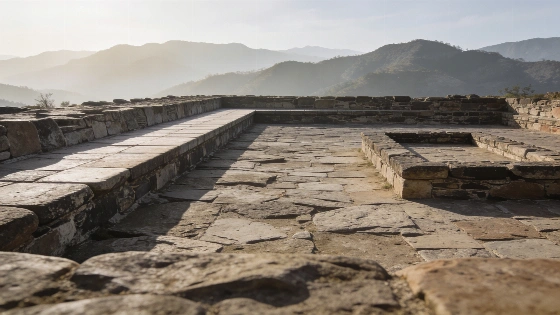
A monumental courtyard in Puebla aligns with the Sun's annual movements and may have marked key points in the agricultural year. Its layout is the first confirmed Group E complex identified outside the Maya region
A ceremonial complex in Puebla was built to observe the Sun more than 2,500 years ago, according to Mexico's National Institute of Anthropology and History (INAH). On October 13, 2026, the institute announced findings from the Proyecto Arqueológico Teteles de Ávila Castillo at Teteles de Ávila Castillo, in the state's Sierra Norte. The site, also known as Tetelihtic, lies east of the ceremonial center's Great Plaza. INAH identifies it as the first confirmed example outside the Maya region of a Group E architectural complex, a form associated with observing the solar cycle.
The layout offers evidence that people in the Sierra Norte mountains incorporated observations of the sky into ceremonial architecture. It does not establish exactly how residents interpreted those observations or prove that the complex served only as an observatory. The interpretation is part of an ongoing archaeological project led by Alberto Diez Barroso Repizo.
Platforms and the horizon. The complex consists of a quadrangular courtyard between two platforms aligned east to west. The eastern platform measures about 90 meters from north to south and 40 meters from east to west; the western platform measures approximately 46 by 27 meters. Researchers identify the smaller western structure as a likely observation point from which the Sun's position could be tracked over the eastern platform.
That arrangement resembles Group E complexes at Maya sites, including the structure at Uaxactún in Guatemala. INAH dates both complexes to the Middle Preclassic period, approximately 1000 to 600 BCE, although they differ in scale; the Uaxactún complex is about twice the size. A separate example of Maya architecture is covered in research on Xpujil; that residence is not evidence of a direct connection with Tetelihtic.
INAH's interpretation draws on architectural study, comparison with other ceremonial centers and observations of the Sun's movement across the horizon. The eastern platform's façade is understood as a solar calendar: at sunrise, it could frame the Sun's position at equinoxes and solstices. Diez Barroso has also associated the complex's longitudinal markers with the beginning of the pre-Hispanic calendar cycle in February and the harvest season in October. He has noted that Tetelihtic's elongated structure need not indicate the equinox from a central observation point in the same way as some Maya complexes. These alignments are interpretations of the architecture and horizon, rather than surviving written records of calendar use.
Seasonal markers. Researchers propose that the eastern platform marked dates important to the agricultural cycle, including the February calendar beginning and October harvest season. The layout is also interpreted as allowing observers to follow key points in the Sun's annual movement, including the equinoxes and solstices. These interpretations connect the architecture to seasonal activities but do not establish the exact calendar system or ceremonies practiced there.
Diez Barroso has linked the similarities with Uaxactún to a shared tradition of astronomical observation and ceremonial building. The comparison has prompted investigation of cultural contact and related architectural practices, but resemblance alone does not establish who transmitted the design, whether people moved between the regions or whether both complexes had identical functions.
What the site can show. Tetelihtic began functioning around 900 BCE, and its partial abandonment is dated to about 100 CE. Archaeological offerings indicate that the precinct continued to be used as a ritual space after its initial construction. Offerings around the ceremonial precinct are dated to approximately 100-600 CE, while a later Totonac offering found on one platform dates to about 600-900 CE. The latter reflects further ritual use centuries after the settlement's main occupation.
Researchers are also considering possible links between early communities in Puebla and Maya-speaking populations, as well as the origins of Totonac communities. Diez Barroso has suggested Tetelihtic may have been an early center associated with populations ancestral to the Totonac, who later developed important centers at Yohualichan in Puebla and El Tajín in Veracruz. The later Totonac offering is part of the site's subsequent history; it does not establish that the builders of the Preclassic complex were Maya or that Tetelihtic had a direct political relationship with Maya centers. A proposed connection between the settlement's orientation toward Canopus and the Nahua goddess Nantehuitz is likewise a hypothesis, not a confirmed identification.
The findings were presented at a public conference and photographic exhibition, with support from municipal authorities and the Tzoncoyotl civil association. INAH describes the complex as having functioned as a solar astronomical observatory, based on its configuration, comparative study of Mesoamerican planning and the Sun's movement along the horizon. The institute's announcement presents the interpretation as part of continuing research into the site's architecture and astronomical characteristics.
In archaeological studies, a solar alignment is a relationship between a structure and the Sun's position as observed from a particular location. A building may frame or mark a rising or setting point on the horizon at recurring times of year, with the surrounding landscape shaping what observers could see. At Tetelihtic, the proposed February and October markers connect the architecture to seasonal activities, while the complex's full history also includes later ritual offerings. INAH has outlined the findings as an ongoing archaeological interpretation.