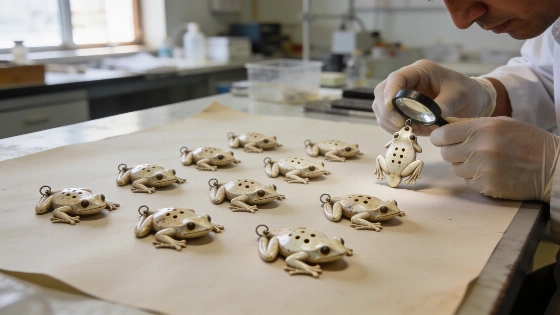
Fourteen small zoomorphic shell pendants recovered during Maya Train salvage excavations in Campeche and Yucatán may illuminate craft production, funerary practice and the movement of marine materials, although no independent chemical provenance study or later official assessment has yet been documented.
Fourteen tiny frog and toad pendants recovered during archaeological salvage work in southeastern Mexico offer a focused material record of Maya craft and ritual practice. Their shell, manufacturing traces, funerary associations and repeated upside-down imagery may connect the movement of raw materials with ideas about rain, fertility and rebirth.
The objects do not prove a single trade route or identify the people who wore them. They do, however, preserve a compact set of observations from the Late Classic period, dated here to AD 650-900. Because the assemblage contains only 14 pieces, its value lies less in statistical generalization than in the possibility of comparing repeated technical features across documented archaeological contexts.
INAH reportedly recovered the pendants during archaeological salvage excavations connected with sections 2, 3 and 4 of the Maya Train Project. The finds came from Sacamuy, Dzitbalché, Xiol, Kimbilá and Kanab in Campeche and Yucatán. The available account places them in the Zooarchaeology Laboratory in Chetumal, Quintana Roo, as part of a wider collection of molluscan material recovered from different archaeological contexts along the route.
Each pendant is reported to measure between 2 and 4 centimeters. The makers carved and polished shell, then added grooved incisions. All 14 examples omit detailed limbs and have two conical perforations near the cloacal area. Researchers also identified two treatments of the head: one uses circular rotary abrasion for the eyes together with an incised mouth, while the other uses abrasion for the eyes alone.
These repeated features matter because they allow archaeologists to compare production choices rather than relying only on visual resemblance. The available report does not identify the shell species, provide a direct dating result for the pendants or present chemical provenance measurements. It also does not report sample-level statistics, confidence intervals, p-values or a peer-reviewed laboratory study. Consequently, proposed exchange patterns remain research questions rather than demonstrated routes.
Future provenance work could combine microscopic examination of manufacturing traces with elemental or isotopic characterization of the shell, provided that suitable comparative samples from potential source regions are available. Such analyses would need to account for diagenesis, conservation treatments and the fact that marine shells can move through exchange before they are carved. A robust model would also require a reference dataset, transparent uncertainty estimates and comparison with other Maya-region shell objects; none of those results is documented for this assemblage in the available material.
The pendants show the anurans upside down. Researchers have compared that position with imagery on folio 17 of the Madrid Codex, where similar figures are associated with falling rain. The comparison is interpretive, not a written label attached to these particular objects, and no independent academic publication confirming this specific interpretation was identified in the available search.
According to the interpretation attributed to INAH, anurans could be regarded as water deities and messengers of rain, while also carrying associations with the underworld and rebirth. Their biological behavior made them relevant to fertility and agricultural ceremonies and to sacrificial practices. The pendants therefore may have expressed a relationship among people, water, the natural world and the spiritual realm rather than serving as decoration alone. No direct quotation from an INAH representative or independently published institutional statement was available to verify the wording of that interpretation.
Shell could have reinforced such associations. Across Mesoamerica, marine shells and snails were made into bracelets, pectorals, armbands, ear ornaments, rings and pendants, as well as musical instruments. Their connection with water could make them religiously significant, while labor-intensive manufacture and circulation could also mark social position. That does not mean every shell ornament belonged to an elite or carried one fixed meaning.
Comparative archaeological research published in journals such as Nature archaeology research illustrates why material interpretation is strongest when morphology, context and laboratory evidence are considered together. For the Maya pendants, however, the current record is limited to reported dimensions, visible production traits, archaeological associations and comparative iconography; it does not yet include the analytical dataset needed to test competing explanations.
The objects were found in funerary contexts, but the available report does not establish whether the associated burials were those of adults or children. Researchers are considering the possibility that the pendants accompanied child burials because comparable zoomorphic shell objects have been reported with infants elsewhere in the region. At present, that is a hypothesis rather than a demonstrated explanation for this assemblage.
Nor does association in a funerary context prove that all 14 pendants were deposited together, made in the same workshop or used by the same community. Excavation context can show that an object entered a burial setting, but it cannot by itself recover the biography of the object or the intentions of the people who placed it. These distinctions are essential when small ornaments are used to infer ritual practice.
The find also complements earlier Maya research on how material evidence can connect objects with social organization, although the pendants address exchange and symbolism rather than elite architecture. Here the strongest evidence lies in the carvings' repeated form, their recovery from archaeological sites and the cultural associations proposed for both shell and anurans.
Specialized approaches developed across archaeology and materials science, including imaging, use-wear analysis and compositional reference databases, could help separate workshop variation from differences caused by use or burial conditions. The Max Planck Society and MIT are examples of institutions associated with advanced archaeological and materials research, but no researcher from either institution is linked to this assemblage in the available record. Mentioning such methods should not be mistaken for evidence that they have already been applied to the pendants.
Further study could compare the pendants with other zoomorphic shell objects from the Maya region, identify the biological or geological source of the shell and reconstruct the movement of raw material between settlements. It could also clarify whether differences in head treatment reflect workshop traditions, chronology, use or symbolic distinctions. Microscopic analysis might test whether the perforations show suspension wear, while three-dimensional recording could quantify carving patterns; these are proposed avenues, not reported results.
The collection's value is therefore strongest when its limits remain visible. Fourteen pendants cannot map an entire Maya economy, and a funerary deposit cannot establish a universal belief about frogs. They can, however, provide a controlled set of material observations from five archaeological sites and a precise basis for testing how craft production, shell circulation and mortuary practice intersected.
Independent confirmation of the pendants' later status, new analyses or formal institutional decisions was not found in the available search. The only additional relevant result appeared to repeat the original account rather than provide an independent catalogue, inventory or peer-reviewed study. That absence does not invalidate the discovery, but it means that claims about trade networks and symbolism should remain explicitly provisional.
Mortuary context is the association between an object and the treatment of the dead, but it does not automatically reveal the object's original function or the identity of its user. Objects may have been made for burial, reused from daily life or selected because their material and imagery carried particular meanings. In this case, the pendants are best understood as evidence for a plausible connection among shell, rain symbolism and exchange-not as proof of a single ritual system. That restrained reading is exactly what makes the assemblage useful: its small size limits broad claims while its repeated, documented features give future research something concrete to test.