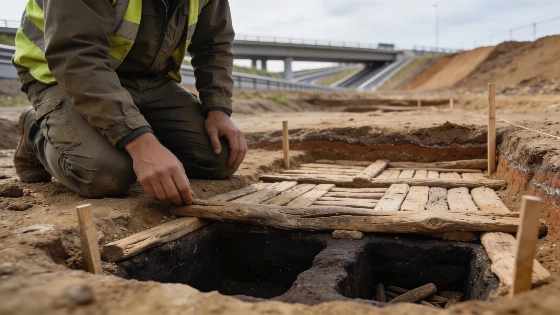
A rescue excavation along the Czech Republic's D55 motorway has documented 1,879 settlement features, 65 cremation and burial contexts, and large Neolithic houses across a landscape occupied repeatedly from the Neolithic to the medieval period.
A motorway route through the Czech Republic has cut across a prehistoric landscape far larger and more complex than archaeologists expected. Along less than seven kilometers between Kokory and Přerov, the excavation recorded 1,879 settlement features, 65 cremation and burial contexts, and one human burial within a settlement layer.
The finds do not represent a single moment in the past. They document repeated use of the same landscape across thousands of years, with evidence of life extending from the Neolithic to the medieval period. The strongest concentration is at Kokory-Podsedky, where archaeologists identified 974 features, making it the densest excavated zone in the surveyed corridor.
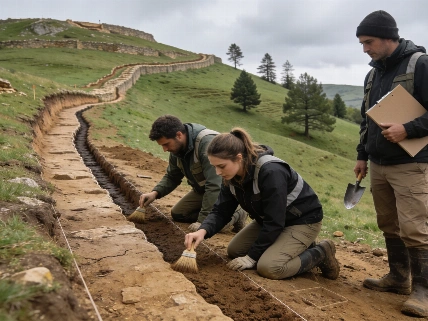
The work was a rescue excavation carried out ahead of construction of the D55 motorway by the Archeologické centrum Olomouc. Led in the field by Marek Kalábek, the excavation campaign ran from September 2025 until 29 July 2026. Archaeologists confirmed all 12 expected archaeological localities along the route and identified an additional previously unknown site in the cadastral area of Dluhonice.
That result changes the scale of the archaeological record being considered. Instead of isolated finds, the motorway corridor revealed linked evidence of settlement activity, storage, food preparation and burial. The concentration of remains shows why infrastructure construction can expose a broad archaeological landscape rather than simply a handful of objects.
The excavation's figures are precise even where the historical interpretation must remain measured: 1,879 settlement features, 65 cremation and burial contexts, and one human burial inside a settlement. The investigated stretch included Kokory-Podsedky, Rokytnice-Za Oborou, Rokytnice-Podlesí and Dluhonice. The number of features is an archaeological count, not a population estimate; one pit, posthole or other feature does not necessarily represent one household or one individual.
At Kokory-Podsedky, archaeologists found evidence of a settlement associated with the Linear Pottery culture. The community lived approximately 7,000 years ago during the Neolithic period, when farming communities were transforming subsistence and settlement across Central Europe.
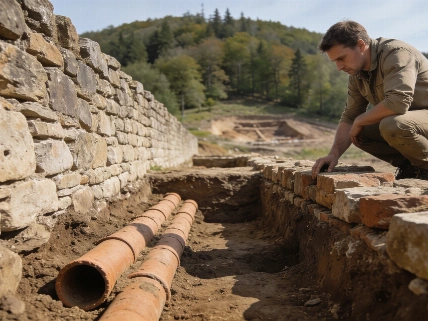
The remains include floors from long timber houses, storage pits, ovens and other features connected with daily domestic activity. Some structures reached up to 36 meters in length. Their size is a direct architectural observation, but it does not by itself establish the social status of the people who built them or describe how many individuals occupied each house.
House floors and pits are valuable because they retain relationships among activities rather than presenting artifacts without context. A pit beside a house can be interpreted within a settlement plan, while an object removed from its archaeological setting would carry much less information. Here the excavation provides spatial evidence for how early farming communities organized domestic space, although the available account does not report detailed analyses of plant remains, animal bones or household assemblages.
The Linear Pottery attribution places part of the settlement within a well-known Neolithic archaeological tradition, but it should not be treated as a modern ethnic label. The excavation establishes cultural and chronological association through the archaeological record described by the project. It does not establish the language, identity, ancestry or self-identification of the people who lived there.
The burial evidence extends the site's chronology into the Bronze Age. At Rokytnice-Za Oborou and Rokytnice-Podlesí, archaeologists identified two Early Bronze Age burial sites together with 18 burials from a later phase of the Bronze Age. Another burial in the Dluhonice area contained pottery vessels, a bronze object and a stone tool.
These objects are associated with their burial contexts, but the available account does not provide skeletal profiles, age estimates, biological-sex estimates, pathological observations or evidence for cause of death. It therefore cannot support claims about individual identity, occupation, status or the meaning of the grave goods. The burials do show that funerary activity formed part of the long-term use of the landscape.
The field excavation has ended, but interpretation has not. As of 22 September 2026, the recovered material was entering cleaning, conservation and documentation at the Archeologické centrum Olomouc. After scientific processing, the finds are expected to be transferred to the archaeological museum structure of the Museum of Natural History in Olomouc. The results are also planned for public presentation during Archaeology Day in Olomouc on 17 October 2026.
The next analytical stage will determine how much more can be learned from the material. Dating methods, sediment analysis, archaeobotany, zooarchaeology and osteological study can refine chronology and reconstruct aspects of diet, environment and activity, but no radiocarbon results, statistical tests, confidence intervals or laboratory datasets have yet been reported for this excavation. The responsible conclusion is therefore that the fieldwork established a large and repeatedly occupied landscape while leaving finer interpretations to the conservation and analysis still ahead.
Archaeological context means that a house floor, grave, pit or artifact is interpreted through its position and relationship to other remains rather than as an isolated curiosity. This principle is shared across modern archaeological science, including research associated with the Nature archaeology collection and the Max Planck Society's work on human prehistory. Those broader research traditions also emphasize that material culture can illuminate behavior without automatically revealing language, ethnicity or individual biography.
The excavation phase has ended, but the motorway project is moving toward construction. Local reporting indicates that work on the missing D55 section in the Olomouc-Přerov direction is expected to begin before the end of 2026, with opening planned for 2029. The archaeological campaign therefore represents the principal opportunity to document deposits that will otherwise be covered or removed by infrastructure.
For a comparable example of how maritime archaeology can reconstruct activity from contextual evidence, readers can consult an earlier survey of underwater sites in Saudi Arabia.
The project's importance lies in the density and continuity of the evidence rather than in one spectacular object. Its settlements and cemeteries connect domestic architecture with burial practice across a long period, while the unfinished conservation and analysis mean that many details remain unavailable. That restraint matters: the excavation has already established a substantial prehistoric landscape, but the strongest historical conclusions must wait for the recovered materials to be studied in context.