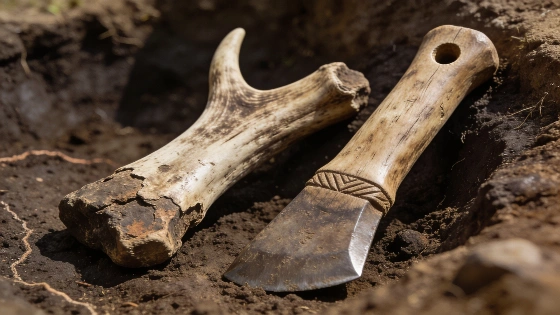
Two deer-antler axes reportedly recovered from pits at a prehistoric settlement near Löddeköpinge add a rare potential example to Sweden's Bronze Age record. Their condition suggests skilled shaping, but independent confirmation, precise dating and evidence of their use have not been published in the available sources.
Two rare deer-antler axes reportedly found at a prehistoric settlement near Löddeköpinge offer a close look at a tool type that is scarce in Sweden. One is badly eroded; the better-preserved example has a perforated shaft hole and a shaped, ground cutting edge. That workmanship indicates deliberate manufacture, but it does not establish whether the axes were used for practical work, ceremony or both.
The reported discovery has not been independently confirmed in the official records and publications located for this account. The available information does not include an excavation report, object inventory numbers, measurements or laboratory results for the two axes. The description of the finds and their context should therefore be understood as reported information rather than a fully documented, independently verified archaeological record.
The axes were reportedly recovered from pits during an archaeological investigation carried out earlier in 2023, according to Arkeologerna. They have been tentatively assigned to the Bronze Age, conventionally dated in this account to about 1700-500 BCE. No dating method is specified, so this cultural and chronological attribution should not be mistaken for a direct date measured on either object.
Their reported context matters: they came from pits at a settlement, rather than from the wetlands where many Danish examples have been found. The available account does not establish the pits' precise function or the axes' relationship to other material in them. A findspot can place an object within an archaeological setting, but without further contextual detail it cannot reveal exactly how the object was used or why it was deposited there.
The better-preserved axe supplies the clearest physical evidence. Its shaft hole and worked edge suggest it was shaped to be mounted on a handle and that its cutting surface was intentionally formed. The other axe is too eroded to offer the same level of detail. As with other ancient tools, a preserved prehistoric tool can retain evidence of manufacture while leaving its full history of use uncertain.
Antler tools were widely used in Scandinavia during the Mesolithic, when hunter-gatherers made implements from deer antler, a durable material suitable for woodworking. They became less visible in the archaeological record during the Neolithic, as agricultural communities increasingly used other materials and toolmaking traditions. Antler axes appeared again in a modified form during the Bronze Age and disappeared from the record during the Iron Age.
Experimental work at the Lejre experimental archaeology centre in Denmark tested reconstructed antler axes and showed that they could fell trees, chop dry timber and split firewood. This demonstrates that such tasks were possible with reconstructed examples; it does not prove that the reported Swedish axes were used for them. Their exact function has not been established.
A peer-reviewed study in Heritage discusses the re-examination of three elk-antler axes or adzes held by the Historical Museum at Lund University. Those museum objects are not the Löddeköpinge finds, and the study does not independently confirm the 2023 discovery. The comparison is useful chiefly as a reminder that museum reanalysis of other artifacts cannot supply missing excavation details or dates for these two reported objects.
The Danish comparison also cautions against treating tool and ritual object as mutually exclusive categories. Of 155 Bronze Age antler axes documented in Denmark, 59 bear decoration, including dotted circles, wheel crosses and spiral patterns. Many Danish examples have been recovered from wetlands and bogs, settings associated with deliberate deposition in Scandinavian prehistory. These patterns have prompted interpretations of symbolic or ceremonial significance, but they do not establish the meaning of the reported Swedish axes, which were found in pits.
Care is also needed when consulting regional archaeological records. A separate Swedish National Heritage Board Fornsök entry for a Late Iron Age settlement lists six radiocarbon dates, with reported ranges from 420-590 to 890-1040 CE. That record concerns a different site and period, and cannot be used to date the Löddeköpinge axes. The distinction between observations, dating evidence and interpretations is fundamental across scientific reporting, including work published in journals such as Nature and PNAS.
If the reported finds are confirmed, they would add two objects to a comparatively small Swedish record, despite the larger number documented in neighboring Denmark. Their potential significance is specific: they would indicate the presence of Bronze Age antler-axe technology at a settlement in southern Sweden. The information currently available does not identify a particular activity, establish a ritual, or show that the two axes had the same purpose.
The physical features and reported find context should be considered separately from interpretations of meaning. The worked edge makes practical use plausible, while comparisons with decorated and wetland-deposited Danish examples keep symbolic use in view. Neither interpretation has been demonstrated for the Löddeköpinge finds. That restraint reflects the limits of the evidence: the reported workmanship is clearer than the objects' role.
A tentative archaeological date is not the same as a direct measurement of an object's age. Here, the reported account assigns the axes to the Bronze Age but does not specify the basis for that attribution, and the available official material provides no exact dating, subsequent conservation details, laboratory analysis, museum display record or formal conclusion about function. The reported finds may broaden the known Swedish record, but claims about exactly when they were made and what they meant require evidence not currently documented in the available sources.