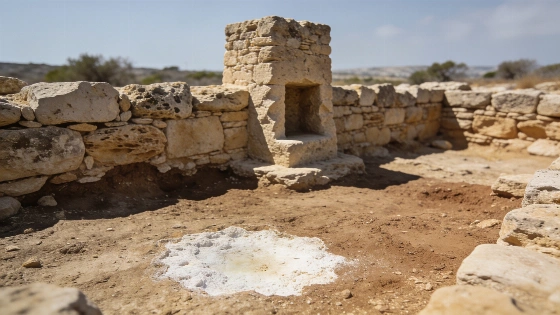
Pottery beside a newly exposed rampart section places its earliest known construction in Late Cypriot IIC-IIIA, while a tower rebuilt in stages records later defenses at Marchello
A tower at Marchello was expanded in stages, turning a rectangular bastion into an almost square defensive structure. Its foundations, together with pottery from a nearby deposit, provide new evidence about the development of fortifications at ancient Palaepaphos.
Dating the rampart
The excavation took place at Marchello in Kouklia, less than 1 kilometer northeast of the Sanctuary of Aphrodite at Palaepaphos. The sanctuary was an impressive religious center associated with the worship of Aphrodite. Earlier excavations at Marchello by British teams and German-Swiss teams were followed by work from the University of Cyprus. Those investigations revealed an extensive rampart and a monumental gate, but the fortifications' chronology remained unresolved.
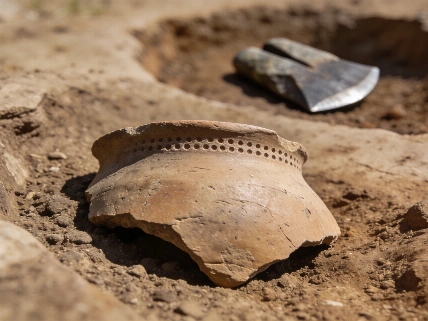
Since 2021, a team from the Department of History and Archaeology of the National and Kapodistrian University of Athens (NKUA), directed by Professor Konstantinos Kopanias, has been investigating the site's development. In the August-September 2026 season, archaeologists exposed a section of rampart beside an undisturbed deposit containing pottery from Late Cypriot IIC-IIIA, toward the end of the Late Bronze Age.
The excavators also found marl on the deposit's surface. They interpret it as material prepared for construction and spread over stone foundations to level the base for a mudbrick superstructure. Its association with the pottery and foundations supports a Late Bronze Age date for the rampart's earliest construction phase.
A tower in phases
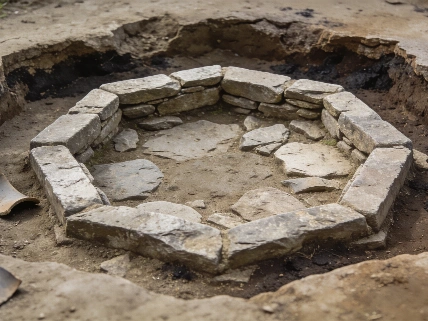
The principal architectural find from the season is a rectangular bastion projecting from the defensive wall. It was built during Late Cypriot IIIA. A three-sided addition was later placed in front of it, creating an almost square tower with thick walls around a basic chamber.
The tower measures approximately 7.4 by 7.3 meters, and its chamber covers about 9 square meters. A wall approximately 2.7 meters thick was subsequently added along the northwestern side, probably during Late Cypriot IIIA. The archaeologists interpret the plan, large walls and enclosed chamber as evidence of a defensive function; they also suggest the tower may have supported additional levels. Only foundations survive, so its original height cannot be established.
The excavated remains preserve the tower's foundations, plan and successive construction phases. Its large walls and enclosed chamber form the architectural basis for interpreting the structure as a defensive tower.
Later reinforcement
Construction continued centuries later. In the Late Cypro-Classical period, during the 4th century BCE, a reinforcing wall was built along the tower's northeastern and southeastern sides. Pottery from its foundation trench helps date this modification. The basic rampart was also widened in a later phase, possibly during the same period.
The excavated area has yielded no securely identified Cypro-Geometric or Cypro-Archaic construction phase. The sequence recorded at Marchello includes the Late Bronze Age fortifications and later reinforcement. A separate report on excavations at Posa Hill concerns a medieval palace and monastery network, a different site and period that cannot date Marchello's walls.
The Department of Antiquities describes the remains as the first Late Bronze Age fortification system found at Palaepaphos. Further study of the archaeological material is expected to clarify the complex's chronology and wider significance. At the end of the 2026 excavation season, the exposed remains were covered with protective ground-cover fabric.
Pottery in the undisturbed deposit beside the foundations provides evidence for the rampart's early phase. Pottery from the later tower's foundation trench helps date its reinforcement during the Late Cypro-Classical period.