China's Chang'e 7 lunar mission, designed to search for water ice near the Moon's south pole, has been postponed due to a tropical depression threatening the Hainan launch site. The new launch window remains uncertain
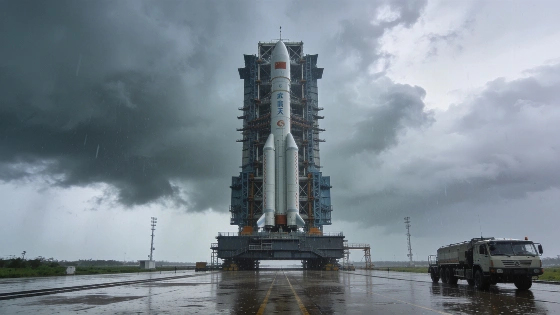
China's planned Chang'e 7 mission to the Moon's south pole has been postponed after a developing tropical depression in the Gulf of Tonkin forced a halt to launch preparations at the Wenchang Space Launch Site. The mission, which aims to investigate potential water ice deposits in permanently shadowed lunar craters, was originally scheduled for liftoff this week. The China Manned Space Agency confirmed that current weather conditions do not meet launch safety requirements, and no revised launch date has been announced.
Weather Forces Mission Standby
The immediate cause of the delay is Tropical Depression Narra, which has intensified near the Chinese island of Hainan, home to the Wenchang launch facility. Mission planners initially considered a brief postponement, but the evolving storm system and its associated high winds and heavy rainfall led to a full suspension of launch activities. The Chang'e 7 mission requires precise alignment between Earth and the Moon, meaning that even a short delay can push the next viable launch window months or even years into the future.
Some unofficial reports have suggested that a new attempt could be possible as early as September, but official sources, including the state-run Xinhua news agency, have indicated that the launch may be postponed until 2027. The uncertainty reflects both the technical constraints of lunar transfer orbits and China's typically reserved approach to public mission updates.
Mission Objectives and Architecture
Chang'e 7 is designed to deliver a suite of robotic explorers to the Moon's south polar region, an area of high scientific interest due to the suspected presence of water ice in permanently shadowed craters. The mission architecture includes an orbiter, a lander, a rover, and a small hopping robot, all intended to characterize the local environment and search for accessible ice deposits. While China has not officially confirmed the landing site, Shackleton Crater remains a leading candidate due to its persistent shadow and potential for ice preservation.
The lander's instruments will analyze surface and subsurface composition, while the rover and hopper are tasked with exploring difficult terrain and sampling areas that may be inaccessible to conventional wheeled vehicles. The mission's findings could inform future plans for sustained human presence on the Moon, as both China and the United States have announced ambitions to establish outposts near the lunar south pole.
Scientific Stakes and International Context
The search for water ice at the lunar south pole is a central goal for multiple space agencies, as ice could provide both life support and fuel for future crewed missions. Chang'e 7's payload is expected to include spectrometers, cameras, and environmental sensors capable of detecting and mapping ice deposits. The mission's outcome will contribute to a growing body of evidence about the distribution and accessibility of lunar volatiles.
China's approach to lunar exploration has emphasized technological demonstration and international collaboration, though public details remain limited compared to NASA or the European Space Agency. For a broader overview of Chang'e 7's planned science goals and mission hardware, see this recent analysis of China's lunar south pole strategy: China's preparations for a complex south pole mission.
Launch Windows and Technical Constraints
The timing of lunar launches is governed by the relative positions of Earth and the Moon, as well as the specific requirements of the mission's intended orbit and landing site. For Chang'e 7, the need to reach a narrow target zone near the lunar south pole further restricts available launch windows. Even after the weather improves, the next opportunity may not arise for months or years, depending on orbital mechanics and mission readiness.
Delays of this kind are not unusual in planetary exploration, where launch windows can be infrequent and mission hardware must be protected from environmental hazards. The Chang'e 7 postponement underscores the operational risks faced by all lunar missions, especially those targeting challenging terrain and ambitious science objectives.
Spacecraft launches to the Moon require careful planning to ensure that the vehicle can enter the correct trajectory, achieve lunar orbit insertion, and arrive at the intended landing site under favorable lighting and thermal conditions. These constraints mean that a missed launch window can have significant consequences for mission timelines and scientific return.
Understanding lunar launch windows is essential for appreciating the complexity of modern Moon missions. The timing is dictated by the need to match the spacecraft's trajectory with the Moon's position in its orbit, as well as the desired landing site's illumination and thermal environment. For south polar missions, these factors are especially restrictive, as the target regions may only be accessible during brief periods each year. This makes weather-related delays particularly consequential, often requiring mission teams to wait months or even years for the next viable opportunity.