NASA's SpaceX Crew-12 is preparing to leave the International Space Station after a 235-day mission investigating quantum systems, living tissue, microbes, materials and medical supplies, with undocking possible as early as October 5, 2026.
The most consequential part of Crew-12's mission is not the journey home but the laboratory it leaves behind: an orbiting platform where altered gravity allowed researchers to test pharmaceuticals, bone scaffolds, quantum systems, microbes and manufacturing methods under conditions unavailable on Earth. NASA astronauts Jessica Meir and Jack Hathaway, European Space Agency astronaut Sophie Adenot and Roscosmos cosmonaut Andrey Fedyaev launched on February 13, 2026, and are completing roughly seven months aboard the International Space Station.
NASA's latest station update places the crew in the handover phase. The astronauts are packing cargo, configuring Dragon systems and completing pressure-suit checks while preparing for a possible undocking on October 5. The timing remains dependent on weather conditions off the California coast, with additional briefings planned before the departure decision.
Crew-13's arrival made the return possible. After docking and joining Expedition 75, the new crew is scheduled to assume mission responsibilities from Crew-12 on Sunday, October 4. The brief transition will allow Crew-12's Dragon to depart and free the Harmony module port for a Cargo Dragon arrival planned for October 13. NASA's latest station update describes the sequence as a short operational handover followed by the return process.
If weather and recovery operations remain favorable, the spacecraft is expected to splash down in the Pacific Ocean off Southern California shortly after noon Eastern time on October 6. The planned timeline would close a 235-day mission, according to reporting from CBS News, rather than a short-duration visit.
Orbit as a test condition
Microgravity is not simply a weaker version of gravity. It changes how fluids move, how particles settle, how cells organize and how crystals form. That makes the station useful as a controlled environment for experiments that are difficult to separate from gravity-driven effects on the ground.
The crew's work began with the basic act of observing Earth and the cosmos through a Dragon spacecraft window during transit. The view is striking, but its scientific value is more practical: reaching orbit gives researchers a setting in which familiar materials and biological systems can behave differently. The results still require comparison with ground-based controls and later analysis; the station does not turn every unusual behavior into a finished technology.
That same emphasis on extracting information from limited observations appears in an earlier galaxy study that used overlapping systems to map dust. The subjects differ, but the principle is shared: careful interpretation matters as much as the image or sample itself.
Crystals and quantum matter
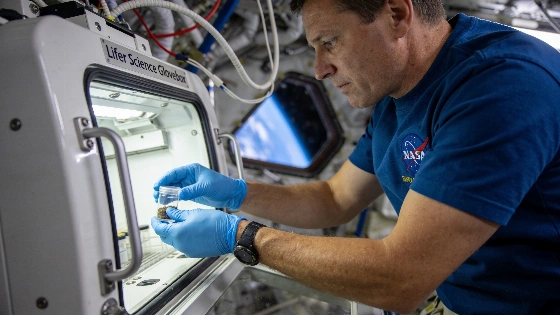
Jack Hathaway worked with hardware for crystal-growth experiments involving cancer-targeting treatments. Without gravity-driven sedimentation and convection dominating the process, researchers can examine crystal structures in greater detail. The stated goal is to improve understanding of pharmaceutical properties and stability rather than to claim an immediate new therapy.
Jessica Meir also worked with the Cold Atom Lab, where light is used to cool, trap and study atoms. Microgravity allows ultracold atoms to be observed for longer periods, opening a clearer view of their quantum behavior. A facility upgrade increased the number of atoms produced, creating more data for research relevant to technologies including solar cells and components used in phones and computers.
These experiments illustrate a central limit of space-based research: the orbiting environment supplies a useful physical condition, not an automatic answer. Scientists must still determine which changes come from microgravity, which arise from the hardware or procedure and which can be reproduced on Earth. As in NASA and Nature research on terrestrial laboratories, the strength of the conclusion depends on controls, calibration and independent analysis.
Living systems under stress
Sophie Adenot handled a wooden bone scaffold designed to mimic the architecture of real bone. Because spaceflight can accelerate bone loss, microgravity provides a demanding test for whether the scaffold supports bone-cell growth. The work could inform countermeasures for astronauts and possible treatments for osteoporosis, which affects more than 200 million people globally.
Other investigations targeted biology at smaller scales. Hathaway worked with equipment examining antibiotic-resistant bacteria and sequencing their DNA. In a closed spacecraft environment, microbes that tolerate antibiotics, starvation or disinfection present a specific operational concern. The experiment is intended to show how resistance-related traits respond to spaceflight and to help identify ways of managing that risk.
Meir's work on engineered cartilage examined how tissue develops in microgravity, with the aim of producing implants that more closely resemble natural cartilage. A separate stem-cell investigation tested whether microgravity can help generate larger quantities of clinical-grade cells that retain the ability to transform into other cell types. The proposed medical value remains tied to what later analysis shows about cell quality and function; the orbital experiment itself is not a clinical treatment.
Building a more independent station
Crew-12's research also addressed the logistics of operating far from Earth. Meir prepared an experiment on colloidal solids, soft materials made from tiny particles suspended in water. Watching those particles assemble without ordinary gravitational effects may help researchers tune materials for plant growth, 3D printing and pharmaceutical production.
Adenot installed the Metal 3D Printer, which has already produced small metal parts in microgravity for comparison with ground-made examples. The engineering case is direct: if parts can be manufactured when needed, crews on longer missions may depend less on stored spares and resupply flights. That possibility is still being evaluated through the quality of returned parts.
She also worked on IVGEN Mini, a system intended to produce intravenous fluid on demand. Commercial IV fluids expire after about 16 months, while carrying large supplies consumes mass and storage volume. An on-demand system could address those constraints in space and could have uses in remote or emergency settings on Earth, but the mission's research role is to test the method rather than establish routine deployment.
The numerical frame is unusually clear. Crew-12 launched on February 13, 2026, and is scheduled to conclude its 235-day mission with a possible October 5 undocking and October 6 Pacific splashdown. Its investigations span pharmaceutical crystallization, ultracold atoms, bone regeneration, cartilage engineering, microbial DNA sequencing, metal printing and fluid generation. The research program combines physical science, biology and life-support engineering rather than pursuing a single medical or commercial outcome.
Microgravity experiments are best understood as controlled physical comparisons. They isolate processes that gravity can mask, but they do not remove the need for controls, calibration or follow-up on Earth. Crew-12 therefore leaves behind more than a catalogue of promising applications: it leaves tests that can show which ideas survive contact with measurement. That makes the mission a strong example of what the space station does well-turning orbit into a specialized laboratory-without mistaking an experiment for a finished medical product or an autonomous space industry.