NASA researchers have mixed biodegradable plastic with simulated Moon and Mars dust to create a tunable composite now being tested for future habitat equipment and extreme space conditions.
A material that could let crews make and repair equipment away from Earth is now being tested by NASA. Developed at NASA's Glenn Research Center in Cleveland, the composite combines biodegradable plastic with simulated lunar or Martian dust and is intended for possible manufacturing on the Moon or Mars. The work belongs to a broader NASA effort to develop construction materials, excavation systems, robotics, dust mitigation, and in-situ resource utilization for long-duration surface missions.
The appeal is logistical rather than cosmetic. Future crews cannot reasonably carry every bracket, wrench, chair, or replacement component they might need, so a material made partly from local surface resources could reduce the amount of hardware launched from Earth. NASA's lunar technology planning treats excavation and construction, dust mitigation, and in-situ resource utilization as separate but connected engineering challenges. The current work remains a development effort: NASA has demonstrated samples in the laboratory but has not established that the material is ready for routine habitat construction.
Research chemical engineer Allison Christy led the work with NASA Glenn summer interns Tyler Klinchuch, Ethan Bilodeau, and Emma Levenson. They combined a special plastic with dust designed to imitate material found on the Moon and Mars. The plastic is biodegradable and could potentially be produced by bacteria fed with crew waste or carbon dioxide, providing a biological route to making a useful feedstock during a mission. That possibility remains conceptual for space operations; the article does not establish that such biological production has been demonstrated in a lunar or Martian environment.
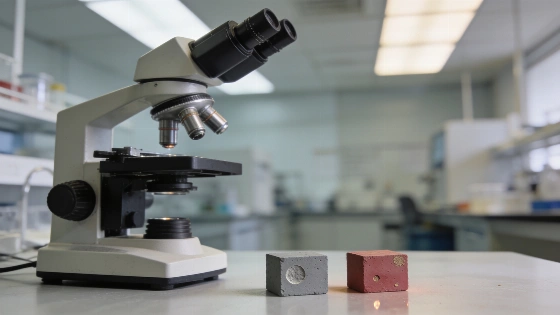
The microscopic images show the result as a pair of sharply different materials. One gray sample contains mock lunar dust, while the reddish sample contains mock Martian dust. These are laboratory analogues rather than collected extraterrestrial soil, so their performance cannot automatically be generalized to every lunar or Martian deposit.
Adding the simulated planetary particles did more than supply bulk. NASA's team found that the dust made the plastic stronger and easier to process. Changing the type and amount of dust also allowed researchers to adjust the material's properties rather than treating lunar or Martian soil as a fixed ingredient with one predictable performance.
That distinction matters for manufacturing. A structural bracket may need a different balance of strength and processability than a hand tool or a chair. The reported results indicate that the composite can be tuned for different uses, but they do not yet show how it would perform under the full combination of radiation, dust abrasion, vacuum, thermal cycling, and mechanical loading found on an exposed planetary surface. The available description also does not report a human-use trial, a flight-qualified manufacturing demonstration, a published sample-size calculation, p-values, or confidence intervals; those omissions make the work a materials-development result rather than a completed qualification program.
The colorful microscope photographs are therefore evidence of the material's internal crystal structure rather than proof of a finished construction system. Their kaleidoscope-like appearance reflects how the samples are revealed at microscopic scale; it does not by itself measure durability or establish that the material can support a habitat.
NASA is testing samples in Glenn's Lunar Environment Structural Test Rig to examine how they withstand extreme temperatures. Other samples are slated to fly on the Materials International Space Station Experiment 23 mission, where they will be exposed to intense conditions outside the International Space Station. Those tests address important environmental stresses but will still represent controlled experiments rather than manufacturing directly on the Moon or Mars. NASA's broader mission-development practice relies on ground testing and in-space demonstrations before technologies are considered for operational missions or transfer to commercial partners.
The research is funded through NASA Glenn's 2026 Center Innovation Fund, which is managed by the agency's Research and Technology Mission Directorate. The work also fits the engineering logic behind recent lunar coverage: extended human activity beyond Earth depends not only on transport but on reducing the equipment that must be transported. NASA's public technology programs describe this progression as an ecosystem involving agency researchers, industry, universities, entrepreneurs, and nonprofit organizations rather than a single-material solution. Further background on NASA's technology-development approach is available through its official NASA programs.
The next question is whether the composite remains useful outside a protected habitat. NASA's team plans to examine possible exterior applications in harsh lunar and Martian environments. Lunar dust is itself an active engineering concern in NASA's south-pole planning because abrasive, electrostatically affected particles can threaten mechanisms, seals, surfaces, and human systems. Until the planned tests are complete, the strongest claim supported by the work is narrower: simulated planetary dust can alter a biodegradable polymer in ways that may be useful for future fabrication.
In-situ manufacturing means producing an item where it is needed instead of shipping the finished object from Earth. In this case, the proposed system would combine a biologically produced plastic with surface material and then shape it into equipment. That approach could reduce resupply demands and help crews respond to breakages, but it would require reliable processing hardware, feedstock production, power, quality control, and verification in an environment where repair options are limited.
NASA is also testing the machinery needed to handle local material. Its ISRU Pilot Excavator, known as RASSOR, has been tested at Kennedy Space Center while excavating simulated lunar soil. That hardware work illustrates why lunar manufacturing cannot be evaluated as a chemistry problem alone: excavation, transport, sorting, processing, dust control, and fabrication must operate as an integrated chain. A successful polymer composite would still depend on the ability to collect and prepare consistent feedstock.
The evidence supports a promising materials platform, not a self-sufficient lunar factory. Its value will be decided by thermal testing, exposure outside the station, repeatable mechanical measurements, and eventually demonstrations connecting microscopic structure to performance after processing. NASA is right to pursue the idea because local fabrication addresses a real mission constraint, but the responsible reading is equally clear: this is an early test of versatility whose operational usefulness still has to be earned.
Microscopic crystal structure describes how a material is organized at scales too small to see unaided. That structure can influence strength, processing behavior, and how a composite responds to heat or stress. A microscope image can reveal patterns within a sample but cannot replace mechanical tests, which measure whether the material survives a specified load, temperature, radiation exposure, or number of processing cycles. For this NASA material, the images show what was made, while the structural test rig and space-exposure experiments must determine what it can actually do.