The Artemis II astronauts will meet the public at the University of Houston after traveling 406,771 kilometers from Earth during the first crewed lunar flyby in more than 50 years.
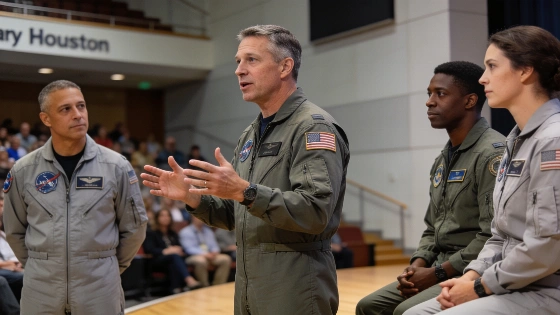
The Artemis II crew will bring its record-setting lunar mission back to Houston on Wednesday, September 30, when the four astronauts appear at the University of Houston's Fertitta Center. Their public presentation will close the post-flight campaign and give audiences a direct account of a roughly 10-day journey around the Moon aboard Orion.
Reid Wiseman, Victor Glover, Christina Koch and Canadian Space Agency astronaut Jeremy Hansen traveled as far as 406,771 kilometers from Earth during Artemis II, equivalent to about 252,756 miles. The distance exceeded the human-spaceflight record associated with Apollo 13's 1970 flight and became the farthest distance humans have traveled into space. The measurement is also expected to receive formal recognition from the National Aeronautic Association during the Houston event.
The figure describes the crew's maximum distance from Earth during the mission rather than a new destination reached by Orion. Its significance is comparative: Artemis II carried people farther from Earth than any previous crewed flight while testing the spacecraft and launch system intended for later Artemis missions. NASA's record-setting result is therefore both a historical benchmark and an operational test of deep-space transportation.
Artemis II launched on April 1, 2026, and splashed down in the Pacific Ocean on April 10 after a roughly 10-day mission. The flight was a crewed lunar flyby, not a Moon landing, and it marked the first crewed trip around the Moon in more than 50 years. Wiseman, Glover, Koch and Hansen were the first astronauts to launch aboard NASA's Space Launch System rocket and flew inside the agency's Orion spacecraft.
The record is best understood alongside the mission's trajectory. A spacecraft traveling around the Moon can reach a greater Earth-relative distance without touching the lunar surface, and the maximum separation changes continuously as the vehicle follows its planned path. The 406,771-kilometer value is therefore a precise point-in-time distance, not the length of the entire route or a claim that Orion maintained that separation throughout the flight. Further background on the mission's verified record appears in BBC mission coverage.
The free public presentation is scheduled for 7 p.m. CDT at the Fertitta Center. It is the crew's first public event in Houston after the lunar mission earlier this year and is hosted by industry and community partners at the University of Houston.
Media will have an earlier opportunity to question the astronauts during a session scheduled for 5:45 p.m. Attendance requires a reply to Kenna Pell at NASA by noon on September 30. The public presentation will center on the crew's mission highlights rather than on a new flight or a new spacecraft test.
The University of Houston appearance follows NASA's public recognition of the crew at Johnson Space Center on August 28. President Donald Trump honored the astronauts at that ceremony, which also included the Congressional Space Medal of Honor. Trump described the crew as having made history and praised the flight for breaking the distance record, reinforcing the official framing of Artemis II as a milestone in human spaceflight.
For readers following the wider human-spaceflight record, the event also provides a useful contrast with an earlier report on a completely different measurement problem: both stories depend on precise quantitative comparisons but involve very different physical systems.
Artemis II was not a surface-landing mission. The astronauts traveled around the Moon and returned to Earth aboard Orion while NASA used the flight to advance a crewed architecture built around the Space Launch System and the spacecraft's deep-space operations. Orion's performance during the flight is relevant to later mission planning because future Artemis flights will require reliable launch, navigation, communications, life-support and atmospheric reentry systems over greater distances than those used in low Earth orbit.
That distinction matters. A distance record is a mission result and an engineering milestone; it is not by itself evidence that NASA has established a lasting lunar presence or demonstrated readiness for a crewed Mars expedition. NASA describes Artemis as a sequence of increasingly difficult missions intended to support lunar exploration, scientific discovery, economic benefits and preparation for future Mars missions.
The verified material does not provide detailed instrument results, a study sample size, statistical analysis or a peer-reviewed scientific data release from Artemis II. The strongest confirmed findings are therefore operational and historical: the launch aboard SLS, the crewed Orion flight around the Moon, the April 10 splashdown and the 406,771-kilometer distance record. This distinction keeps the mission's engineering accomplishments separate from scientific claims that would require formal datasets and independent analysis in journals such as Nature or Science.
Late-September reporting also indicates that Victor Glover and Reid Wiseman moved into emeritus roles at NASA's Johnson Space Center in Houston. The change signals that the post-mission personnel transition is already underway, even as the program continues to use Artemis II's results for later planning.
Artemis II gives the program a concrete human-spaceflight benchmark before later missions become more demanding. Its value lies in the combination of crewed launch, deep-space travel, lunar flyby and safe return rather than in a single dramatic image or isolated measurement. The mission also provides an operational bridge between Apollo-era experience and modern spacecraft systems designed for sustained exploration beyond Earth orbit.
The Houston appearance is consequently more than a ceremonial stop. It places the mission's verified accomplishments in front of the public while allowing the astronauts to explain what the Orion flight involved. The August recognition at Johnson Space Center and the September public presentation add context, but neither replaces the technical work still required for future Artemis objectives.
The most defensible reading of Artemis II is measured rather than promotional: it completed a crewed lunar journey, set a new human-distance record and demonstrated the use of SLS and Orion together. NASA's broader lunar and Mars ambitions remain a program of planned missions, so the Houston event should be judged as a clear account of what this flight achieved-not as proof that every later objective has already been secured.
Distance in human spaceflight is calculated relative to Earth along a changing spacecraft trajectory and is not the same as a straight-line separation maintained throughout the mission. That distinction helps explain why a flight around the Moon can set a record even without landing there. Artemis II's 406,771-kilometer figure is therefore best understood as a precise historical measure of maximum distance from Earth, while the mission's larger scientific and engineering significance rests on how safely Orion and SLS carried people through that route. The event deserves attention because it marks a completed step in NASA's lunar program while leaving future claims to future missions.