China's Chang'e 7 spacecraft, launching in August 2026, will deploy an orbiter, lander, rover, and hopper to investigate the Moon's south pole, targeting water ice and testing new navigation and international science payloads
China is advancing its lunar exploration program with the scheduled launch of Chang'e 7, a multi-component robotic mission designed to investigate the Moon's south polar region. The mission, set for liftoff on August 24, 2026, from the Wenchang Satellite Launch Center aboard a Long March 5 Y14 rocket, will deliver an orbiter, lander, rover, and a specialized hopper to the vicinity of Shackleton Crater. This region is of particular scientific interest due to its permanently shadowed areas, which are considered promising sites for water ice deposits.
Mission Architecture and Scientific Goals
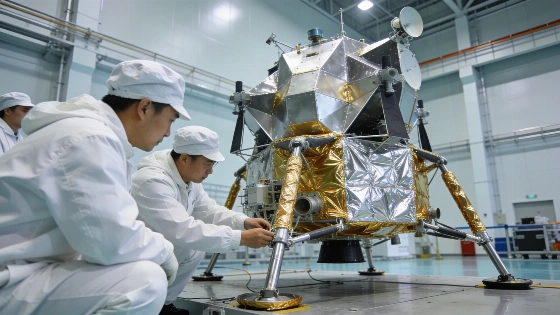
The Chang'e 7 mission architecture integrates several autonomous elements. After entering lunar orbit, the orbiter will conduct remote sensing and serve as a communications relay. The lander will attempt a precision touchdown near the rim of Shackleton Crater, deploying both a rover for surface mobility and a hopper engineered to traverse steep, shadowed crater interiors. The hopper is equipped with active shock-absorption technology, enabling it to 'jump' between sunlit and shadowed regions in search of water ice. The lander will also test China's first deep-space landmark image navigation system, intended to improve landing accuracy in challenging terrain.
Scientific objectives include direct investigation of potential water ice, mapping surface and subsurface composition, and characterizing the local environment. The mission will employ a suite of instruments to analyze lunar dust, plasma, and radiation, as well as to conduct astronomical observations from the lunar surface. The search for water ice remains a central focus, as no mission to date has definitively confirmed or quantified accessible ice at the lunar south pole.
International Collaboration and Instrumentation
Chang'e 7 carries a diverse set of international payloads, reflecting growing global interest in lunar science. The lander will host the Russian Academy of Sciences' PmL-Ch7 suite for dust detection and a Langmuir probe for plasma measurements. An Italian laser retroreflector array will support precision ranging, while a wide-field optical telescope developed by the International Lunar Observatory Association (ILOA Hawaii) and the University of Hong Kong will attempt the first color astronomical imaging from the Moon's surface. The orbiter will carry LunaHcam, a hyperspectral camera developed by the Bahrain and Egyptian space agencies, and the Moon Aiming Thai-Chinese Hodoscope (MATCH) from Thailand, designed to monitor high-energy particles. Switzerland's Physical Meteorological Observatory will contribute a dual-channel Earth radiation spectrometer.
The ILO-C camera, built to specifications from ILOA Hawaii and the University of Hong Kong, is intended to capture wide-field, full-color images of the Milky Way from the illuminated rim of Shackleton Crater. This instrument aims to provide both scientific data and public engagement, continuing the legacy of ILOA's founding director Steve Durst. The camera was constructed by the Beijing Institute of Space Mechanics & Electricity, with the goal of operating reliably in the Moon's extreme environment.
Pathway to Human Lunar Exploration
Chang'e 7 is positioned as a precursor to China's planned crewed lunar landing, targeted for 2030. By demonstrating integrated robotic operations-combining orbiting, landing, roving, and hopping-the mission will test technologies and operational concepts essential for future human activity. The mission's findings are expected to inform site selection, resource assessment, and risk mitigation for subsequent landings.
China's lunar program is also developing Chang'e 8, scheduled for launch around 2028, which will focus on in-situ resource utilization and habitat construction using lunar regolith. Together, Chang'e 7 and Chang'e 8 are intended to lay the groundwork for the International Lunar Research Station (ILRS), a multi-phase project involving international partners. For context, recent Chinese efforts to map the Moon in detail and update its geologic timeline have been described in a previous Science Report article.
Technical Challenges and Scientific Uncertainty
Despite advances in remote sensing and orbital mapping, the presence and accessibility of water ice at the lunar south pole remain unconfirmed. While orbital instruments have detected spectral signatures consistent with ice, direct sampling and in-situ analysis are required to establish its abundance, distribution, and physical state. The Chang'e 7 hopper's ability to access shadowed craters may provide the first direct measurements, but operational risks are significant due to extreme temperature gradients, steep slopes, and limited solar illumination.
Instrument calibration, data transmission, and surface navigation will all be tested under conditions not previously encountered by Chinese lunar missions. The mission's success will depend on the performance of both Chinese and international payloads, as well as the reliability of new landing and mobility systems. The outcome will shape not only China's lunar ambitions but also the broader international approach to lunar resource exploration.
Landing on the Moon's south pole presents unique engineering and scientific challenges. Permanently shadowed regions can reach temperatures below -200°C, preserving volatile compounds such as water ice. However, these areas are difficult to access and observe directly. Instruments must be designed to operate in low-light, high-radiation, and thermally unstable environments. The distinction between orbital detection and in-situ confirmation is critical: only direct sampling can establish the presence, purity, and extractability of lunar ice, which is essential for future sustained human activity on the Moon.