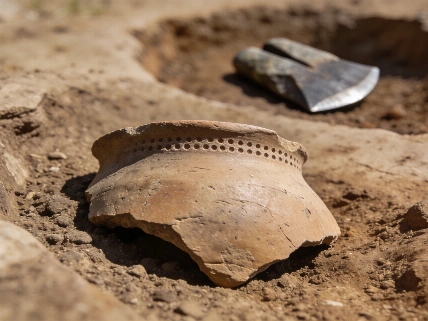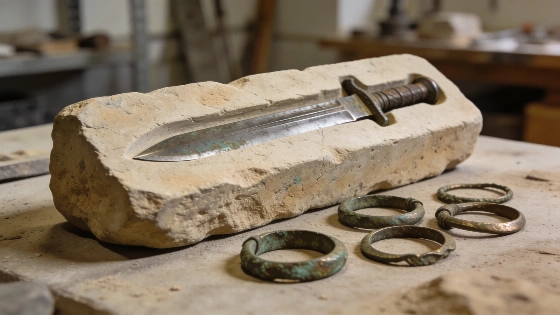
A Late Bronze Age hoard near Grabenstätt yielded 52 arm and ankle rings, while a settlement at Großeibstadt preserved a sandstone mould for casting a sword. Together, the finds document metalworking in southern Bavaria.
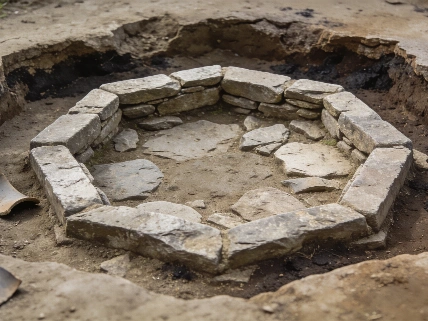
At Großeibstadt, archaeologists excavating a lowland settlement found a fully preserved half of a sandstone mould made to cast a bronze tang-hilted sword. The mould comes from a settlement associated with the Urnfield culture, conventionally dated to about 1300-800 BC.
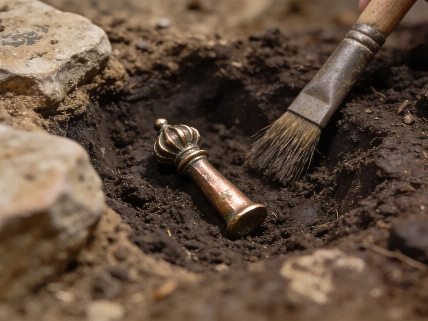
A separate discovery near Grabenstätt adds a large assemblage of Late Bronze Age objects to the picture. A metal detectorist encountered bronze in a field in October 2024, documented the finds and reported them to the Bavarian State Office for Monument Protection (BLfD).
Scattered Hoard
Archaeologists dated the hoard to the late Urnfield period, around 880-800 BC. Earlier agricultural or earthmoving activity appears to have disturbed the original deposit, scattering objects over a broad area. The finder worked with the BLfD to survey the site during 2025 and 2026, recovering dozens of additional pieces.
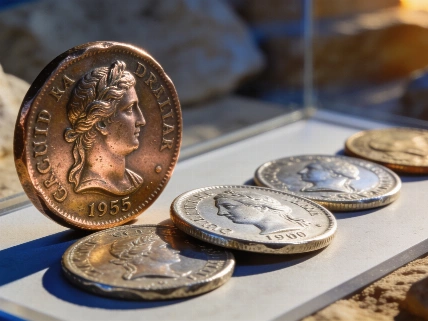
The documented assemblage includes 52 substantial bronze arm and ankle rings and two bronze axes. It also contains fragments of a sheet-bronze bracelet, parts of at least one bronze cup, and a plate-sized mass of cast bronze. The BLfD describes it as one of the most extensive hoards of this composition and period known from southern Bavaria.
The objects offer material for studying how bronze circulated and was deposited in the region during the final centuries of the Bronze Age. A separate ironworking report concerns metal production in medieval Kazakhstan, a distinct archaeological context from the Bavarian finds.
Evidence of Casting
The Großeibstadt mould is considered unique in Bavaria. Archaeologists also found a second stone mould for making a decorative pendant, alongside evidence of a bronze worker at the settlement around 3,000 years ago. Together, the moulds document work on bronze weapons and personal ornaments at the settlement during the Late Bronze Age.
The Bavarian State Archaeological Collection (ASM) assessed the two moulds and valued them at a four-figure sum. The report does not specify the amount or explain the valuation method.
Heritage Rules
The BLfD and ASM presented the discoveries in Munich on 11 November 2026, describing them in connection with Bavaria's Schatzregal. The framework followed amendments to the Bavarian Monument Protection Act in July 2023. Under the revised rules, qualifying archaeological finds become the property of the Free State of Bavaria; local authorities can apply to take ownership so significant objects may remain in their region and potentially go on public display.
Finders and landowners may receive compensation or reward payments when a discovery is valued above €1,000 and recovered in accordance with heritage law. BLfD head of archaeological monument conservation Dr Stefanie Berg said the system is intended to protect finds while keeping them in regional collections. According to the BLfD, 24 regional institutions meet the requirements to receive archaeological finds, with another 25 applications submitted by towns and municipalities.
ASM director Professor Rupert Gebhard said the legislation is also increasing archaeology's regional visibility. The collection reports that about 9,000 archaeological objects are displayed at 130 locations in Bavaria through branch museums and municipal partnerships.