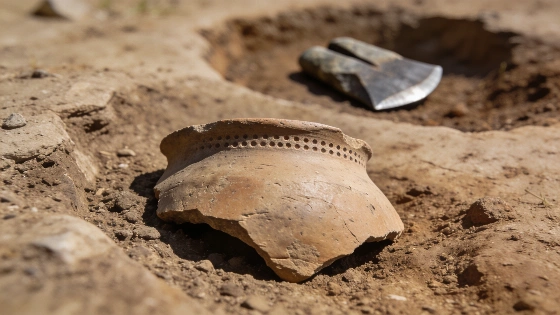
Researchers traced plain pottery styles across Late Neolithic Europe and examined how stone axes circulated across the same broad region. Collective graves add another line of evidence, while local differences remain clear
Plain pots with a few dots beneath their rims appear across a wide stretch of Late Neolithic Europe. Their spread, alongside other evidence, suggests that communities separated by hundreds of kilometres shared ideas across a region often treated as divided by the Rhine.
The study by Sebastian Schultrich, an archaeologist with Kiel University's ROOTS Cluster of Excellence, brings together evidence that has not always received equal attention. Published in Germania, it examines the Late Neolithic Battle Axe / Coarse Ware Horizon in western, central and northern Europe during the fourth and early third millennia BCE, around 5,000 years ago. The article appears in volume 103 (2025/2026), pages 151-205. Its evidence includes coarse ware-roughly shaped pottery with little decoration-distinctive stone double axes and large collective graves.
Everyday pottery
Coarse ware became widespread from the middle of the fourth millennium BCE in areas corresponding to modern central and northern France and the western Alpine region. Similar pots later appeared in western and northern Germany, as well as Denmark. Kiel University describes this spread as a gradual process of adaptation and communication, not a rapid expansion in which one unified tradition replaced another. The Kiel University account presents the finds as evidence of connections across regions on both sides of the Rhine.
Schultrich interprets the gradual resemblance between vessels as cultural convergence without a deliberate, centrally directed plan. The pottery provides evidence of shared material forms, but by itself cannot establish how often people travelled, who carried particular vessels or why.
Here, as in a separate Siberian burial report, material traces leave some interpretations unresolved. The pottery supports a pattern of cultural contact; it does not identify the people who carried particular vessels or prove that distant groups shared one identity.
Axes and graves
The double axes provide a different kind of evidence. Made from stone, with a shaft hole and cutting edges on both sides, these elaborately crafted prestige objects have been found from France across Central Europe and into Scandinavia and Poland. Their broad distribution overlaps with the coarse-ware horizon, while their status distinguishes them from more ordinary pottery.
The study places the relevant double axes in the fourth and early third millennia BCE, within the same broad period as examples found farther north and east. That chronological overlap places the objects within a wider horizon of related practices and finds, while their distribution does not by itself establish how they moved between communities.
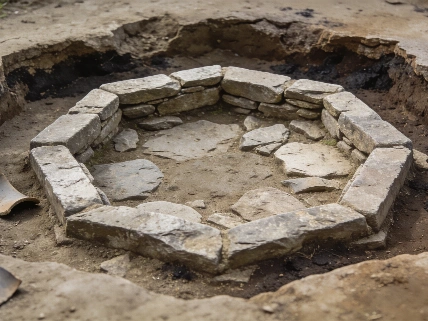
Large collective burial monuments add a third line of evidence. The examples include passage graves and gallery graves, whose designs varied locally. They could hold dozens to hundreds of people, were used across multiple generations and served as settings for ritual activities and gatherings.
Taken together, the pottery, axes and graves document connections across western, central and northern Europe while preserving evidence of regional variation. Schultrich's study describes shared fundamental patterns alongside local characteristics; the Rhine, in this interpretation, was not a rigid cultural frontier during the Late Neolithic.