A new genome analysis method has identified traces of two previously unknown extinct human lineages in the DNA of living people, offering fresh insight into ancient population interactions and the complexity of human evolution
Recent research using advanced genome analysis has identified genetic traces from two previously unknown extinct human lineages-sometimes called 'ghost lineages'-within the DNA of modern humans. This work, published in a peer-reviewed journal, demonstrates that the genetic legacy of long-extinct populations persists in people today, even when no physical remains or ancient DNA samples from those groups have been recovered.
Detecting Hidden Ancestry
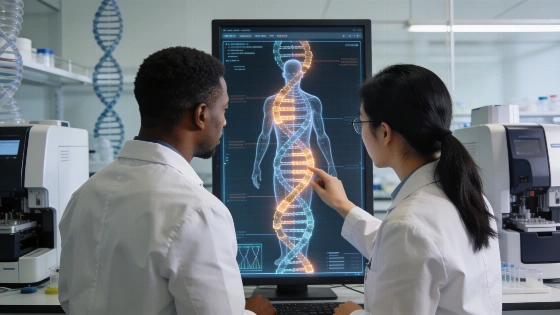
The study analyzed over 500 complete genomes from present-day populations worldwide, employing a new computational method that reconstructs genealogical relationships across the genome. Unlike earlier approaches, this technique does not require ancient DNA from fossils, instead inferring deep ancestry by identifying segments of DNA that diverged from the main human lineage far in the past. The researchers focused on regions of the genome where the most recent common ancestor is unusually ancient, suggesting introgression from populations that split from Homo sapiens hundreds of thousands or even millions of years ago.
One of the identified ghost lineages contributed DNA to all modern humans, with the introgression event estimated to have occurred in Africa more than 50,000 years ago, prior to the last major migration of Homo sapiens out of Africa. This ancestry accounts for approximately 0.5% to 1% of the genomes of living people, a proportion similar to the Neanderthal contribution found in many non-African populations. The divergence time for this lineage is estimated at around 800,000 years ago, roughly coinciding with the split between the ancestors of Neanderthals, Denisovans, and modern humans.
Super-Archaic Lineage in Oceania
The analysis also revealed a second, even older ghost lineage-described as 'super-archaic'-that contributed DNA to populations in Oceania. This lineage is estimated to have diverged from the ancestors of modern humans about 1.8 million years ago, predating the common ancestor of Homo sapiens, Neanderthals, and Denisovans. The super-archaic DNA is present at very low levels, averaging about 0.002% of the genomes of Oceanian individuals studied, and appears within regions of Denisovan ancestry, suggesting that the DNA entered the modern human gene pool via interbreeding between Denisovans and an even more ancient hominin group.
Possible candidates for these ghost lineages include Homo heidelbergensis for the African introgression and Homo erectus for the super-archaic contribution, though the lack of direct ancient DNA from these species means these assignments remain provisional. The study's findings are consistent with fossil evidence from East Asia, where Homo erectus remains have been found with features overlapping those of Denisovans, but only a small amount of genetic material from H. erectus has been sequenced to date.
Implications for Human Evolution
The presence of these ghost lineages highlights the complexity of human evolutionary history, which involved repeated episodes of divergence, migration, and interbreeding among multiple hominin populations. The DNA segments inherited from these extinct groups are distributed throughout the genome, with some enrichment in regions related to immune function and metabolism. This pattern suggests that interbreeding may have provided adaptive advantages, as has been proposed for Neanderthal and Denisovan ancestry in modern populations.
These results reinforce the view that the evolution of Homo sapiens was not a simple linear process but a network of interactions among diverse populations. The new method allows researchers to detect ancient genetic contributions even in the absence of fossil DNA, expanding the potential for reconstructing population history in regions and periods where preservation conditions are poor. This approach may also help clarify the origins of other ancient populations, as seen in recent work using isotope and DNA analysis to investigate long-term cemetery use in the Arabian Peninsula (see related research on ancient population continuity in the UAE).
Limitations and Future Directions
While the study provides strong evidence for previously unknown introgression events, several limitations remain. The scarcity of ancient DNA from Africa and tropical regions means that the identity and geographic range of these ghost lineages cannot be established with certainty. The method relies on statistical inference and is sensitive to assumptions about population structure and divergence times. Further sampling, especially from underrepresented regions, and advances in ancient DNA recovery may help clarify the relationships among archaic hominins and modern humans.
As more genomes from diverse populations are analyzed, and as new techniques are developed to extract and sequence ancient DNA from challenging environments, researchers expect to uncover additional episodes of admixture and population interaction. These findings challenge the notion of a single origin for Homo sapiens and support a model of human evolution as a braided stream, shaped by repeated contact and genetic exchange among multiple lineages.
Understanding the contribution of ghost lineages to modern genomes depends on the preservation and detection of ancient DNA. DNA degrades rapidly in warm and humid environments, limiting the recovery of genetic material from many regions and time periods. Computational methods that infer ancestry from present-day genomes can partially overcome these limitations, but their accuracy depends on the quality and diversity of the reference data. As the field advances, integrating genetic, archaeological, and fossil evidence will be essential for reconstructing the full complexity of human evolutionary history.