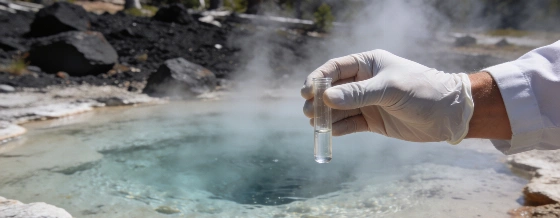
A NASA-supported study identifies an amoeba from California hot springs that reproduces at 63°C, remains active at 64°C and can recover after brief exposure to temperatures approaching 70°C.
An amoeba living in the geothermal waters of California's Lassen Volcanic National Park has reproduced at 63 degrees Celsius. That observation sets a new upper temperature limit for known eukaryotes and challenges the assumption that cells with nuclei and membrane-bound organelles cannot remain functional at such heat.
The amoeba's thermal resilience extends beyond its active range. After brief exposure to temperatures approaching 70 degrees Celsius, it may recover when returned to cooler conditions. This is different from growth or reproduction at 70 degrees Celsius: the result indicates temporary survival and recovery, not a higher reproductive threshold.
The earlier upper limit for eukaryotic growth was about 60 degrees Celsius. That threshold came from a very limited number of fungi and red algae. The new result therefore concerns more than the survival of one amoeba: it extends the known range in which a complex cell can complete reproduction.
The study was published in the peer-reviewed journal Cell on 22 September 2026. Its central observation is direct: researchers watched I. cascadensis reproduce by division at a temperature previously considered beyond the stable operating range of complex cells. The lead author, Beryl Rappaport of Syracuse University, said the findings exceed temperatures previously considered possible for any eukaryote and reopen questions about the boundaries of complex life.
Heat threatens cells through several linked mechanisms. Proteins can lose their functional shape, membranes can become unstable, and other biomolecules can break down. Those hazards are especially significant for eukaryotes because their cells contain a nucleus that encloses genetic material as well as membrane-bound structures such as mitochondria and the endoplasmic reticulum.
Prokaryotes such as bacteria and archaea lack a nucleus and most membrane-bound organelles. Many archaea are already known to tolerate extreme environments, which has made them the traditional focus of research into heat-loving organisms. A true thermophile must be able to replicate, move, feed and survive above 45 degrees Celsius; I. cascadensis is notable because it performs these complex cellular functions at temperatures beyond the previous eukaryotic benchmark.
The team sequenced the amoeba's genome and examined gene expression at multiple temperatures. The data identified genes associated with DNA stabilization, environmental sensing and the maintenance of correct protein folding. At higher temperatures some of these genes became more active.
Some proteins in the amoeba also carry a strongly positive surface charge. That feature may help them remain stable in heat and resembles a strategy found in thermophilic bacteria and archaea. The result does not show that one molecular mechanism explains the entire survival system. Instead it points to several cellular defenses operating together.
Researchers also compared the amoeba's genetic information with data from geothermal samples collected in locations including New Zealand and Yellowstone National Park. Similar DNA fragments were present in those datasets, suggesting that related heat-tolerant amoebas may exist elsewhere. The genetic comparison is evidence for possible relatives rather than a confirmed census of living populations.
Extremophiles are useful to astrobiology because they define the environmental limits of life on Earth. NASA-supported research into organisms that tolerate unusual temperature, acidity, radiation or other stresses helps constrain the range of conditions that could support life beyond Earth, including on Mars. The new finding gives planetary scientists another terrestrial example of how complex cells can function under severe thermal stress.
The implication is narrower than a claim that complex extraterrestrial life has been found or is likely. I. cascadensis still requires water, suitable acidity, oxygen levels, pressure and food, and it depends on a wider ecosystem. Temperature alone cannot determine whether a planet or moon can support it.
Extreme-environment organisms can also produce proteins with potential uses in biotechnology and medicine. For astrobiology, the more immediate value is conceptual: eukaryotic cells may tolerate greater thermal stress than laboratory assumptions had allowed. That widens the set of terrestrial environments worth examining and gives researchers additional biological strategies to consider when modeling habitability, an area also informed by comparative work published across journals such as Nature.
The discovery belongs to the same broad scientific effort that studies how unusual physical conditions shape possible life. In a different setting researchers can model rare transformations in stars as described in this earlier investigation; here the evidence comes from an organism observed in a natural geothermal environment and tested through genome analysis. The broader NASA research context connects these subjects without implying that the amoeba is a model for life on another world.
Thermophiles are not simply organisms that endure a brief thermal shock. The relevant test is whether they can sustain the core activities of life at high temperature, including growth and reproduction. That distinction makes I. cascadensis scientifically important: it does not erase the chemical limits imposed by heat, but it demonstrates that those limits for complex cells were drawn too narrowly.
The strongest reading of the study is therefore a measured one: Earth's known thermal boundary for eukaryotic life has moved upward, with reproduction documented at 63 degrees Celsius, active movement at 64 degrees Celsius and recovery possible after brief exposure near 70 degrees Celsius. The conditions required to support such life nevertheless remain demanding and firmly tied to a suitable terrestrial environment.
Further details on the reported temperature record and its significance for complex life are summarized in a Reuters science report.