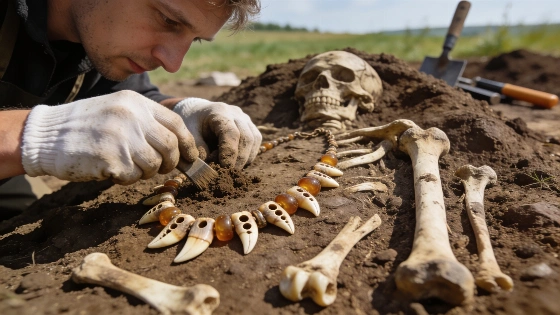
Archaeologists near Wrocław have uncovered a 5,000-year-old burial containing a necklace made from 42 animal teeth, stone weapons, and human skulls, offering new evidence for Corded Ware culture and prehistoric mortuary practices in southwestern Poland
When archaeologists opened a prehistoric burial mound near Żórawina, southwest Poland, they encountered a necklace unlike any previously documented in the region: 42 perforated animal teeth, strung together and placed beside the skeleton of an adult. The find, dating to just after 2900 BCE, immediately raised questions about status, ritual, and the social world of Corded Ware communities five millennia ago.
What sets this burial apart is not only the elaborate necklace, but the combination of grave goods and human remains. Alongside the adult skeleton, researchers recovered two flint implements-a small spearhead and a flint knife-plus a stone axe showing clear evidence of use. The presence of two additional human skulls, unaccompanied by postcranial bones, complicates the mortuary picture and suggests practices that may have included secondary burial or ritual deposition of heads.
Material Evidence and Analytical Plans
The necklace itself consists of 42 single-rooted teeth, including incisors and canines, each carefully perforated for stringing. Preliminary anatomical analysis indicates the teeth likely came from large mammals such as canids (possibly wolves), deer, or a young bear, though the possibility of human teeth has not been excluded. Bone and amber beads were also present, adding to the complexity of the assemblage.
To clarify the species represented, researchers have prepared the teeth for genetic analysis. The human remains-including the two isolated skulls-will undergo detailed morphological, genetic, and radiocarbon analysis to establish age, sex, and possible biological relationships. The main skeleton, identified as an adult male based on preserved bone morphology, will be examined for evidence of trauma or activity-related changes that might support interpretations of hunting or combat.
Preservation is a significant challenge. Many bones are extremely fragile, requiring removal with surrounding soil for laboratory micro-excavation and X-ray imaging. Radiocarbon dating of bone samples is underway, with initial estimates placing the burial between 2900 and 2700 BCE, but final results are pending.
Context and Comparative Finds
The Żórawina mound is one of the earliest burial monuments of its kind identified in the Wrocław region. Its discovery came during excavations focused on a much later cemetery from the Roman and Migration periods, revealing a deep time depth to the site's mortuary use. The mound's proximity to other prehistoric burials is notable: at Iwiny, only a few kilometers away, archaeologists recently uncovered another burial mound containing a skeleton with two axes, flint artifacts, and amber ornaments. A second mound at Iwiny yielded the bones of a calf, raising the possibility of animal offerings or ritual deposition.
In total, the Żórawina burial contained the adult skeleton, two additional human skulls, the tooth necklace, two flint implements, a stone axe, and several beads. The combination of weapons and personal ornaments has led researchers to propose that the individual may have held a position of importance-perhaps as a clan leader or patriarch-though this remains an interpretation rather than a confirmed fact. The presence of isolated skulls, meanwhile, invites comparison with other prehistoric European contexts where secondary burial or head deposition is documented, but the evidence here is not yet sufficient to establish deliberate decapitation or ritual violence.
Comparable finds in Poland are rare, but the recovery of cremated remains in a disturbed Przeworsk culture burial, as reported earlier, highlights the diversity of mortuary practices in the region's archaeological record.
Interpreting Status, Ritual, and Mobility
Researchers are cautious in assigning social status or occupation based solely on grave goods. While the presence of weapons and an elaborate necklace may suggest a person of influence, such associations are not automatic. The Corded Ware culture, known for its distinctive pottery and burial customs, spanned much of Europe during the third millennium BCE and is often linked to population movements and changing social structures. Ancient DNA studies have previously demonstrated genetic connections between Corded Ware populations and groups with ancestry from the Eurasian steppe, but the specific dynamics in southwestern Poland remain under investigation.
Planned DNA analysis of the Żórawina and Iwiny remains may clarify biological relationships among individuals and shed light on ancestry, population history, and possible migration routes. Researchers also intend to analyze bone and tooth chemistry to reconstruct aspects of diet, including the relative importance of meat and cereals, and to search for evidence of ancient disease or inherited traits. Patterns of dental wear and microscopic enamel damage may provide further clues to daily life and food processing techniques.
Interpretations remain preliminary. The association of multiple individuals in a single mound, the inclusion of animal remains at nearby sites, and the diversity of grave goods all point to complex mortuary behaviors that resist simple explanation. The evidence does not currently support claims of elite status, ritual killing, or direct kinship, but ongoing analysis may refine or challenge these initial assessments.
Limits of the Evidence
As with many prehistoric burials, the Żórawina mound presents both opportunities and constraints. The archaeological context is secure, but preservation is incomplete and some bones are too fragile for standard analysis. The dating is based on radiocarbon samples from bone, but calibration and potential reservoir effects may affect precision. The identification of tooth species and the biological sex and age of all individuals await laboratory confirmation. Interpretations of status, ritual, and ancestry depend on integrating multiple lines of evidence, each with its own limitations.
For now, the Żórawina burial stands as a rare and well-documented example of Corded Ware mortuary practice in southwestern Poland. Its combination of personal ornament, weaponry, and multiple human remains offers a window into the diversity of prehistoric lifeways, but resists reduction to a single narrative of leadership, violence, or migration. As further results emerge from genetic, isotopic, and morphological analysis, the site will test prevailing models of Corded Ware society and challenge assumptions about the meaning of grave goods and burial treatment in the third millennium BCE.
Estimating the age and sex of ancient skeletons relies on a combination of skeletal and dental features. In adults, pelvic morphology provides the most reliable indicator of biological sex, but preservation is often incomplete. Cranial traits and long bone measurements can supplement the estimate, though with greater uncertainty. Age at death is typically assessed through dental wear, cranial suture closure, and degenerative changes in the skeleton, but these methods yield broad ranges, especially in older adults. In the Żórawina case, the adult skeleton's sex was estimated from preserved bone morphology, but the two isolated skulls will require further analysis to determine age, sex, and possible relationship to the main burial. Such estimates are always probabilistic and must be interpreted in light of preservation, population variation, and the limits of comparative reference samples.