A new analysis of pelvic bones from Homo floresiensis suggests this small-bodied hominin walked upright in a way more similar to humans than to earlier australopithecines, raising new questions about its evolutionary origins
Recent research on the pelvic bones of Homo floresiensis, the diminutive hominin species discovered on the Indonesian island of Flores, has provided new insight into how these individuals moved through their environment. By closely examining the preserved pelvis of the specimen known as LB 1, an adult female who lived between 100,000 and 60,000 years ago, anthropologists have found that the structure of her hip bones is more similar to that of other members of the genus Homo than to earlier australopithecines such as Australopithecus afarensis.
Pelvic Evidence and Comparative Analysis
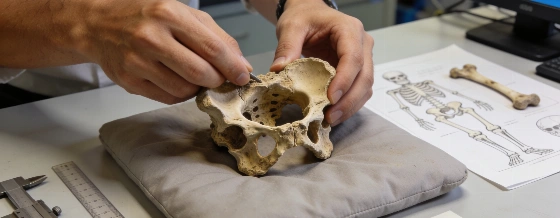
The study, published in the American Journal of Biological Anthropology, compared the LB 1 pelvis to those of chimpanzees, gorillas, australopithecines, and both extinct and living human species. Researchers developed a quantifiable measure of iliac flare-the degree to which the hip bones project outward from the trunk-and incorporated additional pelvic measurements to assess locomotor similarities. Their results indicate that the pelvis of Homo floresiensis is statistically aligned with Pleistocene Homo species, including Homo erectus, and distinct from the more flared, less efficient bipedal anatomy of australopithecines.
Despite these similarities, the evidence suggests that Homo floresiensis did not walk exactly like modern humans. The pelvic morphology points to a form of upright walking that was likely slower and less suited to long-distance travel. The researchers also note that some aspects of the skeleton, such as the hand bones, retain more primitive features, while the shoulders and upper arms are more derived. This mosaic of traits complicates efforts to pinpoint the evolutionary origins of the species.
Origins and Evolutionary Scenarios
Since its discovery in 2003, the ancestry of Homo floresiensis has been debated. Two main hypotheses remain: either the species descended from a population of Homo erectus that underwent insular dwarfism after arriving on Flores, or it represents a lineage from an earlier, small-bodied Homo population. The new pelvic data support both scenarios, as the anatomy is consistent with Pleistocene Homo but does not exclude the possibility of descent from a more archaic ancestor.
LB 1, the most complete skeleton of the species, stood approximately 1 meter tall. The study's comparative approach included measurements from a range of fossil and extant primates, strengthening the reliability of the findings. However, the researchers caution that the sample size is limited and that preservation of pelvic bones in the fossil record is often incomplete, which restricts broader population-level conclusions.
Behavioral Implications and Remaining Questions
While the pelvis of Homo floresiensis suggests a human-like gait, other evidence points to significant behavioral differences from Homo sapiens. Archaeological investigations have not found secure evidence for hunting or controlled use of fire among the Flores hominins, and their toolkits remain relatively simple. This contrasts with the more complex behaviors documented for other Pleistocene Homo species.
Independent experts in paleoanthropology have noted that the new findings are consistent with previous, smaller-scale analyses of the LB 1 pelvis. The results also highlight the considerable anatomical variability among early human groups, complicating efforts to draw clear evolutionary lines. As with other recent studies-such as research tracing Neanderthal-derived gene variants in modern humans (see this analysis of ancient gene flow)-the story of human evolution continues to be shaped by new discoveries and ongoing debate.
Resolving the ancestry of Homo floresiensis will likely require additional evidence, including ancient DNA or protein analysis, but the tropical conditions of Flores present major challenges for biomolecular preservation. For now, the pelvic anatomy of LB 1 adds a crucial piece to the puzzle, underscoring both the diversity and the complexity of hominin evolution in Southeast Asia.
In skeletal analysis, the pelvis is a key element for understanding locomotion and estimating biological sex. The degree of iliac flare, the shape of the acetabulum (hip socket), and the orientation of the sacrum all contribute to reconstructing how an individual moved. However, fossil pelvic bones are often fragmentary or distorted, and differences in measurement techniques can lead to conflicting interpretations. As a result, conclusions about gait and evolutionary relationships must be drawn with caution, always considering the limitations of the available evidence.