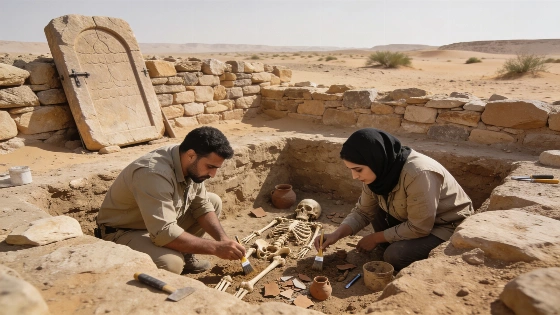
Archaeologists have excavated a communal tomb at Qattarah Necropolis in Al Ain, UAE, showing continuous use from the Wadi Suq period through the Iron Age. Isotope and ancient DNA analysis may clarify population origins and burial practices
Archaeological excavations at the Qattarah Necropolis in Al Ain, United Arab Emirates, have uncovered a large communal tomb that remained in use for more than a thousand years. The structure, first constructed during the Wadi Suq period and Late Bronze Age (circa 2000-1300 BCE), continued to receive burials into the Iron Age, making it one of the region's longest-used mortuary monuments. The site's extended use offers a rare opportunity to examine changing burial customs and population continuity across major cultural transitions in southeastern Arabia.
Construction and Reuse of Ancient Masonry
The tomb's architecture reflects both continuity and adaptation. Measuring approximately 11 meters in length and 2.5 meters in width, the chamber was built using ashlar blocks salvaged from older Umm an-Nar period funerary monuments, which date to around 2700-2000 BCE. Rather than quarrying new stone, the builders repurposed masonry from earlier tombs, preserving elements of monuments that were already centuries old at the time of construction. The entrance was sealed with a stone door weighing over 200 kilograms, itself fashioned from reused material. Archaeologists suggest the east-facing orientation of the entrance may have been intentional, potentially allowing sunlight to enter the chamber during burial ceremonies and marking a symbolic boundary between the living and the dead.
Burial Population and Grave Goods
Excavations within the tomb have revealed the commingled remains of hundreds of individuals, along with a diverse assemblage of pottery, weapons, and personal ornaments. These grave goods reflect both the long duration of use and the evolving mortuary practices of the communities who returned to the tomb over successive generations. The presence of artifacts from different periods provides evidence for changing social and ritual behaviors, as well as possible shifts in regional interaction and exchange networks. The minimum number of individuals represented in the tomb is not yet finalized, but the scale of the burial population is among the largest documented for the period in the region.
Scientific analysis is now underway, with researchers applying stable isotope and ancient DNA techniques to the human remains. These methods may clarify the geographic origins, dietary patterns, health status, and possible genetic relationships of those interred. Such approaches have previously transformed understanding of ancient population mobility and interaction, as seen in studies of other long-used burial sites, including the monumental Bronze Age enclosure at Haughey's Fort in Ireland (recently analyzed using geophysical and excavation methods).
Regional Context and Heritage Significance
The Qattarah Necropolis has yielded a sequence of important discoveries over several decades, including communal tombs from the Wadi Suq period, Iron Age shaft burials, and Late Pre-Islamic tower tombs. Al Ain's archaeological landscape was the first in the United Arab Emirates to be recognized on the UNESCO World Heritage List, reflecting its significance for understanding the region's prehistoric and early historic development. The newly excavated tomb adds to this record by providing a stratified context for examining long-term mortuary behavior and population history.
Once conservation and scientific study are complete, artifacts and selected remains from the tomb are expected to be curated in Abu Dhabi's museums. These materials will contribute to ongoing research into the lives, deaths, and social organization of communities in southeastern Arabia more than 3,000 years ago. The results may also inform broader debates about the scale and nature of population movement, trade, and cultural change across the Arabian Peninsula during the Bronze and Iron Ages.
Interpreting Extended Mortuary Use
While the tomb's long period of use is exceptional, several factors complicate interpretation. The reuse of older masonry and the commingling of remains make it difficult to assign specific individuals or artifacts to precise chronological phases without further stratigraphic and laboratory analysis. Post-depositional disturbance, including later burials and possible reopening of the chamber, may have altered the original arrangement of bones and objects. As with many communal tombs, selective preservation and recovery bias must be considered when reconstructing demographic profiles and burial practices.
Future research will depend on the results of ongoing isotopic and genetic analyses, as well as careful integration of stratigraphic, architectural, and artifact data. The Qattarah Necropolis tomb stands as a key case study for understanding how communities in southeastern Arabia navigated continuity and change in mortuary traditions over more than a millennium.
Stable isotope analysis is a laboratory technique used to investigate the geographic origins and dietary habits of ancient populations by measuring the ratios of specific isotopes-such as carbon, nitrogen, oxygen, or strontium-in human bone or tooth samples. These ratios can reflect the types of food consumed, the water sources used, and the geological background of an individual's childhood environment. When combined with ancient DNA analysis, which recovers genetic information from preserved skeletal material, researchers can reconstruct patterns of mobility, ancestry, and health in past populations. Both methods require careful sampling and are subject to preservation limitations, but together they provide powerful tools for interpreting the lives of people buried in archaeological contexts like the Qattarah Necropolis.