Excavations at Castelo dos Mouros have exposed a wall beneath a Roman-period room, where earlier work found only Roman remains. Its age and purpose are still unconfirmed
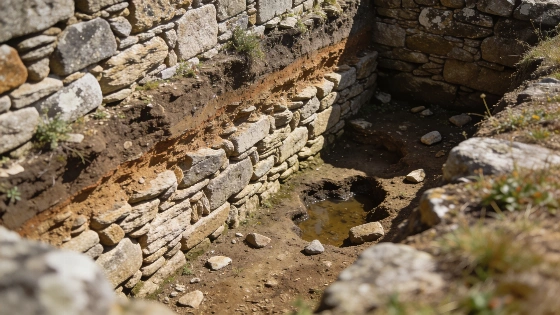
Earlier work east of Castelo dos Mouros' fortified enclosure had placed settlement beyond the defenses in the Roman period. In October 2026, archaeologists from the University of Vigo and the Xunta de Galicia reported finding a wall beneath the occupation layers of a Roman-period room. The structure is considered possibly Iron Age, complicating the account of when people first used the lower part of the site.
A buried structure
Castelo dos Mouros is a fortified settlement on Ons Island in Pontevedra, Galicia. Archaeological investigations by the University of Vigo's Group for the Study of Archaeology, Antiquity and Territory (GEAAT), in collaboration with the Xunta de Galicia, have been under way since 2021. The team uncovered the wall in an area where previous investigations had identified Roman remains. La Voz de Galicia reported that it lies beneath layers associated with the use of a room in a Roman building.
The wall's position establishes a relative sequence at that spot: it predates the Roman-period occupation layers above it. Archaeologists have described it as possibly belonging to the Iron Age hillfort, but its precise date and function remain to be established. The find does not by itself determine how far Iron Age settlement extended beyond the defenses.
The discovery adds to a settlement history spanning approximately nine centuries, as established by GEAAT's campaigns since 2021. Earlier interpretations placed Iron Age occupation mainly on terraces protected by the rampart, with activity spreading to lower ground and the coastal-facing slope during the Roman period. Historia de Galicia describes this shift in the settlement's spatial pattern.
More of the terrace
The 2026 fieldwork continued a campaign that began in May and included conservation work at the site. On the intermediate terrace, archaeologists completed the investigation of a hut first identified in 2025 and recorded a newly identified curved stone wall. Together with three other partially investigated structures and a previously known hut, it brings the number of dwellings identified on the terrace to five.
In the largest investigated house, the team recorded a possible central hearth of the type known as a lar, as well as a feature made from vertically set stone slabs. The slabs' function has not yet been determined. On the terrace, excavation also documented a stone wall, a paved surface thought to be associated with an entrance, and a separate feature of unknown purpose.
The five dwellings are evidence of substantial Iron Age use of the intermediate terrace. Near the coast, archaeologists have also found remains linked to Roman fish-salting installations, evidence for the processing of marine resources. A separate report on a Roman window grille concerns a different site and does not establish the date of the Ons Island wall.
Dating remains open
The buried wall is older than the Roman-period occupation layers above it, but that stratigraphic relationship does not provide a calendar date. Its identification as possibly Iron Age remains a preliminary archaeological interpretation. Continued investigation will help establish its date and function and clarify its relationship to the wider settlement.
The autumn phase followed the spring campaign and combined excavation with preservation work. Across the site, GEAAT's campaigns have documented occupation over approximately nine centuries. Further study of the wall and the surrounding area will help clarify the extent and sequence of activity beyond the fortified core.
Stratigraphy is the study of how archaeological deposits and structures relate to one another in a sequence. A feature beneath a later occupation layer is generally earlier than that layer, provided the deposits have not been disturbed or reworked. This relative order does not supply a calendar date. At Castelo dos Mouros, the wall's position beneath Roman-period occupation is therefore evidence for sequence, while its precise age remains unresolved.