Excavators at Augusta Raurica found a Roman iron window grille in a collapsed wall 1.7 metres below ground. Its fittings survive, but the building's date and purpose remain unknown
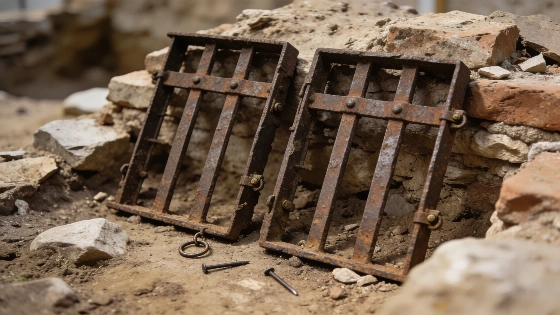
A Roman window grille recovered from a collapsed wall at Augusta Raurica preserves a rare piece of architectural ironwork. The archaeological site lies in northwestern Switzerland, near Basel, on the former Roman settlement. Archaeologists found the grille during excavations near the Roman House, about 1.7 metres below the modern ground surface. Augusta Raurica describes the ironwork as exceptionally well preserved: it survives in two sections, with its construction largely intact.
The find provides direct evidence of a grille's design and fastening, but not a date or a confirmed use for the building associated with the wall. Augusta Raurica reports that the structure's date and function remain undetermined; Archaeology Magazine also notes that the building has not yet been dated.
The official excavation announcement describes five vertical iron bars joined by two flat horizontal strips. Eyelets at the ends of the strips are interpreted as fittings for securing the grille to a wooden window frame. Two iron nails were recovered with it, still in their original positions.
One section holds three vertical bars and a shorter horizontal strip; the other contains the remaining two bars and horizontal elements. The pieces retain much of their original arrangement, but the account does not report a reconstruction or a measured window opening.
The recovery context matters. The grille came from a collapsed stone-and-mortar wall rather than from an intact window still in place. Its position supports the interpretation that the wall was part of the building's exterior, but the evidence supplied does not establish precisely how the grille sat within the wall or when it fell.
Roman exterior windows were generally relatively small, while courtyards, atria and peristyle gardens could bring light into buildings from within. A grille could help prevent unauthorized entry while still allowing light and ventilation through an opening. The iron rings and nails are physical clues to fixing the object in place; they do not, by themselves, identify the building's occupants or its wider use.
Glass panes were introduced in the first century CE, but their cost meant that many buildings continued to use wooden shutters or other materials. One alternative was lapis specularis, a translucent form of selenitic gypsum that could be split into thin sheets. The grille does not show which material, if any, filled the window at Augusta Raurica.
A separate geophysical survey mapped a Roman town and amphitheater in Austria, as described in an earlier survey. That settlement-scale evidence addresses a different question from a single architectural fitting: the grille documents one element of a building, not the plan or social role of the settlement.
Augusta Raurica stood on the southern bank of the Rhine, about 10 kilometres east of modern Basel. The discovery adds a tangible example of Roman ironwork from the settlement, but the reported evidence gives no direct date for the grille or the wall. Without a dated context, its place in the building's history cannot yet be fixed more precisely.
After recovery, the grille was safely transferred to Augusta Raurica's collections storage facility. The archaeological team plans to examine, document and conserve it there. These steps will support the study of its construction and condition, while the building's date and function remain undetermined.
Archaeological context is the relationship between an object and the deposits or structures around it. A find's depth alone does not provide a calendar date: dating depends on evidence such as securely associated materials or a documented sequence of deposits. Here, the reported measurements describe the grille and its position, while the account provides no dating method or associated dated material.
Archaeology Magazine describes the wall as a collapsed stone structure and reports that the building has not yet been dated. The grille's five bars, two crosspieces, eyelets and accompanying nails document its construction and fittings; the window frame itself was not reported among the recovered objects.