A team from Hefei Guizhen Chip Technology and USTC has built a 16-qubit measurement-based quantum computing system on a silicon photonic chip, achieving high-fidelity operation using high-dimensional path encoding
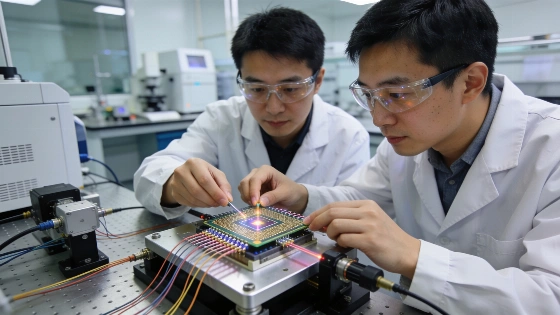
Researchers from Hefei Guizhen Chip Technology Co., Ltd., in partnership with the University of Science and Technology of China (USTC), have experimentally demonstrated a 16-qubit measurement-based quantum computing (MBQC) architecture on a single silicon photonic chip. The system, described in a preprint released in August 2026, uses high-dimensional path encoding to generate and manipulate multi-qubit graph states, enabling the execution of quantum algorithms with a reported average identification probability of 98.7% for Grover's search algorithm across four search targets.
High-Dimensional Path Encoding
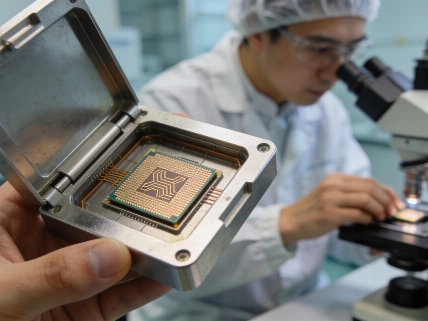
The device integrates four single photons, each routed through 16 distinct waveguide paths on a silicon-on-insulator (SOI) platform. This approach encodes four qubits per photon by exploiting four-level (ququart) path encoding, resulting in a total of 16 physical qubits. By compressing quantum information into fewer photons with higher-dimensional encoding, the architecture avoids the exponential loss in multi-photon coincidence rates that typically limits photonic quantum computing scalability. The chip generates both Greenberger-Horne-Zeilinger (GHZ) and cluster graph states, which are essential resources for MBQC.
Experimental Performance and Benchmarks
In benchmarking experiments, the team executed Grover's search algorithm and achieved an average identification probability of 98.7%, surpassing the previous on-chip photonic MBQC benchmark of 80.8% reported by the University of Stuttgart. Genuine multipartite entanglement was certified across 10 of the 16 path-encoded qubits using entanglement witnessing techniques. The chip's architecture includes four layers of Mach-Zehnder interferometers and thermo-optic phase shifters, enabling adaptive single-qubit measurements controlled by real-time classical feedback. While the high-dimensional encoding reduces the number of required photons, it introduces a vulnerability: the loss of a single photon results in the simultaneous loss of four qubits' worth of information.
Engineering Challenges and Verification
The experiment was conducted on a standard silicon photonic platform, which is compatible with established semiconductor fabrication processes. However, the preprint remains subject to peer review, and independent verification of the reported transmission loss and entanglement metrics is still pending. The approach demonstrates a potential path toward scalable photonic quantum computing, but the increased impact of photon loss and the need for high-efficiency single-photon sources and detectors remain significant engineering challenges. If the reported fidelity and entanglement can be reproduced, the architecture could serve as a component for future fusion-based quantum computing (FBQC) systems.
Context in Photonic Quantum Hardware
This demonstration builds on recent advances in integrated photonic quantum processors, where the ability to generate and control large entangled states on-chip is a key milestone. The use of high-dimensional encoding represents a shift from traditional two-level qubit systems, offering a route to higher qubit counts without a proportional increase in photon number. For comparison, other recent developments in quantum hardware, such as the hardware security evaluation of entanglement-based quantum key distribution systems, have focused on different aspects of photonic quantum technology, as seen in recent device certification efforts.
In measurement-based quantum computing, computation is performed by preparing a highly entangled resource state-often a cluster or graph state-and then executing a sequence of adaptive single-qubit measurements. The outcome of each measurement determines the basis for subsequent measurements, with classical feedback loops enabling conditional operations. This model is distinct from the gate-based approach and is particularly suited to photonic systems, where entanglement and measurement can be performed with high speed and low cross-talk. However, the scalability of MBQC depends critically on the ability to generate large, high-fidelity entangled states and to mitigate photon loss, which remains a central engineering challenge for photonic quantum computing.