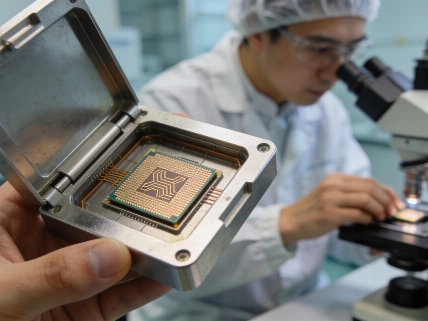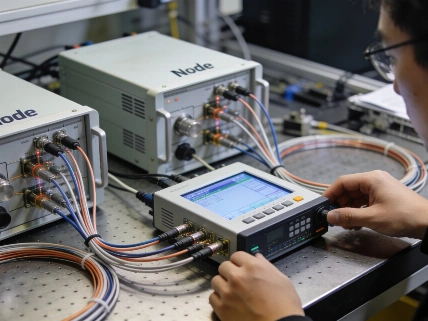

ORNL's LuGo framework moves heavy initialization onto Frontier before quantum state mapping and reduces a fluid-dynamics circuit from about 2 million gates to 91,000 across several hardware platforms
A quantum fluid-dynamics circuit that once demanded about 2 million logical gates has been compressed to 91,000 by LuGo, an algorithmic framework developed at Oak Ridge National Laboratory. The reported reduction of more than 95 percent does not come from a new quantum processor or from eliminating physical errors. It comes from changing which part of the calculation is performed classically before information reaches the quantum device. Oak Ridge National Laboratory described the result in an official ORNL briefing published on September 29, 2026.
The target is quantum computational fluid dynamics built around the Harrow-Hassidim-Lloyd quantum linear-system solver. In the example described by the team, the solver addresses the Hele-Shaw flow equation, which models viscous fluids moving between parallel plates. Conventional quantum phase estimation introduces a deep circuit during state preparation, and that depth increases exposure to noise and decoherence before the algorithm can produce a result.
LuGo is presented as an enhanced implementation of quantum phase estimation. It reorganizes the workflow by moving a substantial portion of the preliminary computation to classical high-performance computing before data are encoded in the quantum circuit. Heavy initialization routines are executed on a classical system, and the resulting compressed representation is then mapped into a quantum state. The approach therefore reduces the burden placed on the quantum processor without turning the complete calculation into a quantum-only task.
The work was presented at IEEE Quantum Week 2025, while the associated paper, titled "LuGo: An enhanced quantum phase estimation implementation," is identified as appearing in Future Generation Computer Systems 178 (2026), article 108270. The distinction between circuit compression and total algorithmic speedup is important in the same way that benchmark interpretation is important in reports from institutions such as MIT and journals such as Nature: a lower hardware burden is a meaningful engineering result, but it is not by itself evidence of practical quantum advantage.
The classical stage ran on a single node of the Department of Energy's Frontier system at the Oak Ridge Leadership Computing Facility. The official description identifies Frontier as a flagship supercomputer capable of 1.4 exaflops, or up to 1.4 quintillion operations per second. That detail matters because the 91,000-gate figure describes a hybrid workflow in which classical computation is not an incidental convenience but a central part of the method.
The comparison is consequently narrower than a claim that quantum hardware has become faster than classical computing. The reported result measures the reduction in quantum gate operations required after preprocessing. It does not establish a lower total runtime or energy cost than a classical fluid simulation, and the supplied material does not provide such a comparison.
ORNL reports that the circuits were also assessed through classical simulation. This allows researchers to study the transformed circuits and compare gate counts before hardware execution, but classical circuit simulation is not equivalent to demonstrating a scalable quantum calculation on a fault-tolerant processor. The work addresses a bottleneck in the quantum portion of the workflow rather than proving an end-to-end advantage.
The team evaluated LuGo through the Quantum Computing User Program and the DOE Quantum User Expansion for Science and Technology initiative. Tests used Quantinuum's H-1 trapped-ion processor, IBM's Marrakesh and Sherbrooke systems, and IQM's Garnet and Sirius superconducting devices.
Testing across trapped-ion and superconducting platforms gives the circuit transformation a wider hardware check than a demonstration on one processor. It does not mean that every platform produced identical accuracy or that the method has been independently reproduced outside the reported program. The supplied material provides no gate-fidelity values, readout fidelities, coherence times, qubit counts, or error rates for the devices, so those measures cannot be used to judge how much computational quality survived the shorter circuit.
The independent reporting associated with the project also connects the work with the 2026 R&D 100 Award and describes checks across multiple platforms through QCUP and QUEST. These details broaden the practical context, but they do not replace full benchmarking of accuracy, resource requirements, and total execution cost.
Reducing circuit depth is valuable because every additional operation creates another opportunity for control error, decoherence, or accumulated noise. Yet fewer gates are not the same as error correction. LuGo changes the distribution of computational work and may make a fluid equation more approachable for early error-mitigated or error-corrected processors, but the reported work does not describe logical qubits, fault-tolerant execution, or a complete error-corrected CFD calculation.
The claimed application range includes fluid flow, aerodynamics, microfluidics, and groundwater flow. Those uses remain a proposed route for the framework rather than demonstrated large-scale simulations in the material provided. The practical test will be whether preprocessing preserves the information needed by the quantum linear solver while keeping state-preparation and measurement costs manageable as the equations grow.
That distinction is central to interpreting the result alongside an earlier analysis of quantum utility. A circuit that is easier to run is not automatically a circuit that solves a useful scientific problem more accurately, cheaply, or quickly than the best classical alternative.
Quantum phase estimation is especially sensitive to this trade-off because it encodes information about an operator's phase through controlled evolution and repeated measurements. In a hybrid algorithm, the classical processor can prepare or transform data while the quantum processor performs the portion that benefits from quantum interference. LuGo's reported achievement is therefore best understood as a compilation and workflow advance that attacks a specific bottleneck rather than as evidence that quantum computers have already surpassed classical fluid dynamics.
The numbers make the case for pursuing that engineering direction: roughly 2,000,000 gates were reduced to 91,000 while the framework was evaluated on four named hardware families across trapped-ion and superconducting systems. That is a substantial cut in quantum workload. It is not yet a demonstration of end-to-end quantum advantage or scalable computational fluid dynamics, but it is a concrete example of classical preprocessing making a difficult quantum circuit less demanding and bringing the application closer to a testable hardware regime.