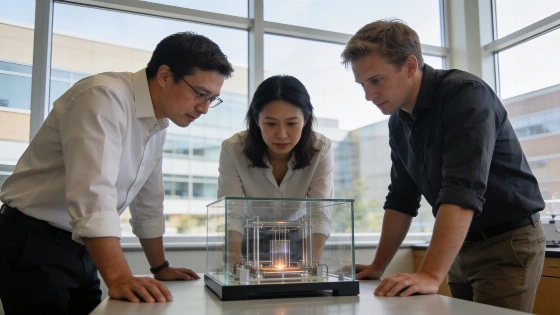
The Midwest Quantum Collaboratory has become an eight-university consortium after UIC and other regional institutions joined a network focused on quantum research, knowledge sharing and workforce development.
The Midwest Quantum Collaboratory has expanded into an eight-university regional consortium focused on joint research, innovation and workforce preparation in quantum technologies. The University of Illinois Chicago is now part of the network, which brings together institutions working across quantum computing, sensing and communication.
According to UIC's announcement, the consortium includes Purdue University, the University of Michigan, Michigan State University, Indiana University, Washington University in St. Louis, The Ohio State University, Northwestern University and UIC. The initiative was created in 2021, when Purdue, Michigan and Michigan State formed the original three-university collaboration.
UIC reported that it participated in the fifth annual Midwest Quantum Collaboratory Entanglement meeting in July and that the network's expansion was formalized after that event. The timing links the membership announcement to an established forum for academic exchange, but it does not identify a single research project, hardware demonstration or performance milestone resulting from the expansion.
The university's participation is supported financially by the Office of the Vice Chancellor for Research. That detail indicates an internally backed institutional commitment rather than a purely symbolic affiliation. Daniela Tuninetti, professor and head of UIC's electrical and computer engineering department, described the move as an effort to establish a larger presence in the rapidly changing quantum ecosystem.
MQC's three areas involve distinct scientific and engineering problems. Quantum computing requires the preparation, control and measurement of qubits while limiting errors caused by noise and unwanted interactions. Quantum sensing uses quantum states or quantum-sensitive devices to detect changes in fields, time, motion or other physical quantities. Quantum communication studies how quantum states or correlations can be transmitted, distributed and measured through optical, electronic or other channels.
These fields overlap but are not interchangeable. A processor's qubit count does not establish the sensitivity of a quantum sensor, and a communication network's ability to distribute quantum states does not by itself demonstrate computational advantage. The same measurement discipline applied in laboratories associated with MIT, CERN and NASA is relevant here: claims about performance require defined protocols, calibrated instruments and independently reproducible results.
A regional quantum ecosystem therefore depends on more than processors. It requires expertise in cryogenic systems, photonics, materials science, microwave engineering, control software, statistics and error characterization. In quantum experiments, results can be limited by decoherence, detector inefficiency, calibration drift or crosstalk between components. Peer-reviewed venues such as Nature generally distinguish between a proposed architecture, a laboratory demonstration and a validated application, a distinction that also matters when interpreting consortium announcements.
UIC's arrival creates an additional relationship with the Chicago Quantum Exchange. The CQE is a separate, larger regional coalition in which the University of Illinois Urbana-Champaign serves as a core member. UIC's participation in MQC therefore adds another institutional connection to overlapping Midwest quantum networks rather than placing the university inside the CQE itself.
These affiliations are not interchangeable. MQC is described as a consortium centered on inter-university partnerships, information exchange and workforce development, while the Chicago Quantum Exchange is identified here as a separate coalition. The available information does not establish shared governance, common infrastructure or a formal merger between the two networks.
The distinction is important for readers evaluating quantum announcements. A university joining a consortium demonstrates an intention to coordinate research and training; it does not by itself demonstrate a new processor, a sensing record, a communication distance or a commercially useful application. The same restraint applies when comparing this development with earlier quantum partnerships: institutional cooperation is an input to technical progress, not technical evidence on its own.
The MQC expansion gives the Midwest a denser map of universities working around the same broad technology area. It may make it easier to share specialized knowledge, develop educational programs and prepare researchers for roles spanning computing, sensing and communication. However, the announcement supplies no data on research outputs, patents, devices, publications, staffing levels, equipment or independently measured performance.
That makes the clearest interpretation a measured one. MQC is becoming a wider coordination platform at a time when quantum research spans multiple disciplines and requires highly specialized skills. Its value will ultimately be judged by the collaborations, training outcomes, peer-reviewed findings and technically documented results that follow, rather than by the member count alone.
For now, the eight-university MQC is best understood as research infrastructure in organizational form. Its expansion strengthens the Midwest's connected academic network and gives UIC a supported position alongside other regional initiatives. It signals credible coordination around quantum science and workforce development, but it does not constitute evidence of quantum advantage or a finished technology.
In this context, a collaboratory is a coordination structure rather than a quantum device. It can connect institutions working on physical systems such as qubits, sensors and communication links, but membership does not imply that every university builds or operates all three. The meaningful test will be whether shared knowledge and training produce reproducible experiments and technically documented results that extend beyond the announcement itself.