
White Dwarf
5 reportsThe public record for White Dwarf is read through spectral type, population distribution, and mass estimate. For questions involving population distribution, the account uses distance or orbit estimates as the measured record and model comparison to expose uncertainty; the conclusion remains provisional because limited viewing geometry and indirect measurements can leave competing explanations.

Hubble Data Point to a Possible Planet Born After Its Star Died
Reanalyzed NASA Hubble spectroscopy and archival FUSE ultraviolet data reveal extreme niobium enrichment around the white dwarf HS 0209+0832, while TESS detected a 4.4-day brightness cycle consistent with-but not proving-the presence of a close-orbiting gas-giant candidate.
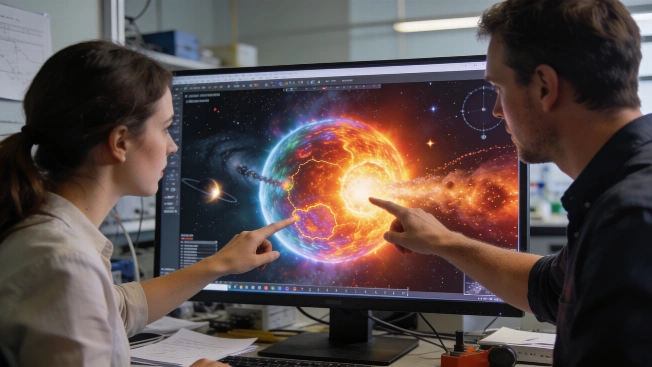
Vampire white dwarfs can collapse into neutron stars under precise conditions
Researchers have modeled how certain white dwarfs feeding on companion stars can collapse into neutron stars if their mass and accretion rate fall within a narrow range, revealing a rare but physically distinct pathway for stellar evolution.
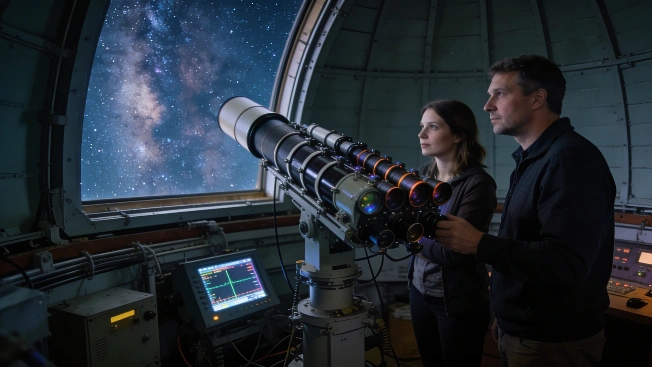
Helix Nebula Reveals How Dead Stars Return Material to the Galaxy
Astronomers using the MOTHRA instrument have observed the Helix Nebula dispersing its outer layers into the interstellar medium, providing direct evidence of stellar material recycling that will enrich future generations of stars

Hubble Reveals High-Speed Gas Bullets from Rare Helium Nova in Milky Way
Astronomers using Hubble and other observatories have observed V445 Puppis, the Milky Way's only known helium nova, ejecting dense gas clumps at speeds up to 32 million kilometers per hour

Hidden White Dwarfs Detected Near Earth in Red Dwarf Binaries
Astronomers have identified four white dwarfs concealed by red dwarf companions within 65 light-years, using ultraviolet observations from the Hubble Space Telescope to reveal these elusive stellar remnants