
Seismology
1 reportSeismology is an Earth-science method used to measure subsurface structure, surface change, fluids, hazards, or environmental history. Reliability depends on calibration standard, field instrument, and spatial resolution; biased samples, violated assumptions, or measurement error can narrow what the result establishes.
For Seismology, the central questions concern calibration standard and field instrument, with separate attention to spatial resolution. Conclusions about calibration standard are drawn from instrument records and comparison with independent methods, with the qualification that the main constraint is that coverage, noise, and inversion assumptions can limit subsurface or surface interpretation.
For Seismology, the central questions concern calibration standard and field instrument, with separate attention to spatial resolution. Conclusions about calibration standard are drawn from instrument records and comparison with independent methods, with the qualification that the main constraint is that coverage, noise, and inversion assumptions can limit subsurface or surface interpretation.
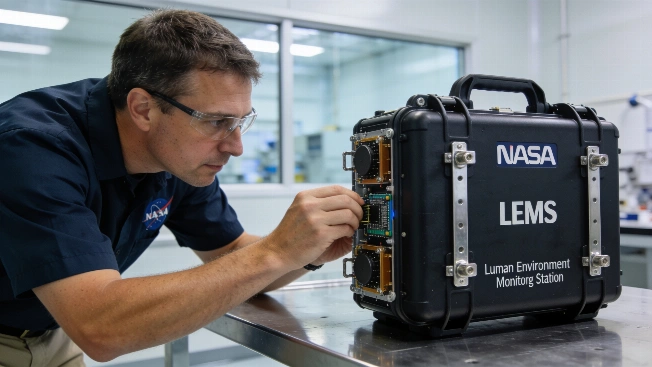
NASA Prepares LEMS Seismic Station for Artemis Lunar Surface Deployment
NASA engineers have completed the Lunar Environment Monitoring Station (LEMS), a compact seismic instrument suite designed for long-term deployment by Artemis astronauts near the Moon's south pole, aiming to monitor moonquakes and meteorite impacts.