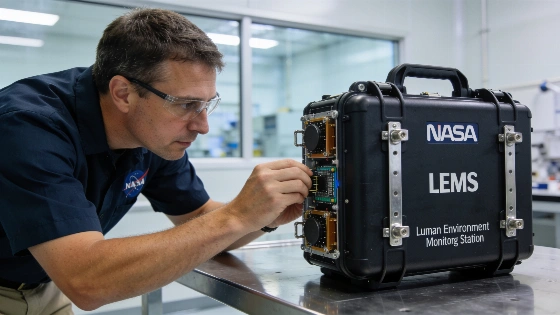
NASA engineers have completed the Lunar Environment Monitoring Station (LEMS), a compact seismic instrument suite designed for long-term deployment by Artemis astronauts near the Moon's south pole, aiming to monitor moonquakes and meteorite impacts.
NASA has finalized hardware development and testing for the Lunar Environment Monitoring Station (LEMS), a compact seismic payload intended for astronaut deployment on the Moon's surface as part of the Artemis program. The instrument suite, now awaiting assignment to a specific Artemis mission, is designed to operate autonomously for years in the challenging environment near the lunar south pole, where it will monitor seismic activity and surface vibrations.
Instrument Design and Capabilities
LEMS is engineered as a suitcase-sized, self-sustaining station weighing approximately 5 kilograms (11 pounds) in lunar gravity. Its core scientific payload consists of two highly sensitive seismometers, developed in collaboration with the University of Arizona and Silicon Audio, Inc., capable of detecting faint ground motions from moonquakes and meteorite impacts. The instrument is built to function independently after deployment, with a flexible solar array for power generation and thermal management systems to maintain stable internal temperatures during extreme lunar day-night cycles.
The modular design of LEMS allows for future upgrades or the addition of new instruments, supporting evolving scientific objectives. The system is programmed to collect seismic data continuously and transmit results to Earth on a monthly schedule, relying on a telecommunications system provided by Morehead State University. Data processing and dissemination will be managed by Washington University in St. Louis, ensuring that the broader scientific community can access and analyze the results.
Testing and Environmental Challenges
Before being cleared for lunar deployment, LEMS underwent a rigorous five-month campaign of environmental and operational tests at NASA's Goddard Space Flight Center in Maryland. Engineers verified that the payload could withstand the mechanical stresses of launch, the vacuum and radiation of space, and the Moon's temperature extremes, which can plunge to -240°C (-400°F) during the two-week lunar night. Unlike earlier Apollo-era seismometers, which relied on radioisotope heaters, LEMS uses advanced insulation, low-conductivity cables, and a thermal regulator to survive without external heat sources or power during the night.
These engineering choices reduce the mass and energy requirements of the instrument, making it feasible to deploy multiple stations at future Artemis landing sites or a permanent lunar base. The system's design also prioritizes astronaut safety, with mechanical and electrical features tested for safe handling during surface operations.
Scientific Goals and Historical Context
LEMS builds on the legacy of the Apollo seismic network, which operated from 1969 to 1977 and recorded over 13,000 seismic events on the Moon's nearside. However, those instruments were limited in sensitivity and geographic coverage. By deploying LEMS at the lunar south pole, NASA aims to collect new data on the Moon's internal structure, ongoing seismic activity, and the frequency of meteorite impacts in a region of high scientific interest for future exploration.
The Artemis program's focus on the south polar region has prompted debate about landing site selection and mission safety, as highlighted in recent discussions about crewed landings and operational risks. For example, the question of whether to prioritize the south pole or a safer equatorial site for Artemis IV was recently examined in detail (see this analysis of Artemis IV landing site considerations).
Mission Status and Next Steps
With hardware development complete, LEMS will remain in a controlled clean room at Goddard until it is assigned to a specific Artemis mission for delivery to the lunar surface. The instrument's deployment timeline will depend on mission scheduling, surface operations planning, and integration with other Artemis science objectives. The project is led by the University of Maryland Baltimore County and University of Maryland College Park, with NASA Goddard responsible for technical implementation.
Once deployed, LEMS is expected to operate for years, providing continuous seismic monitoring and supporting a new era of lunar surface science. Its data will help refine models of the Moon's interior, assess seismic hazards for future missions, and inform the design of lunar infrastructure.
Seismometers are instruments that measure ground motion by detecting vibrations transmitted through solid material. On the Moon, these sensors must be highly sensitive to register the faint signals produced by distant moonquakes or small meteorite impacts. Unlike Earth, the Moon lacks an atmosphere and has a dry, fractured crust, which affects how seismic waves propagate. Interpreting lunar seismic data requires careful calibration and modeling to distinguish between natural events, surface disturbances, and instrument noise. The deployment of modern seismometers like LEMS will provide higher-resolution data than previous missions, enabling more detailed studies of the Moon's internal structure and ongoing geological activity.