
Neutron Star
6 reportsA detailed treatment of Neutron Star follows environmental interactions, population context, and population distribution. The discussion asks what can be established from multiwavelength observations about population context and whether a compatible result appears in distance or orbit estimates; the result is bounded by the possibility that limited viewing geometry and indirect measurements can leave competing explanations.

XRISM Tracks Stellar Wind Falling Onto a Pulsar
XRISM has traced iron-rich plasma moving toward the pulsar GX 301-2 at about 540,000 kph, providing spectroscopic evidence that a neutron star captures its giant companion's stellar wind and powers recurring X-ray flares.

Vampire white dwarfs can collapse into neutron stars under precise conditions
Researchers have modeled how certain white dwarfs feeding on companion stars can collapse into neutron stars if their mass and accretion rate fall within a narrow range, revealing a rare but physically distinct pathway for stellar evolution.

Supernova Experiments Reveal New Clues to Element Formation in Stars
Two new studies use nuclear experiments and astrophysical modeling to clarify how supernovae forge and distribute elements like titanium and nickel, offering the most precise look yet at the processes that shape the chemical makeup of the universe

NASA's IXPE Observes Magnetar and Tests Quantum Vacuum Theory
NASA's IXPE telescope spent over 140 hours observing magnetar 1E 1547-5408, collecting X-ray polarization data that may reveal how empty space behaves in extreme magnetic fields

NASA's IXPE Detects Signs of Quantum Vacuum Effect Near Magnetar
NASA's IXPE telescope has measured X-ray polarization from a magnetar, providing evidence consistent with a quantum electrodynamics effect predicted for nearly a century but never directly observed in space
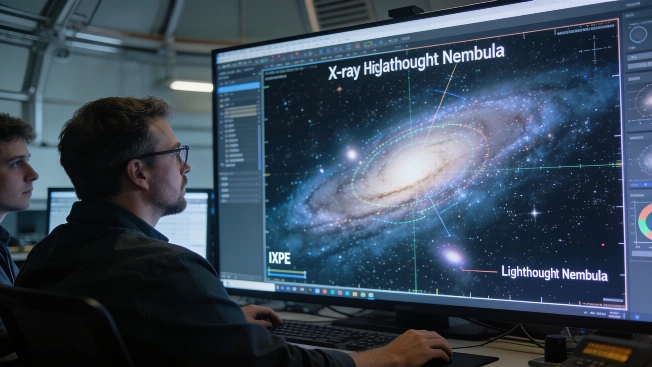
NASA's IXPE Maps Magnetic Field of Unusual Pulsar in Milky Way
Astronomers have used NASA's Imaging X-ray Polarimetry Explorer to directly map the magnetic field around the pulsar PSR J1101-6101, revealing how high-energy particles stream through the Milky Way and testing long-standing theoretical predictions