
Gravitational Lens
4 reportsFor readers assessing Gravitational Lens, the relevant threads are source populations, together with competing physical models and observational signature. The discussion relates instrument calibration to source populations and uses population statistics to examine alternatives; the comparison must account for the fact that selection effects and uncertain source distances can alter inferred rates or energies.
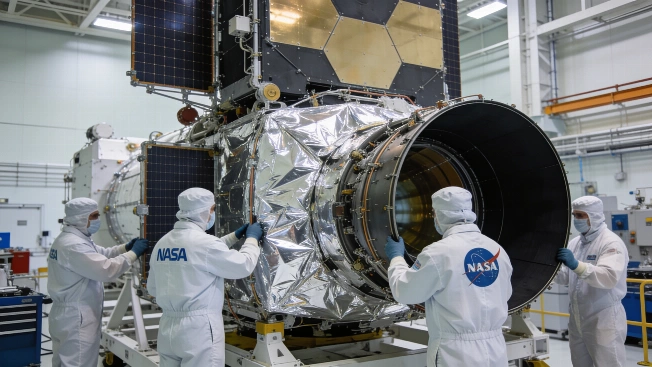
NASA's Roman Space Telescope Nears Launch After Budget Uncertainty
NASA's Nancy Grace Roman Space Telescope is set for launch after nearly two decades of development, overcoming a threatened cancellation and major funding cuts to become the agency's next flagship observatory for dark energy, exoplanets, and cosmic structure
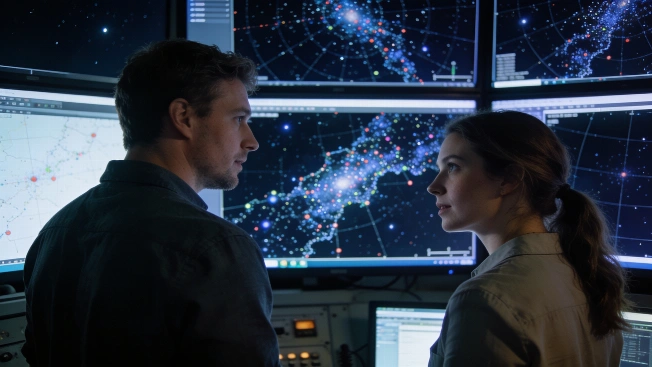
Astronomers Map 4 Billion Cosmic Objects in Largest 2D Sky Survey
A new 2D map of the universe, built from 13 years of ground and space-based observations, catalogs 4 billion stars, galaxies, and other objects, offering an unprecedented resource for future astronomical research
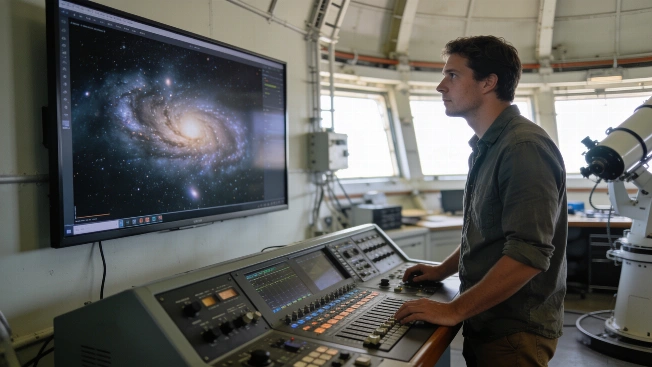
Webb Telescope Uses Gravitational Lensing to Reveal Ancient Galaxies
The James Webb Space Telescope has captured a detailed image of the galaxy cluster MACS J0553.4-3342, using gravitational lensing to magnify galaxies from the universe's first billion years
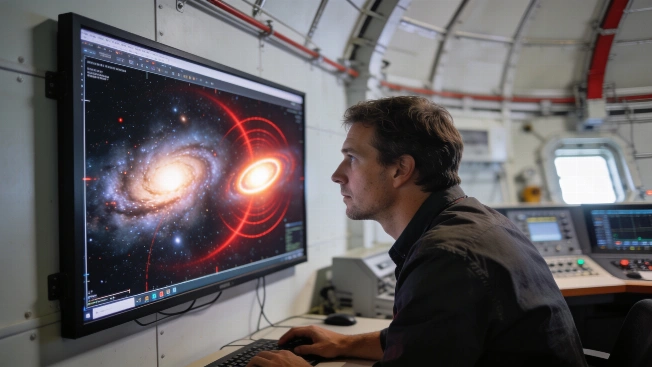
Webb Telescope Reveals Merging Young Galaxy Cluster 4.4 Billion Light-Years Away
NASA's James Webb Space Telescope has imaged the galaxy cluster MACS J0553.4-3342 as it appeared 4.4 billion years ago, capturing two massive sub-clusters in the process of merging and highlighting the gravitational effects shaping distant galaxies