
Event Horizon Telescope
2 reportsEvent Horizon Telescope is a ground observatory that combines a carefully chosen site, telescope systems, instruments, and data pipelines. Performance and scientific value are assessed through atmospheric seeing, survey program, and telescope aperture, with calibration and engineering limits shaping the usable evidence.
The practical and scientific questions around Event Horizon Telescope span archive access and carefully chosen site, with separate attention to data pipelines. The analysis begins with raw and calibrated measurements for data pipelines, and uses technical performance records to identify where the explanation succeeds or fails; the result is bounded by the possibility that weather, detector limits, and target selection can shape the available record.
The practical and scientific questions around Event Horizon Telescope span archive access and carefully chosen site, with separate attention to data pipelines. The analysis begins with raw and calibrated measurements for data pipelines, and uses technical performance records to identify where the explanation succeeds or fails; the result is bounded by the possibility that weather, detector limits, and target selection can shape the available record.

AI reconstructs black hole jet motion from decades of radio data
A new AI-driven analysis of 27 years of radio telescope data has produced the sharpest reconstruction yet of a black hole jet, revealing unexpected details about plasma motion in the blazar 3C 345
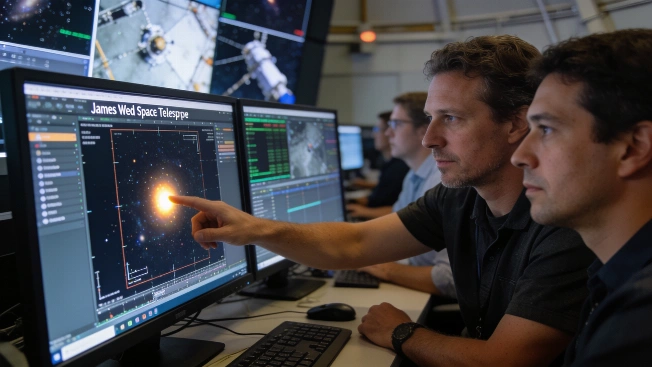
Webb Telescope Spots Candidate Black Hole Star in Early Universe
Astronomers using the James Webb Space Telescope have identified a luminous, solar-system-sized object from 660 million years after the Big Bang, offering the strongest evidence yet for a hypothesized 'black hole star' class.