A new AI-driven analysis of 27 years of radio telescope data has produced the sharpest reconstruction yet of a black hole jet, revealing unexpected details about plasma motion in the blazar 3C 345
Material ejected from the heart of a distant galaxy has been tracked in unprecedented detail, as researchers used artificial intelligence to reconstruct the motion of a supermassive black hole's jet over nearly three decades. The resulting animation, built from more than a hundred radio images, exposes surprising features in the plasma flow and challenges assumptions about how these extreme cosmic structures evolve.
Reconstructing a jet across decades
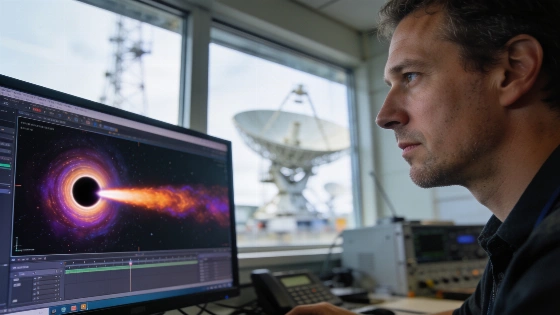
The blazar 3C 345, located in the constellation Hercules, is powered by a supermassive black hole that launches a jet of charged particles at nearly the speed of light. Between 1995 and 2022, the Very Long Baseline Array (VLBA)-a network of ten radio telescopes spanning the United States-recorded 116 separate images of this jet. These observations, part of long-term programs including BEAM-ME and MOJAVE, provided a rare opportunity to follow the jet's evolution over time.
To overcome the limited resolution of individual VLBA images, the research team developed a neural network called Kine. This AI model was trained to recognize patterns in the spatial and temporal structure of the jet, allowing it to interpolate between observations and reconstruct a continuous, high-resolution video. The resulting animation achieves four times the resolution of any single image, revealing fine details in the jet's motion and structure that were previously inaccessible.
Unexpected plasma speeds
Analysis of the reconstructed jet revealed that its brightest components appear to move at apparent speeds between 10 and 13 times the speed of light, while the surrounding plasma travels at 9 to 12 times light speed. These so-called superluminal speeds are a well-known effect of relativistic motion at small angles to the observer's line of sight, but the relative velocities within the jet were not anticipated. The finding complicates the standard shock model, which predicts that the brightest features-interpreted as shock fronts-should move faster than the surrounding material.
Instead, the data suggest that the velocity structure of the jet is more complex, with the brightest regions not always corresponding to the fastest-moving plasma. This result does not rule out the shock model entirely, but it indicates that additional physical processes may be shaping the jet's appearance and dynamics in 3C 345.
AI methods and observational limits
The Kine neural network represents a significant advance in astronomical image reconstruction, enabling researchers to extract more information from sparse and irregularly sampled datasets. By learning the correlations between spatial structure and time evolution, Kine can generate a plausible sequence of images even when observations are separated by months or years. This approach is particularly valuable for studying variable sources like blazars, where traditional imaging methods struggle to capture rapid changes.
However, the method's accuracy depends on the quality and cadence of the input data. The VLBA's ten antennas provide only limited coverage of the sky at any given time, and the resulting images are subject to noise and resolution constraints. While Kine can enhance the apparent detail, it cannot recover information that was never recorded. The reconstructed video is therefore a model-dependent interpretation, not a direct record of the jet's true appearance.
Implications for jet physics
The new analysis of 3C 345's jet offers a sharper view of plasma dynamics near a supermassive black hole, but it also raises questions about the physical mechanisms driving jet variability. The observed velocity structure suggests that shocks alone may not explain the brightest features, and that magnetic fields, turbulence, or other processes could play a significant role. Further application of AI-based reconstruction to other blazars and jets may help clarify whether these findings are unique to 3C 345 or reflect a broader pattern.
Long-term monitoring remains essential for disentangling the interplay of relativistic effects, jet composition, and environmental factors. As demonstrated by this study, combining archival data with advanced computational methods can reveal new aspects of well-studied objects. For context, similar approaches have been used to analyze other cosmic phenomena, as in the previous investigation of early-universe black holes using space telescope data.
Interpreting the reconstructed jet requires caution. While the AI model provides a powerful tool for visualizing long-term changes, its output is shaped by both the underlying physics and the assumptions built into the reconstruction process. The evidence supports a more nuanced view of jet dynamics, but does not yet resolve the fundamental questions about energy transport and particle acceleration in these extreme environments. The field will benefit from further cross-comparison of AI-driven reconstructions with direct, high-cadence observations as new instruments come online.
Understanding the apparent superluminal motion in blazar jets requires familiarity with relativistic effects. When a jet moves close to the speed of light at a small angle to our line of sight, its projected speed on the sky can appear to exceed light speed-a phenomenon explained by special relativity, not by actual faster-than-light travel. This effect complicates the interpretation of jet structure and velocity, making it essential to combine careful modeling with high-resolution, time-resolved observations to distinguish physical motion from projection and light-travel-time effects.