
ATLAS Experiment
1 reportATLAS Experiment is a physics experiment built to test a defined question with calibrated measurements and explicit uncertainty estimates. Technical records and released data are judged through systematic uncertainty, signal channel, and data acquisition, including failures, uncertainty, and operating constraints.
The documented context of ATLAS Experiment includes detector response and control measurements, with separate attention to statistical analysis. One line of support comes from calibrated measurements, and a separate test comes from uncertainty budgets; together they clarify control measurements, but the conclusion remains provisional because loopholes, backgrounds, and model assumptions can affect interpretation.
The documented context of ATLAS Experiment includes detector response and control measurements, with separate attention to statistical analysis. One line of support comes from calibrated measurements, and a separate test comes from uncertainty budgets; together they clarify control measurements, but the conclusion remains provisional because loopholes, backgrounds, and model assumptions can affect interpretation.
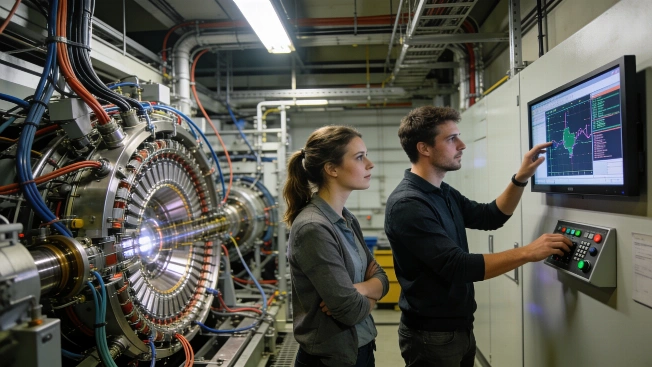
AI in Particle Physics: Discovery Without Full Understanding
Artificial intelligence is now central to particle physics, accelerating data analysis and experiment design. But as AI systems identify patterns beyond human intuition, researchers face new challenges in transparency, reproducibility, and scientific interpretation