
Arctic Sea Ice
1 reportArctic Sea Ice is a climate phenomenon expressed through circulation, temperature, precipitation, feedbacks, and regional connections. Researchers test interpretations with feedback mechanism, model simulation, and temperature anomaly, while incomplete records, model assumptions, and measurement limits constrain certainty.
Work involving Arctic Sea Ice is reported through surface melt and dynamics; sea-level or carbon effects; and model uncertainty. Complementary views of model uncertainty come from reanalysis products and independent climate models, but the conclusion remains bounded because the account does not overlook that short records, natural variability, and scenario assumptions can widen uncertainty.
Work involving Arctic Sea Ice is reported through surface melt and dynamics; sea-level or carbon effects; and model uncertainty. Complementary views of model uncertainty come from reanalysis products and independent climate models, but the conclusion remains bounded because the account does not overlook that short records, natural variability, and scenario assumptions can widen uncertainty.
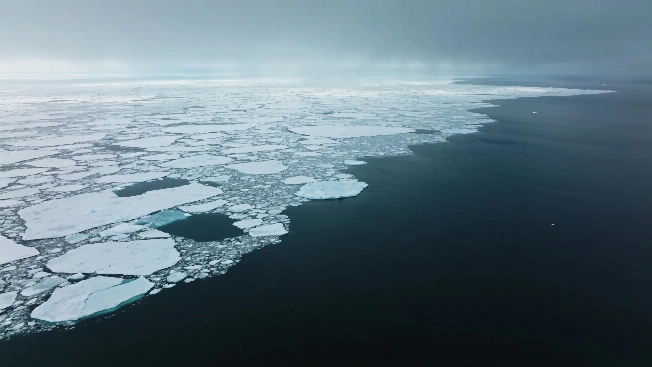
Arctic Sea Ice Reaches Its Preliminary 2026 Minimum at the 11th-Lowest Level
Arctic sea ice reached a preliminary 2026 minimum of 4.60 million square kilometers on Sept. 12. The estimate ranks 11th-lowest in the satellite record, although the final value and ranking remain subject to confirmation.