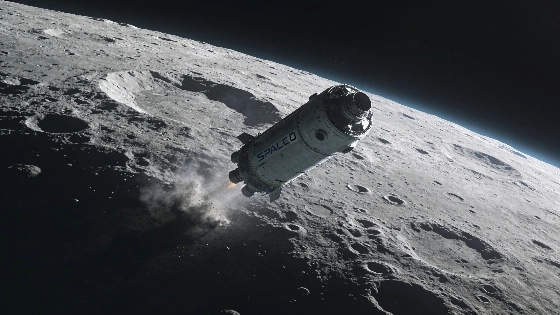
A spent SpaceX Falcon 9 upper stage is set to collide with the lunar surface on August 5, offering researchers a rare opportunity to observe the effects of artificial impacts on the Moon using telescopes and orbital instruments
On August 5, a discarded upper stage from a SpaceX Falcon 9 rocket is expected to strike the Moon at high speed, providing scientists with a unique chance to observe the immediate and longer-term consequences of a human-made impact on the lunar surface. The event, involving hardware left over from the launch of Firefly's Blue Ghost-1 lander and ispace's Hakuto-R Mission 2, will unfold near the Einstein and Bell craters along the Moon's western limb.
Modeling the Impact
Researchers have used physics-based simulations to estimate the outcome of the collision. According to a recent preprint on arXiv, the impact is predicted to generate a debris plume with a central spike of ejected material reaching altitudes between 75 and 100 kilometers above the lunar surface. For a brief period after impact, the plume may be several orders of magnitude brighter than the surrounding dark sky, potentially making it visible to observers with sensitive telescopes. However, these predictions are based on nominal models, and the actual event may differ in brightness and structure.
The Falcon 9 upper stage, unlike natural impactors such as asteroids or comets, is a hollow, spacecraft-like object. This distinction means that existing models for lunar impacts may not fully capture the behavior of the resulting ejecta. Scientists are particularly interested in comparing the observed plume with model predictions to refine their understanding of impact processes on the Moon.
Observational Opportunities
The predicted location of the impact, near the lunar limb, increases the likelihood that ground-based and space-based telescopes will be able to observe the event. The flash and subsequent plume could be detected in real time, although the precise visual magnitude remains uncertain. Instruments such as NASA's Lunar Reconnaissance Orbiter (LRO) are scheduled to pass over the projected site about a week before and after the impact, allowing for before-and-after imaging of the affected region.
In addition to direct observation, the event offers a test case for methods used to localize impacts on the lunar surface, which is important for future seismic experiments and hazard assessment. The maximum range of resolved ejecta particles is estimated to be just under 1,000 kilometers, raising questions about the potential risk to future lunar infrastructure and astronauts from artificial debris impacts.
Efforts to track and characterize space debris have become increasingly important as more missions target the Moon and other celestial bodies. For example, recent work has demonstrated how radio telescopes can monitor objects in geostationary orbit, as described in a related Science Report article.
Scientific Implications
Artificial impacts like this one provide a rare opportunity to calibrate models of ejecta dynamics and surface modification under controlled conditions. By comparing the observed plume and crater with predictions, researchers can improve their understanding of how both natural and artificial objects interact with the lunar regolith. This knowledge is essential for interpreting the Moon's geological history and for planning future missions that must contend with the hazards posed by space debris.
The event also highlights the growing complexity of lunar exploration, as commercial and international missions increase the number of objects in lunar orbit and on the surface. Understanding the consequences of artificial impacts will be critical for managing the risks associated with human activity on and around the Moon.
Limitations and Uncertainties
Despite detailed modeling, significant uncertainties remain regarding the brightness, structure, and extent of the impact plume. The actual outcome will depend on factors such as the precise impact angle, the physical state of the rocket stage, and the properties of the lunar surface at the collision site. Observers are encouraged to monitor the event, but scientists caution that the most valuable data may come from tracking the evolution of the ejecta plume rather than the initial flash.
As with previous artificial impacts, the interpretation of results will require careful analysis of both remote sensing data and in situ measurements, where available. The event underscores the need for continued refinement of impact models and for coordinated observation campaigns to maximize scientific return from rare opportunities like this one.
To understand the significance of this impact, it is helpful to consider how scientists model and interpret ejecta plumes. When a high-velocity object strikes the Moon, it excavates material from the surface, launching it outward in a characteristic pattern. The height, brightness, and distribution of the plume depend on the impactor's mass, speed, structure, and the properties of the lunar regolith. By comparing observed plumes with model predictions, researchers can test their understanding of impact physics and improve their ability to interpret both natural and artificial craters across the solar system.