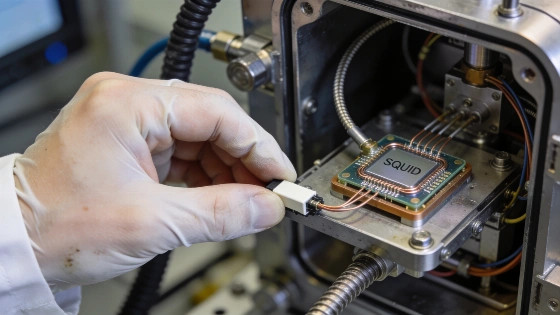
Alice & Bob and ENS Lyon used a microvolt-scale DC-biased SQUID to control photon conversion between superconducting resonators and demonstrate multi-photon dissipation for cat-qubit stabilization.
A microvolt-scale DC voltage bias has driven a superconducting coupler through several selective photon-conversion channels in an experiment by Alice & Bob and researchers at the École Normale Supérieure de Lyon. The result targets a specific hardware problem in cat-qubit architectures: strong microwave pump tones can introduce unwanted nonlinear frequency shifts that damage the states they are meant to protect.
The work is available as an open arXiv research manuscript, rather than as evidence of a completed commercial system or a regulatory-approved technology. The reported experiment is a circuit-quantum-electrodynamics demonstration; the available description does not report a conventional biological sample size, p-values or confidence intervals, because the measured object is a superconducting resonator device and its engineered photon-exchange dynamics.
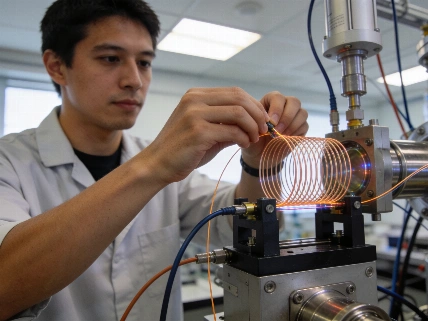
The device uses a flux-tunable SQUID between two superconducting resonators. One is a high-Q memory-waveguide resonator operating at 4.0429 GHz; the other is a lossy buffer resonator at 7.56 GHz. The memory stores the bosonic quantum state while the buffer provides a route for removing selected photons.
In conventional implementations, continuous two-photon dissipation is activated with a powerful microwave drive. That drive can generate self-Kerr and cross-Kerr nonlinearities, shifting resonator frequencies and changing the dynamics of the encoded state. The DC-biased design replaces the pump tone with a steady voltage across the Josephson-junction SQUID, so the architecture can operate without a microwave signal used as the activation drive.
At a voltage V, tunneling Cooper pairs exchange discrete energy associated with 2eV. By tuning that energy to the difference between memory and buffer photon states, the circuit can favor particular conversion processes. The Josephson frequency continues to rotate rather than remaining fixed to a microwave pump phase, allowing first-order parasitic Kerr terms and flux detunings to average out dynamically according to the reported architecture.
The two-photon process was reported at a bias of approximately 1.1 microvolt. That operating point is notable because the control parameter is a DC voltage rather than a conventional microwave pump amplitude or phase. The distinction is central to the design: the goal is not simply to replace one wire with another, but to reduce the pump-induced nonlinear terms that can complicate bosonic-state stabilization.
The experiment did not rely on a single conversion ratio. Adjusting the DC bias activated 1-to-1, 2-to-1 and 4-to-1 photon-conversion processes, giving the researchers a way to select how energy leaves the memory mode. This multi-photon scattering capability places several engineered dissipation channels within one device architecture.
Wigner-state tomography was used to examine the resulting cavity states. The reported measurements showed deterministic pair-photon extraction, with a maximum two-photon swap rate of 18.2 MHz and an effective two-photon dissipation rate of 0.48 MHz. Those numbers describe the engineered exchange and loss channel; they are not gate fidelities, logical error rates or evidence that a complete fault-tolerant quantum computer has been built.
The distinction matters because cat qubits are bosonic encodings rather than ordinary two-level physical qubits. Information is stored in superpositions of coherent states in a resonator, and engineered dissipation is used to suppress selected error processes. Demonstrating a controllable loss mechanism therefore addresses one component of the architecture, not the full burden of state preparation, measurement, logical gates and error correction.
The isolated 4-to-1 swaps are relevant to four-component cat qubits. Such encodings distribute information across four coherent states and are intended to increase error-protection capacity without requiring a complex collection of microwave tones at different frequencies. The result therefore expands the set of circuit-level tools available for testing higher-component bosonic codes, while leaving their full logical performance to be established.
That architectural issue also connects to an earlier quantum-utility analysis, which examined why quantum hardware must be judged by its architecture and error control rather than by a headline capability alone. Here the useful question is similarly narrow: whether the engineered dissipation remains stable and controllable as the rest of the bosonic code is added.
The reported work does not provide the evidence needed to answer that larger-systems question. The manuscript describes an experimental demonstration and does not establish independent replication, a full logical-qubit error rate, a completed fault-tolerant gate set or a useful computation. It also does not establish that the DC-wiring solution eliminates every cryogenic or calibration challenge associated with a larger processor.
The engineering attraction is concrete. Replacing microwave pump lines with DC voltage-bias wiring can simplify the control layout and potentially reduce heat loads inside a dilution refrigerator. That could matter in architectures where each additional microwave line adds routing, filtering and thermal-management demands.
Yet simpler wiring is not the same as demonstrated scalability. A larger system would still need reproducible SQUID parameters, stable voltage control, calibrated conversion across many modes and protection against unwanted couplings. It would also need reliable readout and logical operations around the dissipative element. None of those requirements is resolved by the reported swap rates alone.
The result should also be interpreted in the context of a broader field that includes superconducting-circuit programs at MIT and Stanford and peer-reviewed analyses in Nature. Comparisons with large facilities such as CERN or mission-scale programs at NASA are useful only as reminders that a component-level laboratory demonstration and a mature technological platform have very different evidentiary thresholds.
The central achievement is therefore best described as an experimentally tested control architecture for engineered bosonic dissipation. Alice & Bob and ENS Lyon showed that DC biasing can select one-to-one, two-to-one and four-to-one photon conversion in a memory-buffer system while avoiding the specific pump-induced Kerr mechanism that motivates the design. That is a meaningful hardware result, but its significance lies in removing one control bottleneck rather than proving a complete cat-qubit platform.
Cat qubits use resonator states that are stabilized by their environment rather than isolated from it entirely. In this experiment the environment is deliberately engineered so that photon conversion removes selected excitations from the memory into a lossy buffer. The architecture can protect information only when that dissipation is balanced with accurate preparation, readout and logical control, so a measured conversion channel is an enabling element rather than a full error-correction result.
As of the dates associated with the open manuscript and independent coverage in late September 2026, the evidence supports a research demonstration rather than industrial deployment. The DC-biased SQUID is a credible route to cleaner bosonic-code control, and the reported measurements justify further testing, but they do not yet establish a scalable or fault-tolerant quantum computer.