Engineers have demonstrated that radio telescopes can detect and monitor space debris in geostationary orbit, using radar signals reflected from distant objects beyond the reach of conventional tracking methods
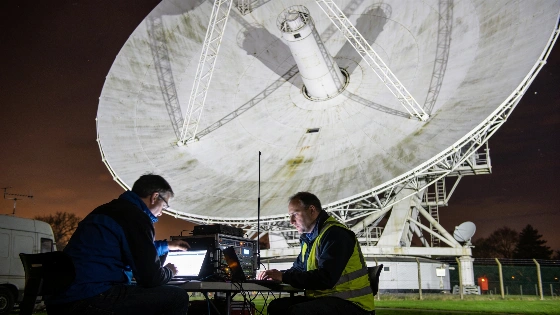
Radio telescopes are typically designed to capture faint signals from distant galaxies and stars, but a new international effort has shown that these sensitive instruments can also be used to monitor space debris in Earth's high-altitude orbits. By leveraging the capabilities of the Lovell Telescope at Jodrell Bank in the United Kingdom, researchers have demonstrated a method for tracking objects in geostationary orbit that are otherwise difficult to observe with standard ground-based systems.
Challenges of High-Altitude Debris
Space debris has become a growing concern as thousands of satellites and fragments from past missions accumulate in Earth's orbit. While most debris is concentrated in low Earth orbit (LEO), where conventional radar systems can track objects below about 2,000 kilometers, geostationary orbit (GEO) lies much farther out at approximately 36,000 kilometers. GEO is home to critical communications and weather satellites, and even a single collision with debris can disable a functioning spacecraft. Traditional optical telescopes can detect larger objects in GEO, typically those exceeding 10 centimeters in size, but smaller fragments remain largely invisible to these methods.
Radar tracking is highly effective for smaller debris in LEO, but the sensitivity required to detect objects at GEO distances has been beyond the reach of most ground-based radar installations. This limitation has left a significant gap in the ability to monitor and characterize the full population of debris threatening satellites in high orbits.
Long Baseline Multistatic Radar Approach
The Long Baseline Multistatic Radar (LBMR) project, supported by NATO and the UK Space Agency, set out to address this challenge by combining radar transmission with radio telescope reception. In the LBMR demonstration, a radar transmitter at the Massachusetts Institute of Technology's Lincoln Laboratory in the United States sent radio waves toward GEO. These signals reflected off debris objects and were then detected by the Lovell Telescope in the UK, which is equipped to receive extremely faint radio signals from space.
Synchronizing a radar transmitter and a radio telescope separated by the Atlantic Ocean required years of technical development. The team succeeded in capturing reflected signals from debris with a single radio telescope, allowing them to measure both the distance to the object and its relative motion in real time. The next phase aims to use multiple radio telescopes to triangulate debris positions in three dimensions, potentially improving the accuracy and completeness of GEO debris tracking.
Implications for Space Safety
This technique opens a new avenue for monitoring debris in orbits that have previously been difficult to survey. By extending radar-based tracking to GEO, the LBMR approach could help operators identify hazardous fragments before they threaten operational satellites. The ability to detect smaller debris is particularly important, as even millimeter-scale objects can cause significant damage at orbital velocities.
Efforts to improve space situational awareness are ongoing worldwide, with agencies and commercial operators seeking to reduce the risk of collisions and cascading debris events. The LBMR demonstration adds to a growing toolkit for debris monitoring, complementing optical and radar systems already in use. Similar advances in observational capability have been crucial for other space science missions, such as those that rely on precise calibration of instruments to distinguish between signal and noise, as seen in recent dual-wavelength imaging efforts by NASA's ESCAPADE mission (see related coverage).
Technical and Operational Limits
While the LBMR method has demonstrated proof of concept, several technical hurdles remain before it can be deployed as a routine operational system. Coordinating radar transmissions and radio telescope observations across continents requires precise timing and data processing. Atmospheric conditions, radio interference, and the need for dedicated observation time on large radio telescopes all present practical challenges. Additionally, the sensitivity of the system must be sufficient to detect the smallest and most numerous debris fragments, which may require further upgrades to both transmitters and receivers.
Despite these challenges, the successful demonstration marks a significant step toward more comprehensive monitoring of the space environment. As satellite launches continue to increase, the need for reliable debris tracking in all orbital regimes will only become more urgent.
Radio telescopes detect electromagnetic waves at long wavelengths, typically from natural cosmic sources. In the LBMR approach, these instruments are repurposed to receive artificial radar signals that have bounced off objects in space. The sensitivity and large collecting area of radio telescopes make them well suited to capturing weak reflections from distant debris. However, interpreting these signals requires careful calibration and synchronization with the transmitting radar, as well as sophisticated data analysis to distinguish genuine debris echoes from background noise and interference. This method illustrates how existing astronomical infrastructure can be adapted to address emerging challenges in space safety and situational awareness.