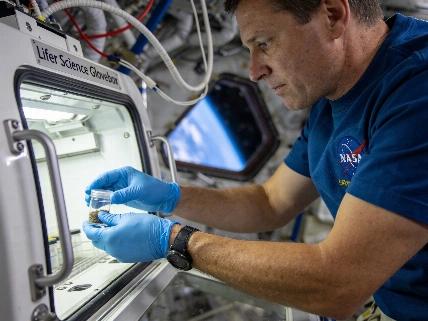
At NASA Langley Research Center, Richard Spolzino tracks the measurements still missing from lunar and Mars planning and helps convert those gaps into priorities for missions and commercial partners.
NASA's return to the Moon is being shaped not only by rockets and landers but by the measurements engineers still lack. At NASA's Langley Research Center in Hampton, Virginia, aerospace engineer Richard Spolzino works on Moon Base mission architecture and systems interoperability, documenting unknowns before they become operational problems. The approach reflects a broader principle shared across NASA, ESA and major research institutions: a mission requirement is meaningful only when it can be tied to a measurable physical property and an explicit engineering decision.
Spolzino's central tool is the data gap: a formal record of what NASA does not know, why the missing information matters, what existing evidence fails to provide and what measurable result would close the gap. The framework does not treat uncertainty as a statistical finding with a p-value or confidence interval; it is an engineering-control method for defining what must be measured, by which instrument and with what operational consequence.
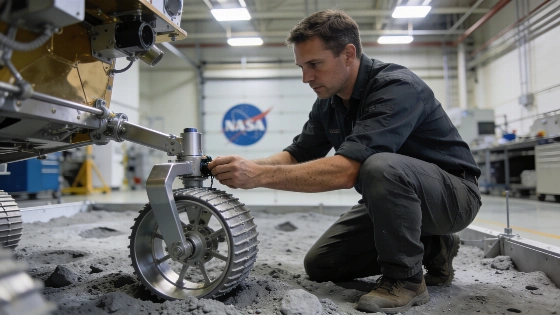
Lunar regolith provides a straightforward example. The surface material may look like dust, but its grain size, density, cohesion and response to loading determine how much weight a rover can carry, how safely it can travel and whether a habitat foundation can support the structure above it. Bearing capacity and shear strength therefore affect landing-site selection, wheel design, mobility margins and construction planning rather than remaining isolated laboratory details. The same systems perspective appears in planetary materials research at institutions such as MIT and in peer-reviewed work published by Nature.
The scale of the catalog is expanding. Spolzino's team began with roughly 25 published data gaps last year and is on track to reach 60 by the end of this year. Those figures describe documented knowledge needs rather than discoveries about the Moon, and they should not be read as a survey sample or as evidence that every gap has equal scientific or operational priority.
The framework is already being used to influence mission decisions. During preparations for the Griffin-1 mission by Voyager Technologies, formerly Astrobotic, the team did not select the instruments because that payload was already locked in. Instead, it helped prioritize which results should be transmitted first through a communications pipeline that cannot carry every desired measurement at once.
That constraint is scientifically important. A mission can collect more information than it can immediately return, so the order of transmission affects which questions receive answers first. Limited bandwidth, intermittent visibility, onboard storage and power use make telemetry a resource-allocation problem. Recent commercial lunar missions have also highlighted recurring risks involving landing and communications, reinforcing why data must sometimes be prioritized rather than transmitted in full.
Griffin Mission One illustrates the practical stakes. Earlier descriptions linked the Griffin lander to the cancelled NASA VIPER-related mission concept, while current mission summaries identify at least Astrolab's FLIP rover and Astrobotic's CubeRover among the planned payloads. Independent reporting places the intended delivered payload above 500 kilograms, or more than 1,100 pounds, for a group of scientific and technical payloads aimed at the lunar south-polar region.
The schedule has also moved. As of October 2, 2026, one launch tracker listed a shift from November 30 to December 31, while other reporting described the mission as flying no earlier than December. An earlier September expectation had placed Griffin-1 no earlier than November, making the change a reminder that mission planning must remain useful even as hardware, launch windows and integration schedules evolve. The updated schedule was reported in a launch-status briefing and in regional spaceflight coverage.
His team has also evaluated proposed spectrometers, sample-collection tools and technology demonstrations against the published data gaps. Proposals that match a documented need can move forward as genuine candidates, while instruments with no clear connection to an identified requirement receive less support. Leadership now asks companies proposing new instruments to show how their designs map onto those gaps.
The same logic applies to infrastructure beyond a single landing. NASA's planning for resource production depends on connections between machines: a lunar oxygen plant would interact with rovers that deliver feedstock and with processing systems that supply users. An earlier lunar agriculture report illustrates the same systems-level problem through controlled crop production and resource recycling rather than through one standalone device.
Spolzino reached aerospace through several changes of direction. He began college as a history major before switching to physics at Santa Clara University and considering astrophysics. Work at Lick Observatory studying interstellar dust polarization showed him that research could be fascinating without making observational astronomy his long-term path.
After graduation he entered the path toward Navy Officer Candidate School with the goal of flying jets. When that route did not continue, he joined a graduate program at the University of Houston combining aerospace engineering with space architecture. In that setting, architecture meant the relationships between systems rather than the design of a single habitat.
That systems perspective also shaped his decision to join NASA. The agency was not a lifelong destination for him; the attraction was the chance to work on problems that crossed technical boundaries and reached senior decisions about lunar exploration. He argues that NASA can give early-career employees room to take on work beyond a narrow job description.
Spolzino's experience has also altered his view of NASA's reputation. The agency does not possess a ready-made answer to every engineering question simply because it has decades of flight experience. Maintaining that standard requires continuous work by people who identify missing information and connect it to decisions. NASA's commercial lunar model has increasingly placed individual CLPS flights within a broader lunar architecture, rather than treating each landing as an isolated demonstration.
That is a less glamorous account of lunar exploration than the launch itself, but it is closer to how complex missions succeed. A rover's route, a habitat's foundation and the order in which data returns can all depend on properties that have not yet been measured well enough. The data-gap process provides a way to expose those weaknesses before hardware commits a mission to them.
For students considering NASA, Spolzino's advice is similarly practical. Projects and demonstrated results can matter more than credentials alone, and clubs or hands-on work give applicants something concrete to show. His own path from history to physics to systems engineering supports that argument without requiring a fixed childhood plan.
A data gap is not proof that a mission is unready, nor does publishing one guarantee that a partner will close it. It is a disciplined boundary between what planners can assume and what they can support with measurements. That boundary is exactly where NASA's lunar ambitions need the most rigor: the agency's return to the Moon will depend not merely on reaching the surface but on knowing which unknowns must be resolved before the next system is built.
In mission planning, a measurement is useful only when its meaning and delivery path are defined. A data gap records that chain by linking an unknown physical property to an operational consequence and then to a target that an instrument can address. This is why the method matters: it separates a compelling technology demonstration from one that answers a documented engineering need. Spolzino's work shows that NASA's most consequential lunar decisions may begin with admitting what is not yet known.