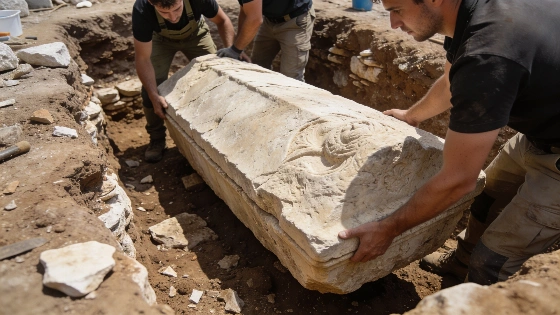
Archaeologists have excavated a massive limestone sarcophagus in Cavtat, Croatia, that remained sealed for over 1,500 years, providing rare insight into Late Antique burial practices and preservation in the eastern Adriatic
A team of archaeologists working in Cavtat, near Dubrovnik on Croatia's Adriatic coast, has uncovered a large stone sarcophagus that remained sealed and undisturbed since Late Antiquity. The find, recovered from a necropolis associated with the Roman settlement of Epidaurum, offers a rare opportunity to examine mortuary practices and material culture from the fourth to sixth centuries CE in the region.
Excavation and Preservation
The sarcophagus, carved from local limestone and weighing approximately five tonnes, was discovered about three meters below the modern ground surface. Its double lid and the presence of well-preserved lime mortar sealing the junction between the coffin and lid indicate that the tomb had not been opened since antiquity. This level of preservation is unusual, as many Roman-era burials in the region were disturbed or looted in later periods.
Excavation required careful coordination among archaeologists, anthropologists, and conservators to document the burial context, remove the heavy lid, and recover the contents without damaging the archaeological evidence. The sarcophagus was subsequently lifted and relocated to an open area in Cavtat for further study and public viewing.
Burial Context and Skeletal Remains
Inside the sealed sarcophagus, researchers found the skeletal remains of a single individual. Although the bones had undergone significant deterioration due to centuries underground, the undisturbed context allowed for the recovery of organic deposits and other materials that may yield further information through laboratory analysis. The biological profile, including age, sex, and possible health status, remains to be established through detailed anthropological and scientific examination.
The burial's context within the necropolis of ancient Epidaurum situates it within a period of major transformation in the Roman world. During Late Antiquity, the region experienced shifts in political power, religious practice, and social organization, with Christianity becoming increasingly influential. The necropolis itself reflects changing funerary customs, as Roman burial grounds were typically located outside settlement boundaries and varied in form according to local traditions and the status of the deceased.
Material Culture and Local Production
The sarcophagus is identified as a Salona-type, a form associated with Late Antique Dalmatia and named after the provincial capital near modern Split. Architectural decoration around the corners and analysis of the limestone suggest that the monument was produced locally rather than imported as a finished object. This points to the existence of skilled stoneworking workshops in the region capable of manufacturing large and technically demanding funerary monuments during this period.
Producing and installing such a monument would have required significant resources, organization, and labor, indicating that the individual interred may have held considerable status within the community. However, without further evidence from the burial or associated artifacts, the precise social position of the deceased remains uncertain.
Comparative and Regional Context
The discovery in Cavtat adds to a growing body of evidence for complex mortuary practices and social differentiation in Late Antique Dalmatia. Comparable finds, such as the chamber grave at Gnezdilovo near Suzdal, which contained a man, horse, and dog with associated grave goods, highlight the diversity of elite burial traditions across the wider region and time period. For example, the chamber grave at Gnezdilovo demonstrates how burial architecture and grave contents can reflect local expressions of status and identity.
Laboratory analysis of the human remains and organic material from the Cavtat sarcophagus is expected to provide further insight into the individual's life, health, and the burial environment. These studies may also contribute to understanding broader patterns of population, mobility, and cultural change in the eastern Adriatic during the final centuries of Roman rule.
After remaining sealed for over 1,500 years, the Cavtat sarcophagus offers a rare, undisturbed context for investigating the intersection of funerary practice, social structure, and material production in a period of significant historical transition.
Understanding the significance of a sealed burial requires attention to taphonomy-the study of processes affecting remains after death. In this case, the lime mortar seal and double lid protected the interior from soil, water, and biological disturbance, preserving both skeletal and organic material. Such preservation is uncommon in open or previously looted graves, where post-depositional processes often destroy or alter evidence. Taphonomic analysis helps archaeologists distinguish between ancient funerary intent, later disturbance, and natural decay, allowing for more accurate reconstruction of past mortuary practices and the lived experiences of individuals in antiquity.