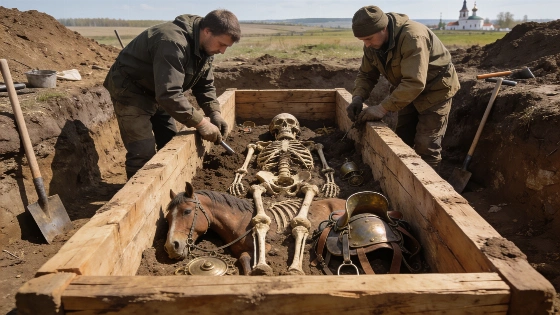
Archaeologists have uncovered a rare 10th-century chamber grave at Gnezdilovo near Suzdal, containing a man, horse, and dog, with weapons and riding gear, offering new evidence for early elite presence in north-eastern Rus'
A newly excavated chamber grave at the Gnezdilovo burial ground near Suzdal, Russia, is providing direct evidence for the presence of high-status individuals in the Suzdal Opolye during the 10th century CE. The burial, discovered by the Suzdal expedition of the Institute of Archaeology of the Russian Academy of Sciences and the State Historical Museum during the 2026 field season, is the first of its kind identified in this region and is notable for its preservation and associated grave goods.
Chamber Construction and Burial Contents
The grave was found in the central area of the Gnezdilovo necropolis and consists of a rectangular wooden chamber measuring approximately 3.1 by 2.7 meters, sunk about one meter below ground. Remnants of the wooden ceiling, plank walls, and floor survived, indicating a deliberate construction distinct from typical earth-filled graves. The chamber remained hollow after burial, with the ceiling eventually collapsing as the wood decayed.
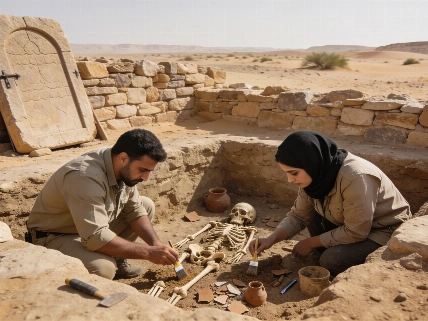
Inside, archaeologists recovered the skeleton of an adult male, estimated to be between 25 and 35 years old at death, positioned on his back with his head to the west. In the northern section of the chamber, the remains of a horse and a dog were also found, both oriented westward. The arrangement and associated objects suggest the deceased was a horseman of elevated social status, possibly linked to the region's military elite.
Grave Goods and Social Implications
The burial was accompanied by a substantial assemblage of artifacts. Two weighted buttons were found near the neck, and a silver horseshoe-shaped fibula, likely used to fasten outer clothing, was located on the right side of the chest. An iron knife lay beside the left hip, while a battle axe with traces of its wooden handle and a horn comb were recovered near the right leg. Between the man and the horse, archaeologists identified a spearhead with preserved shaft fragments, stirrups, and a bit with horn cheekpieces, all indicative of equestrian equipment. A small scale pan and a girth buckle, possibly from a saddle, were also present.
Chamber graves of this type are rare in medieval Rus', with fewer than 100 examples known from controlled excavations. They are typically associated with high-status individuals and often contain weapons and horse gear. The Gnezdilovo find expands the known distribution of such burials, which have previously been concentrated at sites like Staraya Ladoga, Gnezdovo, Kyiv, and Timerevo near Yaroslavl.
Preservation and Archaeological Context
The Gnezdilovo chamber grave is notable for its undisturbed condition and the completeness of its assemblage. Many chamber burials in the region were excavated decades ago under less rigorous documentation standards, limiting the potential for modern analysis. In contrast, the current excavation allows for detailed anthropological and scientific study of both the human and animal remains, as well as the associated artifacts.
During the 2026 season, archaeologists investigated 15 burials at Gnezdilovo, most of which were conventional inhumations. Several female graves contained elaborate jewelry, including silver temple rings and necklaces with glass, carnelian, and crystal beads. One male burial, possibly of a teenager, included a battle axe and a wooden grave structure with notched corners. The majority of these burials date to the 11th century, but the chamber grave pushes evidence for elite presence in the region back into the 10th century.
Regional Networks and Historical Significance
The construction and contents of the Gnezdilovo chamber grave closely resemble those found in the Smolensk region and the Middle Dnieper, suggesting that the Suzdal Opolye was integrated into broader cultural and political networks of early Rus'. Until this discovery, Suzdal and its surroundings were not considered centers of 10th-century military-administrative elites. The new evidence indicates that the region may have held strategic importance earlier than previously recognized, challenging assumptions about the timing and distribution of elite power in north-eastern Rus'.
Excavations at Gnezdilovo have now documented nearly 100 medieval burials, making it the largest collection of burial complexes from the 10th to early 12th centuries in the north-east of Rus' to be excavated with modern methods. The spatial organization of graves, including a line of weapon- and horse-associated burials extending roughly 200 meters through the cemetery, provides further insight into the social structure and mortuary practices of the community.
Recent discoveries at other sites, such as the mapping of a large stone fortress in eastern Türkiye using satellite imagery and fieldwork, as reported in a related Science Report article, highlight the value of integrating new archaeological methods and comparative regional analysis to reassess the emergence of early political centers.
The Gnezdilovo chamber grave, with its well-preserved human and animal remains and rich assemblage, now stands as a key piece of evidence for the early development of elite networks in the Suzdal Opolye and the wider north-eastern territories of Rus'.
Chamber graves are a distinctive mortuary tradition in early medieval northern Europe and Rus'. Unlike simple inhumations or cremations, these burials involve the construction of an underground wooden chamber, often with elaborate grave goods and animal companions. Their rarity and association with high-status individuals make them important for understanding the emergence of social hierarchies, mobility, and cultural connections in the early medieval period. The careful documentation and preservation of the Gnezdilovo chamber grave will enable future research into the lives, identities, and networks of those buried in the region more than a millennium ago.