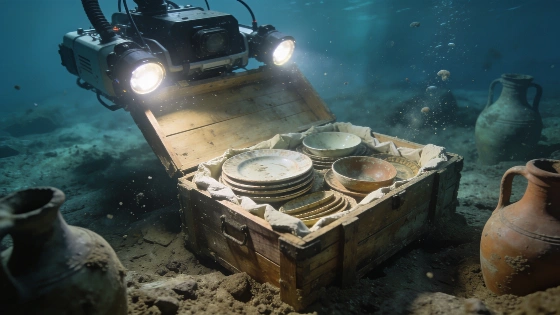
Thousands of ceramic plates, bowls and trays recovered off Adrasan reveal a luxury cargo associated with Rhosus and Mediterranean trade during the 1st century BCE.
Thousands of ceramic vessels survived for about 2,100 years on the seabed off Türkiye, turning a shipwreck near Adrasan into a concentrated record of Mediterranean commerce during the 1st century BCE. Turkish officials reported that the recovered cargo includes plates, bowls and trays representing 122 forms and sizes. The announcement was made on 28-29 September 2026, while excavation work was still continuing.
Underwater archaeologists have recovered tableware from a merchant vessel lying between 42 and 55 meters below the Mediterranean surface. The wreck is located off Adrasan in Antalya Province, and the principal cargo is associated with Rhosus, an ancient settlement generally identified with modern Arsuz in Hatay Province. Reports describe Rhosus as a production center for high-quality ceramic tableware intended for trade across the Mediterranean.
The documented forms include dishes, bowls and trays in multiple sizes. Their variety is archaeologically important because a large, coherent assemblage can reveal more than isolated fragments: it allows researchers to compare vessel shapes, manufacturing traditions, intended functions and patterns of distribution. The scale of the find has been emphasized in official excavation reporting, which characterizes the cargo as one of the best-preserved concentrations of ancient tableware identified in the eastern Mediterranean.
These were not merely utilitarian fragments. Ceramics from Rhosus were traded as desirable tableware across the Roman world, and the wreck provides physical evidence for that movement rather than relying only on literary references or stylistic comparison. The reported count of 122 forms and sizes should nevertheless be understood as a description of this ship's surviving cargo, not as a complete catalog of all Rhosus production.
Underwater investigation at the site began in 2025 and has continued with robotic equipment. Remotely operated systems are particularly valuable at depths of 42-55 meters, where working time, visibility, decompression requirements and sediment disturbance can limit conventional diving. Robotic documentation can also help archaeologists record the position of objects before recovery, preserving information about how the shipment was arranged.
Rhosus occupied a useful position within eastern Mediterranean maritime networks. Its ceramics were sufficiently well known that Marcus Tullius Cicero referred to vessels from the settlement in correspondence with Titus Pomponius Atticus in 50 BCE. Reports interpret that reference as evidence that Cicero ordered Rhosus vessels for Atticus, indicating that the pottery had acquired a recognizable reputation among consumers in the Roman world.
The shipwreck adds a different kind of evidence. Instead of a literary mention of individual vessels, archaeologists now have a large cargo associated with maritime routes linking Rhosus and the Anatolian coast with the Aegean, Greece and Italy. Amphorae attributed to several Aegean islands indicate that the ship carried goods from more than one production center, suggesting a commercial voyage assembled across multiple ports.
The proposed destination was Rome, but that remains an interpretation of the route and cargo rather than a documented final port. Coins from Antioch dated to the 1st century BCE help place the voyage within the middle of that century, but they do not provide a precise sinking date or prove that every item was intended for the same market. Archaeological dating of this kind relies on the combined interpretation of associated coins, ceramic typology, stratigraphy and regional trade patterns.
The ceramics escaped much of the breakage expected from a shipwreck because they had reportedly been placed inside wooden crates with clay packed between individual pieces. That packing likely reduced movement during the voyage and cushioned the vessels when the ship went down. The condition of the cargo is therefore not simply a measure of ceramic durability; it also records a practical transport system designed to protect high-value goods.
Researchers believe the vessel departed from Rhosus and was probably sailing toward Italy when a storm forced it onto a shallow area off Adrasan. The ship then sank, leaving its cargo underwater for roughly 2,100 years. The storm scenario and intended destination fit the wreck's location and material evidence, but the physical remains do not preserve a complete account of the final voyage. Until excavation, conservation and cargo analysis are complete, these explanations should remain hypotheses rather than established facts.
The discovery also fits with earlier Roman evidence showing how individual artifacts can illuminate wider systems of production, exchange and consumption without establishing every detail of a past person's life or a past shipment's route.
Future research will likely combine conservation records, ceramic petrography, compositional analysis and spatial mapping of the wreck. Such work can distinguish local clay sources from imported materials, identify firing traditions and test whether vessels grouped together on the seabed were produced in the same workshop. The evidentiary standards familiar from journals such as Nature and PNAS are especially relevant here: interpretations should separate directly observed objects from statistical or comparative inferences drawn from them.
The cargo demonstrates that ceramic production associated with Rhosus was connected to a market extending across the Mediterranean, while the mixed origin of the amphorae places the vessel within a network rather than an isolated coastal run. It also shows how luxury consumption depended on ordinary technical decisions such as crate construction and clay packing. Those details connect commercial ambition to the physical logistics that made long-distance trade possible.
At the same time, the wreck cannot by itself establish who commissioned the cargo, how much each vessel cost, or whether the tableware was destined exclusively for elite households. Nor can the 122 forms be treated as a complete catalog of Rhosus production. They represent what one merchant vessel carried and what survived recovery from one underwater site.
Contextual dating is central here. The Antioch coins and the ceramic forms provide chronological evidence through association and comparison rather than a direct laboratory date for the ship. That distinction matters: the coins help anchor the voyage in the 1st century BCE, while the wreck's exact loss date and the sequence of its commercial stops remain less precise.
As robotic investigation continues, the strongest value of the site lies in its combination of cargo scale, preservation and geographic connections, not in claims that it explains all Roman Mediterranean trade. The latest confirmed reports describe an ongoing excavation; no separate official announcement establishing that work has been completed or providing a final inventory was available at the time of publication.