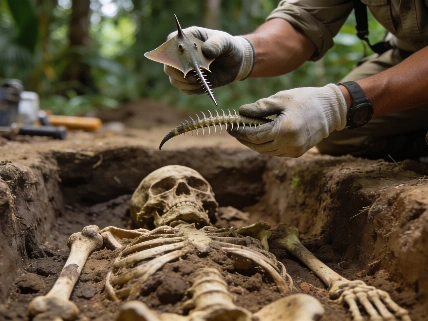
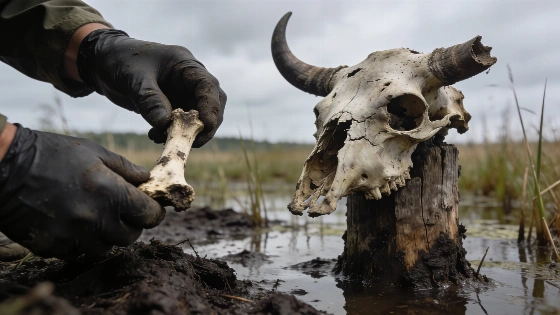
A nearly complete aurochs skull found driven onto a wooden stake near northern Germany's oldest known grave may point to a previously undocumented hunter-gatherer funerary practice, although researchers stress that the interpretation remains provisional.
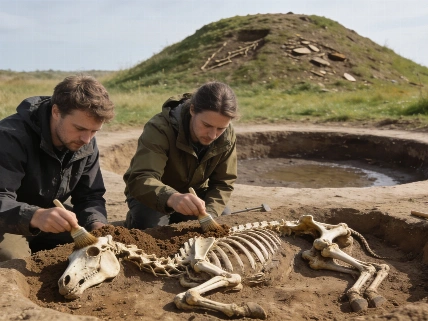
A 10,500-year-old aurochs skull found driven onto a wooden stake is forcing archaeologists to reconsider what happened around one of northern Germany's oldest known burials. The object was recovered from the Duvensee Moor near Lüchow during excavations in the summer of 2025 and lay only a few meters from a grave investigated in 2022 and 2023.
The physical evidence is unusual, but its meaning is not settled. Archaeologist Harald Lübke of the Leibniz Centre for Archaeology believes the skull may have been placed near the grave as part of a protective funerary rite. That interpretation depends heavily on the spatial relationship between the two finds and on determining how the wooden element was attached to the animal bone. As of the latest account, published on October 3, 2026, the object is still undergoing technical examination and has not received a final interpretation.
The object and its context
The aurochs skull is broken into several fragments yet remains almost complete after more than ten millennia in the waterlogged moor. Aurochs were the wild ancestors of domestic cattle and once ranged across large parts of Europe, Asia and North Africa before becoming extinct. Their size and visual presence would have made a complete skull a conspicuous object in any humanly occupied landscape, although the discovery alone cannot establish what people intended it to represent.
The preservation is significant because saturated peat can slow the biological and chemical processes that normally destroy wood and bone. It does not, however, eliminate the effects of pressure, sediment movement or later disturbance. Fragmentation therefore has to be assessed together with the position of the pieces, the condition of the wood and the stratigraphy of the find rather than treated as proof of a particular human action.
More than 20 specialists have examined the fragments in recent months, including researchers at the Schleswig branch of the Leibniz Centre for Archaeology. Their immediate task is technical rather than symbolic: the jaw must be separated carefully from the rest of the skull so investigators can inspect the point where the wooden peg entered the bone. That observation may help distinguish a deliberately mounted skull from one that was later damaged or displaced.
That construction detail matters. A stake passing through the skull could indicate that the object was designed for display or placement at a specific location, while damage caused after deposition would support a different reconstruction. Investigators must also establish whether the wood remained in its original position and whether the bone shows cut marks, abrasion or breakage associated with insertion. Until the jaw and fragments are examined in relation to the wood, the object's original arrangement remains uncertain.
A possible funerary practice
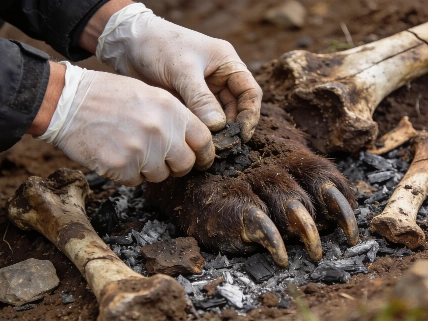
The nearby grave provides the strongest reason to consider a mortuary interpretation. Researchers believe hunter-gatherers in the region cremated their dead and buried the remains with material from the funeral pyre. The aurochs skull may indicate that animal remains were also mounted on wooden stakes around or close to such a burial, but no broader pattern has yet been reported from the site.
Lübke considers the proximity of the skull and grave unlikely to be accidental and has proposed that the animal remains were intended to protect the buried person. This is a plausible reading of the location, not a demonstrated belief system. The find does not by itself prove that the skull was part of a formal ritual, that it was placed during the burial, or that similar practices were common among post-Ice Age communities.
Nor can the skull establish the identity of the person buried nearby or explain the relationship between the animal and the dead. Archaeological association is strongest when an object is securely documented in its original position and when its construction, stratigraphy and chronology align. Here, the proximity is important evidence, but the reported interpretation still depends on further excavation and reconstruction.
The evidentiary standard is comparable to that used in peer-reviewed archaeological work published in journals such as Nature: a striking association can generate a hypothesis, but its strength depends on independently testable observations. In this case, those observations include the wood-bone interface, the depositional sequence and the dating relationship between the skull, stake, grave and surrounding peat.
A wetland under pressure
Duvensee has been investigated for about a century, and more than 20 prehistoric sites have been documented across the moor. The area preserves organic materials unusually well because waterlogged sediments can slow the decay of wood and bone. That same preservation makes the site valuable for studying hunter-gatherer life before permanent farming settlements appeared in northern Europe. The Leibniz Centre for Archaeology is among the institutions contributing specialist expertise to this continuing work; institutional information is available through the DFG research profile.
The preservation system is now weakening. The moor is gradually drying, exposing organic remains to conditions in which they can deteriorate. Further fieldwork was announced for summer 2026, and researchers hope to find the remains of a prehistoric boat that could provide evidence for travel across the area's lakes and waterways. The progress of that work may also clarify whether the skull belongs to an isolated event or to a wider pattern of activity.
The urgency is practical rather than theatrical: once waterlogged wood and bone begin to decay, information that survived for thousands of years can disappear before it is documented. As with the ice-preserved arrow described in an earlier report, preservation is not merely a backdrop to archaeological interpretation; it determines which kinds of evidence remain available to study.
A date described as 10,500 years old is a chronological claim about the object or its archaeological setting, but the available account does not identify the dating method, sample material, calibration range or laboratory result. Radiocarbon dating, if used, would provide a probability range rather than a precise calendar year and would need to be linked carefully to the skull, stake or surrounding deposit. Without those details, the age should be treated as reported rather than as a fully documented analytical result.
The same caution applies to the proposed burial ritual. The skull is a rare and well-preserved find with a potentially important association, but its strongest contribution is to open a testable archaeological problem: whether mounted animal skulls formed part of funerary practice at Duvensee. Until the wood-bone connection, depositional context and chronology are established, the responsible conclusion is narrower and more useful-the object records a possible episode of deliberate human modification, while its ritual purpose remains a hypothesis rather than a fact.