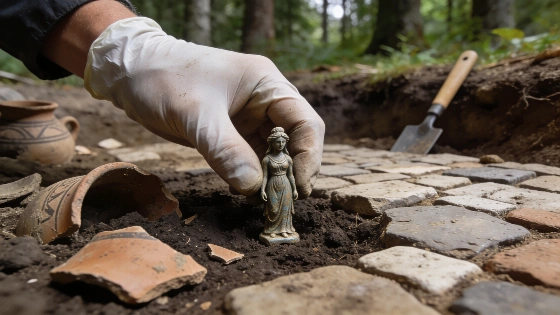
A lead Venus Pudica found during the fourth excavation season at Pilisszentiván is the first known religious object from the Roman vicus, while associated finds illuminate personal equipment, work and monetary circulation.
A small lead figure has become the most consequential find of the 2026 excavation at Pilisszentiván-Hárs Forest. Identified as a Venus Pudica statuette, it is currently the first known religious object recovered from the Roman vicus, a settlement whose wider assemblage points not only to belief but also to clothing, work, household activity and exchange.
The statuette was recovered during a metal-detector survey rather than from a sealed architectural deposit. That distinction matters. The figure demonstrates that an image associated with Venus was present in the settlement's archaeological record, but its precise use, original position within the vicus and relationship to a particular building remain unresolved. Metal detection can locate objects beyond excavated structures, yet subsequent interpretation depends on careful spatial recording, soil observations and comparison with nearby features.
Venus Pudica refers to a recognizable artistic type in which the goddess is shown attempting to cover her body. The excavation reports identify the piece as lead, but the available account does not provide its dimensions, manufacturing details, mould evidence or secure archaeological date. Without those data, the object should be treated as evidence for religious material culture at the site rather than as a complete explanation of local worship.
The find is important precisely because it expands the known range of activity at the vicus without proving the existence of a shrine. A small figurine could have been a personal devotional item, a domestic object or a portable representation whose original context was later disturbed. Typological comparison, microscopic study of manufacturing traces and, where conservation permits, non-destructive compositional analysis could help distinguish among those possibilities.
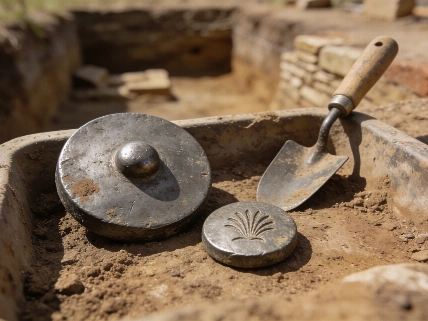
The statuette was one element in a broader group of finds. Archaeologists also recovered a fragment of a leaded-bronze mirror, iron tools, fibulae used to fasten clothing and coins. Each category offers a different line of evidence: the mirror and brooches relate to personal equipment, the tools to practical work and the coins to monetary use or circulation. None of these objects alone identifies the occupants' status or occupation.
The 2026 campaign was the fourth research season at Pilisszentiván-Hárs Forest and concluded on 23 September. Bence Simon of the Department of Ancient Archaeology at ELTE led the project with archaeology students, staff from Archeovertex Kft. and volunteers from local community organisations. Support came from the National Cultural Fund and Pilisszentiván Municipality.
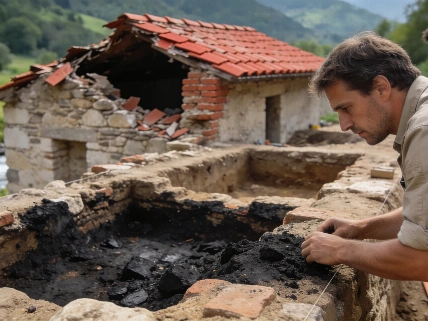
The excavation area lies near Hársas-forrás, where the 2026 fieldwork concentrated on buildings already identified in earlier seasons. Researchers aimed to establish the extent of those structures and determine how they were used. In the residential area and in the northern room or forecourt of Building E, they found a stone-slab surface comparable to paving around other houses. The team considers it potentially associated with economic or working activity, but the feature's function has not been demonstrated.
The season produced a defined set of reported results: one lead Venus Pudica statuette, one fragment of a leaded-bronze mirror, iron tools, fibulae, coins, a paved surface and a rubble layer containing pottery and an intact pair of iron tongs. The published accounts do not report a statistical sample size, confidence interval or p-value; those measures would not by themselves resolve the central archaeological questions, which depend primarily on stratigraphy, spatial association and object formation processes.
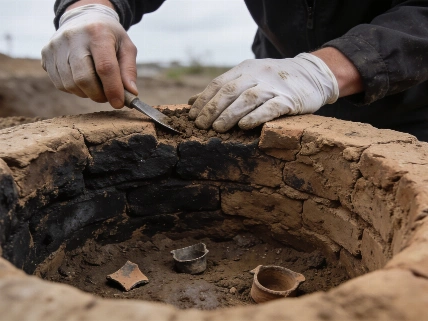
At the northern end of the excavated area, the rubble layer contained a substantial quantity of pottery, including some complete vessels. The intact iron tongs are especially useful because they preserve a functional object within the same deposit, although the available report does not establish whether the pottery and tools were discarded together in one event or accumulated over time.
That uncertainty is not a technical footnote. Archaeologists distinguish between an object's presence at a site and proof of how it was used. A building associated with paving may have supported production, storage or another economic activity; a group of vessels may represent discard, breakage or abandonment; and a metal-detected object may have been moved from its original position. Analysis of the features and finds is therefore essential before the settlement's layout can be assigned a firm social or economic interpretation.
This provenance-first approach is consistent with the evidentiary standards used in archaeological science and discussed across specialist research, including Nature's archaeology coverage. At Pilisszentiván, future work could combine plans and elevation data with ceramic classification, conservation records, metallurgical examination and spatial analysis. Such methods would clarify whether the Venus was associated with domestic space, circulation routes or activity areas, but no such conclusions should be presented before the analyses are completed.
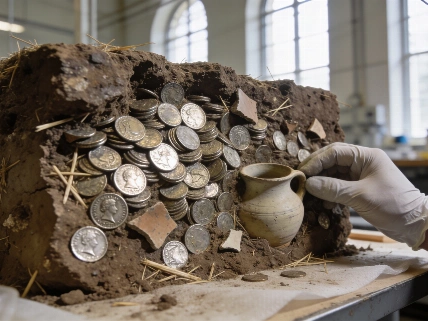
The evidence is nevertheless strong enough to move the site beyond a simple map of Roman structures. The finds connect architecture with activities that took place inside and around it, while the Venus figure adds a religious dimension previously absent from the known record of the vicus. Comparable Roman discoveries in the region can provide context, including Roman coin evidence, but the Pilisszentiván assemblage is not a hoard and should not be interpreted as one.
The broader interpretive framework also resembles the cautious object-centred practice used in laboratory-based archaeology, including research associated with the Max Planck Society: material composition, manufacturing traces and depositional history are complementary evidence streams rather than substitutes for archaeological context. In this case, laboratory work may refine the figurine's technological and chronological profile, but it cannot recover a lost original context if the object was displaced before recording.
Fieldwork for 2026 has ended, while analysis continues. Researchers hope to return next year, with the development of the settlement, the functions of its buildings and the identities of its inhabitants still open to investigation. The responsible reading of the Venus statuette is therefore neither that it explains the vicus nor that it is an isolated curiosity: it is a research lead whose value will depend on its relationship to the settlement's structures and deposits.
Archaeological provenance means more than knowing that an object came from a particular modern site. It includes the object's position, layer, association with structures and relationship to other finds; a metal-detected artifact may retain historical value while offering less secure evidence about its original use. At Pilisszentiván, that distinction keeps the interpretation proportionate to the evidence. The Venus statuette matters because it expands the material record of the vicus, but the settlement's everyday life will be reconstructed from the combined analysis of objects, architecture and deposits rather than from one striking figure.