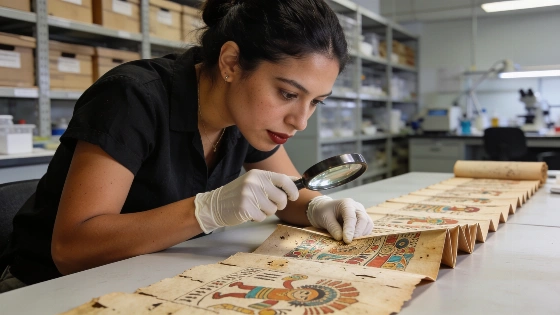
A new radiocarbon analysis of the Aubin Tonalámatl Codex places its creation firmly in the late 15th century, resolving long-standing doubts about whether this Indigenous Mexican manuscript predates Spanish colonization
For decades, the true age of the Aubin Tonalámatl Codex-an 18-sheet divinatory manuscript central to Indigenous Mexican ritual-remained uncertain, with scholars divided over whether it was a genuine pre-Hispanic artifact or a colonial-era imitation. That debate has now been decisively shifted by new radiocarbon dating, which places the codex's production in the late 15th century, before the Spanish conquest of central Mexico.
Scientific Dating and Material Evidence
The latest analysis, conducted through collaboration between Mexico's National Library of Anthropology and History and the University of Colorado Boulder, used accelerator mass spectrometry to date the amate paper of the codex. The results indicate the raw material was likely prepared around 1424 CE, with the manuscript itself produced no earlier than 1450 CE. Researchers propose 1494 CE as the most probable year of completion, but emphasize that the radiocarbon range is broader and does not pinpoint a single calendar year.
The codex consists of 18 sheets of amate paper, each approximately 24 by 27 centimeters, joined to form a continuous strip nearly 4.9 meters long and folded in an accordion-style screenfold. Unlike some comparable manuscripts, the Aubin Tonalámatl lacks the chimaltizatl coating, a detail that previously complicated efforts to establish its chronology and authenticity.
Scientific examination extended beyond dating. Specialists in physics, chemistry, biology, and archaeology analyzed the pigments, manufacturing techniques, and evidence of pentimenti-alterations made during the manuscript's creation. These technical studies, published in a new volume released at the International University Book Fair in 2026, reinforce the conclusion that the codex's imagery and materials are consistent with pre-Hispanic traditions.
Historical Context and Survival
The Aubin Tonalámatl Codex was originally used for divination and the interpretation of destinies within the tonalpohualli, the 260-day sacred calendar of central Mexico. Its pictographs depict deities and symbols associated with successive 13-day periods, providing a rare surviving record of pre-conquest religious and calendrical knowledge.
Following the Spanish conquest, Indigenous religious manuscripts were systematically suppressed. The new research reconstructs a likely history of concealment for the Aubin Tonalámatl: the codex appears to have been deliberately hidden between 1614 and 1648 CE, possibly as an act of resistance to colonial religious policies. Italian antiquarian Lorenzo Boturini is believed to have acquired the manuscript around 1740, long after its original context had been disrupted.
Preservation of the codex through centuries of prohibition is not merely a matter of chance. The study's authors argue that its concealment reflects a deliberate effort to protect Indigenous knowledge from colonial erasure, allowing elements of pre-Hispanic worldview to persist in secret for generations.
Interpretation, Comparison, and Uncertainty
Prior to this scientific dating, some scholars had dismissed the Aubin Tonalámatl as a colonial copy of the Codex Borbonicus, citing stylistic similarities and certain artistic features such as the depiction of the "flower" glyph and layered pigments. Others questioned whether the manuscript's materials and iconography could be reconciled with a pre-conquest origin.
The new radiocarbon evidence does not resolve every question. While the dating of the paper and pigments supports a late 15th-century production, the codex's precise place of manufacture and the identities of its creators remain unknown. The lack of a secure archaeological provenance-common for manuscripts that survived colonial suppression-limits the certainty with which broader cultural conclusions can be drawn.
Nevertheless, the technical findings now provide a robust scientific basis for classifying the Aubin Tonalámatl as a pre-Hispanic manuscript. This places it among the rare surviving witnesses to Indigenous religious and calendrical practice, comparable in significance to the Codex Borbonicus and other screenfold manuscripts of central Mexico.
Recent research into ritual and iconography at other Andean and Mesoamerican sites, such as the earlier breakdown of stone figures at Kuélap, highlights the diversity and resilience of Indigenous traditions under colonial pressure.
Limits of the Evidence
The Aubin Tonalámatl's journey-from its creation in the late 15th century, through clandestine preservation, to eventual acquisition by European collectors-illustrates both the fragility and endurance of Indigenous cultural heritage. The absence of a secure excavation context means that some aspects of its history will remain uncertain, and the possibility of later modifications or repairs cannot be excluded without further analysis.
Despite these limitations, the convergence of radiocarbon dating, material analysis, and iconographic study now makes it untenable to classify the codex as a colonial forgery. Instead, the evidence supports its status as an authentic pre-conquest manuscript, preserved against the odds through centuries of suppression and neglect. The case of the Aubin Tonalámatl demonstrates the value of multidisciplinary scientific approaches in resolving long-standing debates over authenticity and provenance, while also underscoring the ethical complexities of interpreting objects that survived colonial violence and cultural loss.
Radiocarbon dating, the method used to establish the age of the Aubin Tonalámatl Codex, measures the decay of radioactive carbon-14 in organic materials such as paper or parchment. Accelerator mass spectrometry allows for precise measurement of tiny samples, but the resulting date range reflects when the raw material was last alive-not necessarily the exact year the manuscript was produced. Calibration against known atmospheric carbon fluctuations is required to convert radiocarbon years into calendar dates, and contamination or reuse of older materials can complicate interpretation. In the case of the Aubin Tonalámatl, the close agreement between the date of the paper and the likely period of manuscript production strengthens the case for its pre-conquest origin, but does not eliminate all uncertainty about its subsequent history or possible later interventions.