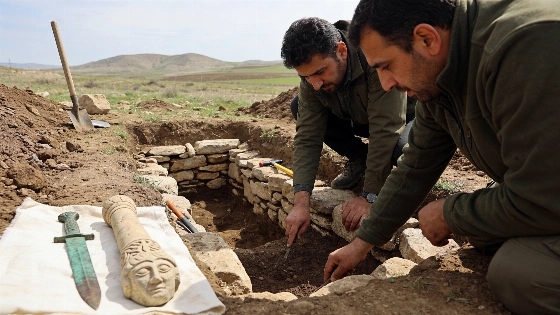
A 3,600-year-old burial mound at Keşikçidağ in Azerbaijan has yielded a bronze dagger, obsidian and flint arrowheads, and a carved stone staff head, offering new evidence for social hierarchy and military roles in the Middle Bronze Age South Caucasus
Archaeologists at the Keşikçidağ State Historical-Cultural Reserve in Azerbaijan have uncovered a Middle Bronze Age burial containing both weaponry and a carved stone staff head. The find adds to ongoing discussions about the rise of social and military elites in the South Caucasus around 3,600 years ago. The burial, tentatively dated to the 17th-16th centuries BCE, was excavated from Kurgan No. 4 in the Sarıyokuş area of Ağstafa district. This site is part of a protected archaeological zone established in 2007, which includes caves, fortifications, and temples. Local documentation highlights the region's archaeological importance.
Weapons and ceremonial objects
The burial chamber contained a bronze dagger and eleven stone arrowheads-two made from black obsidian and nine from flint. Obsidian is not found locally, so its presence points to long-distance exchange or access to distant sources, as noted in comparative studies by the Max Planck Society and in Nature. The combination of dagger and arrowheads suggests the person may have had a martial role, but the evidence does not confirm their occupation or identity.
Excavators also found a shaped diorite object, likely the head of a staff or scepter. It weighs between 400 and 500 grams and has a central hole, suggesting it once held a wooden or bone shaft. Similar objects from the Bronze Age have been interpreted as symbols of authority, possibly linked to leaders or military figures, though their exact function is still debated. The regular, symmetrical stonework shows a high level of skill among craftspeople of the time, a subject of interest in ongoing archaeological research.
Burial construction and context
Kurgan No. 4 is about 12 meters across and rises roughly 80 centimeters above the ground. The burial chamber extends 1 to 1.2 meters deep and was sealed with stone. The grave goods and mound construction suggest the deceased received a level of mortuary investment not typical for most community members. However, the preliminary report does not include skeletal remains or detailed osteological analysis, so age, sex, and health remain unknown.
All artifacts are now undergoing conservation and laboratory analysis. Ceramic fragments and other materials are being stabilized before joining the site's archaeological collection. Planned radiocarbon dating may clarify the burial's date, with analyses expected to involve laboratories in Tokyo and Miami. The research team has not yet published a peer-reviewed report, and all interpretations are provisional pending further study. This approach follows best practices in archaeological research, emphasizing multidisciplinary verification before drawing firm conclusions.
Material evidence and regional connections
The obsidian arrowheads are especially important for understanding regional interaction. Obsidian sources in the South Caucasus are limited, so finding obsidian in the burial is direct evidence for the movement of materials or tools over long distances. The flint arrowheads, which are more locally available, also show manufacturing techniques typical of the region's Bronze Age traditions. The Keşikçidağ reserve contains about 150 burial mounds from the Middle Bronze Age to the Iron Age, placing this find within a broader mortuary landscape and suggesting that such elite burials were part of a regional pattern.
While the burial's contents point to a person of higher status, interpreting the weapons and staff as signs of military or political authority requires caution. Similar finds elsewhere in Eurasia have sometimes been linked to elite roles, but the connection between grave goods and social identity is not always clear. As seen in previous investigations of Iron Age sites in Poland, imported materials and distinctive artifacts can reflect a range of social, economic, or symbolic factors.
Uncertainties and next steps
For now, the Keşikçidağ burial offers a partial view of Middle Bronze Age society in the South Caucasus. Without published osteological data, the individual's sex, age, and health are unknown. Interpretations of status or role must rely on the grave goods and their context, which can be read in different ways. Some researchers with the Azerbaijan National Academy of Sciences have suggested a later date, at the transition from the Late Bronze to Early Iron Age, showing that the debate is ongoing and more scientific validation is needed.
Further analysis, including radiocarbon dating and material studies, will be needed to clarify the burial's date and the source of the obsidian. Only with more data can researchers place this burial within broader patterns of social organization, exchange, and burial practice in the region. Until then, the Keşikçidağ mound highlights both the potential and the limits of archaeological interpretation when skeletal evidence is missing. The careful recovery and ongoing study of these finds reflect a commitment to evidence-based research in South Caucasus archaeology, but firm claims about hierarchy or identity will have to wait for more complete results.
Understanding the meaning of grave goods in archaeological burials depends on context. Objects like weapons or staff heads may signal social status, symbolic authority, or personal identity, but their meaning depends on their association with the body, the grave's construction, and the wider burial landscape. Without skeletal remains or detailed documentation of burial position, archaeologists must rely on the material evidence and its context, recognizing that interpretations are always provisional and may change as new data become available.