Archaeologists at Kuélap in northern Peru have uncovered carved stone figures depicting animals with female traits, offering new evidence for fertility-related rituals and the influence of Inca religious practices at the site
Recent excavations at the monumental hilltop settlement of Kuélap in northern Peru have revealed a group of small carved stone figures, interpreted as ritual objects linked to fertility, reproduction, and household protection. The discovery, announced by Peru's Ministry of Culture, adds to the growing body of evidence for complex ritual practices at this major pre-Columbian site.
Excavation Context and Artifact Description
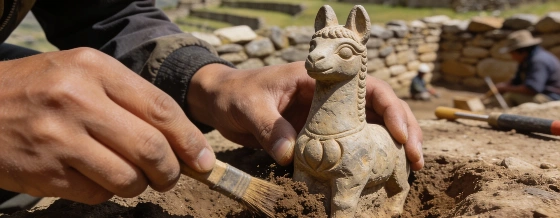
The stone figures, known locally as illas, were recovered from controlled archaeological contexts within Kuélap's extensive architectural remains. These objects depict animals-primarily camelids such as llamas and alpacas-rendered with pronounced female anatomical features. The figures are carved from stone and share characteristics with conopas, a class of ritual objects documented from the Inca period and associated with fertility, abundance, and the protection of livestock and crops.
Some conopas are known to contain small cavities for offerings, including camelid fat, coca leaves, or chicha, a fermented beverage. The illas from Kuélap do not all preserve such cavities, but their iconography and form suggest a similar ritual function. The presence of these figures within Kuélap's stratified deposits provides secure archaeological context, allowing researchers to examine their association with both local Chachapoya traditions and broader Andean religious practices.
Ritual Practice and Political Integration
Archaeological and ethnohistorical research indicates that conopas and related objects were not limited to private household rituals. In the Inca state, such artifacts could play a role in reinforcing relationships between families, sacred places (huacas), and imperial authority. The newly discovered illas may reflect the adaptation or continuation of these practices at Kuélap during the period of Inca expansion, known as the Late Horizon (ca. 1470-1532 CE).
The female characteristics emphasized on the Kuélap figures are particularly significant, as they may provide direct evidence for beliefs about reproduction and fertility at the site. Researchers are investigating whether these objects represent a continuation of earlier Chachapoya traditions, the adoption of Inca ritual forms, or a hybridization of both. The stratigraphic association of the illas with Late Horizon occupation layers supports the interpretation that they were used during or after the region's incorporation into the Inca Empire.
Material Evidence and Chronological Range
Kuélap is best known as a fortified settlement of the Chachapoya culture, which occupied the cloud forests of northern Peru prior to Inca conquest. Archaeological evidence confirms that the site remained inhabited during the Late Horizon, with material culture reflecting both local and imperial influences. The illas were recovered from well-documented excavation units, and their stylistic features are consistent with ritual objects from the Inca period found elsewhere in the Andes.
While the precise number of illas recovered has not been published, the collection includes multiple examples with varying degrees of preservation. The figures' association with domestic and ceremonial contexts at Kuélap allows for comparison with similar finds from other Andean sites. This approach mirrors research at Marcahuamachuco, where the discovery of a puma-headed ceramic vessel and animal remains has provided new insights into ceremonial practices and daily life at another major highland settlement (see coverage of Marcahuamachuco ritual ceramics).
Interpretation and Uncertainty
The interpretation of the Kuélap illas as fertility-related ritual objects is supported by their iconography, archaeological context, and parallels with Inca-period conopas. However, the precise meaning and use of these figures remain open to further investigation. It is not yet clear whether the objects represent a direct continuation of Chachapoya beliefs, a local adaptation of Inca religious forms, or a synthesis of both traditions. Further analysis of their depositional context, associated offerings, and spatial distribution within the site may clarify their role in household and community ritual.
Researchers caution that while the illas provide valuable evidence for ritual practice, their symbolic meaning cannot be established with certainty in the absence of written records or direct ethnographic continuity. The discovery nonetheless highlights the dynamic interaction between local and imperial traditions in the Andes during the Late Horizon, and underscores the importance of secure archaeological context for interpreting ritual objects.
In archaeological research, the concept of archaeological provenance is central to interpreting artifacts such as the Kuélap illas. Provenance refers to the documented origin and context of an object within an excavation, including its stratigraphic position, association with other materials, and recovery method. Secure provenance allows researchers to link artifacts to specific cultural phases, activities, or social groups, while objects lacking context-such as those acquired through the antiquities market-offer limited interpretive value. The illas from Kuélap, recovered from controlled excavations, provide a strong foundation for ongoing analysis of ritual practice and cultural change in the ancient Andes.