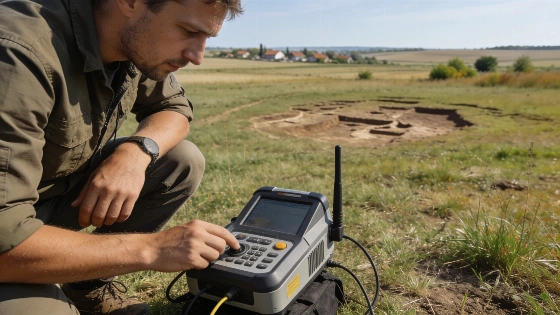
A new survey of Opovo Ugar-Bajbuk in Serbia combines surface collection, geophysics, drilling and targeted excavation to expand the site estimate from five hectares to more than nine and from about 200 residents to over 700.
Opovo Ugar-Bajbuk was not the modest Neolithic settlement archaeologists once imagined. New investigations indicate that the Vinča culture site covered more than nine hectares and may have supported more than 700 people at its peak. The revised estimate is based on the distribution of mapped structures, not on a direct count of individuals.
That is a major change built from buried evidence rather than a wholesale excavation. A detailed research report describes how the new survey more than doubled the estimated footprint of the settlement compared with interpretations based on excavations in the 1980s.
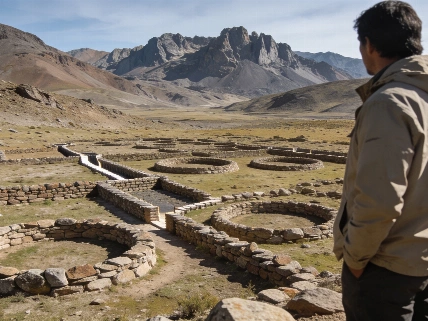
Located in Vojvodina within the southern Banat region of present-day Serbia, Opovo was partially excavated during the 1980s. Those earlier investigations placed its extent at roughly five hectares and suggested a population of about 200 inhabitants. The site was interpreted as a relatively small agricultural settlement or a moderately active center within wider exchange networks.
A German-Serbian research team reassessed that interpretation between 2022 and 2024. Researchers from Kiel University, the National Museum of Pančevo, the Museum of Vojvodina and the University of California, Berkeley, combined systematic surface collection with magnetic geophysical survey, geoarchaeological drilling and a targeted excavation of one surrounding ditch.
The updated reconstruction identifies as many as 220 possible house structures. The population figure is therefore an estimate derived from the mapped settlement and its buildings rather than a direct census of residents. The qualification matters: geophysical anomalies can indicate buried architecture, but they still require archaeological interpretation and, in some cases, excavation.
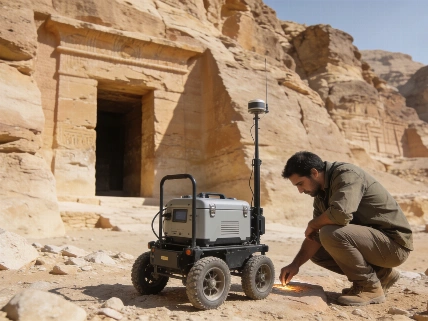
The team deliberately limited excavation. Archaeological material was first collected systematically from the surface, after which geophysical methods were used to map features below ground without removing the deposits that contain them. Drilling at selected points provided geoarchaeological information, while the focused ditch excavation offered a physical check on part of the mapped perimeter.
That combination gives Opovo a stronger spatial record than the earlier excavations alone could provide. It also leaves most of the settlement undisturbed, an important advantage when researchers need to revisit the site with improved methods or answer questions that the current survey cannot resolve. The approach separates three kinds of evidence: the measured geophysical signal, the geological context recorded by cores and the directly observed archaeological material.
Updated radiocarbon dating places the principal occupation between approximately 4850 and 4725 BCE. Radiocarbon results define a calibrated time window rather than a single founding or abandonment year, but the interval supports a more sustained occupation than the earlier picture allowed. The researchers distinguish two occupation phases and report that the settlement expanded over time, rather than treating the mapped houses as one frozen plan.
The result fits a broader pattern in southeastern Europe, where Neolithic communities developed farming, craft production, exchange and long-lived settlements before such practices spread more widely across the continent. Vinča communities were among the later Neolithic populations of the Balkans and are associated with distinctive pottery and stone artifacts as well as extensive regional connections.
The size of Opovo is not the only finding with interpretive weight. Differences in house dimensions suggest that economic disparities existed but were comparatively limited. Professor Martin Furholt, a co-author of the study and spokesperson for the ROOTS Cluster of Excellence, argues that the available evidence does not point to pronounced social stratification.
The settlement was also bordered in places by as many as five perimeter ditches. Such construction required substantial collective labor, but the investigation found no archaeological evidence that this work was imposed through coercion. The researchers instead propose that the earthworks may have been organized cooperatively rather than directed by a strongly hierarchical authority.
That interpretation should remain provisional. House size and ditches can show differences in construction and the capacity to coordinate labor, but they cannot by themselves identify leadership systems, political institutions or the motives of individual residents. The evidence supports a large community capable of major communal projects; it does not provide a complete social biography of that community. Separating observation from inference reflects the evidentiary discipline expected in peer-reviewed research published in journals such as Nature and Science.
The methodological lesson is equally concrete. As with another settlement study, the archaeological meaning lies in relating structures to their setting rather than treating an impressive feature count as a standalone answer.
Opovo now ranks among the largest known settlement sites from the end of the Neolithic in southern Banat. Its revised scale makes it a useful case for studying population growth, settlement expansion and interaction across the Balkans, while comparisons with other sites will be needed before broader regional conclusions can be secured.
The strongest conclusion is measured but significant: modern non-destructive survey has changed the site from a small settlement estimate into evidence for a large and organized Neolithic community. It has also shown why older excavation plans can underrepresent settlements whose architecture extends beyond the areas selected for digging.