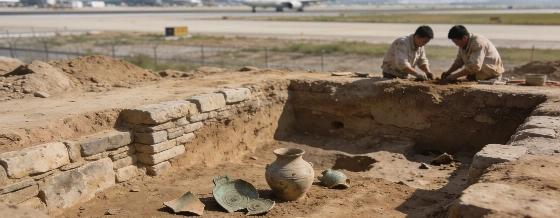
A looted royal tomb beside Xi'an Xianyang International Airport contains a 2,250-year-old burial complex whose date, architecture and associated burials point toward Empress Dowager Huayang, although no inscription has conclusively identified the occupant.
A royal tomb beside Xi'an Xianyang International Airport may belong to Empress Dowager Huayang, the Qin figure whose family connections helped place Qin Shi Huang on the path to unifying China. Archaeologists classify the Shangzhaoyao Qin Mausoleum as a royal-level burial from the late Warring States period, but the identification remains a research hypothesis rather than a confirmed attribution. Looting removed much of the burial evidence, and no inscription, identifiable human remains or other object naming the occupant has been reported.
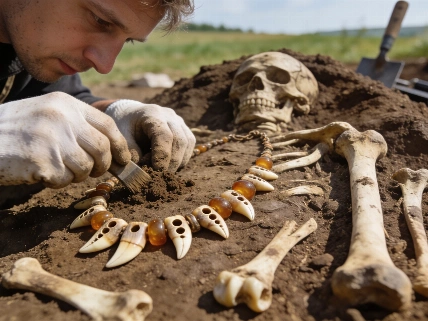
What survives is a large tomb with an independent cemetery and a standardized necropolis layout. Archaeologists have recorded 45 secondary graves around the principal mausoleum. In a separate analysis of 43 sets of remains, biological sex could be determined for 30 individuals, and all 30 were female. That pattern may be relevant to the organization and social meaning of the cemetery, but it does not by itself establish the identity of the person in the main tomb.
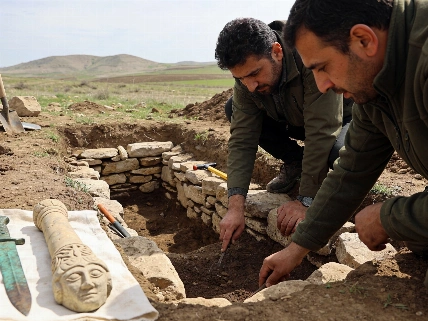
Researchers have recovered 258 objects despite extensive looting, including pottery and artifacts made from bronze, iron, jade, agate and glass. The combination of the tomb's scale, its "imperial" structural features, the standardized plan of the necropolis and the typology of the associated material places it within the royal burial tradition of the ancient Qin state. Zhao Hanqing of the Shaanxi Academy of Archaeology has emphasized that this conclusion depends on the convergence of architectural and artifact evidence rather than on a direct name inscription. The archaeological assessment is summarized in a research report.
The chronological evidence is unusually important because it narrows the historical field. Radiocarbon dating of bones from the complex produced a range of 389 to 208 BCE, while Huayang is recorded as having died in 230 BCE. The range does not identify an individual, but it is compatible with her lifetime and excludes the initial assumption that the complex belonged to a ruler of the Northern Zhou dynasty, which governed the region from 557 to 581 CE.
Radiocarbon dating measures the decay of carbon isotopes in once-living material and produces a probability range rather than a name or an exact calendar year. The result must therefore be interpreted alongside archaeological context, stratigraphy and material culture. As in archaeological studies discussed in journals such as Nature and PNAS, chronological compatibility is evidence that narrows possibilities, not proof of personal identity. The 389-208 BCE interval is consistent with Huayang's death in 230 BCE, but it could also include other people who lived during the same period.
The investigation began with a survey in 2018 after the land was designated for airport expansion. Further work in the northern part of the cemetery followed in 2022, allowing researchers to reconstruct more of the burial complex before comparing it with Qin funerary architecture. In a separate example of why burial layout must be read alongside chronology and context, an earlier burial survey also showed how form alone cannot establish the identity or status of the people interred.
Historical records make Huayang a plausible candidate because her position was political as well as familial. She married the Qin prince who became King Xiaowen. The couple had no sons, so Huayang adopted Ying Yiren, an impoverished Qin prince who had been sent to another state as a political hostage.
Ying Yiren succeeded King Xiaowen after the king's brief reign. His son later became Qin Shi Huang, who defeated the remaining rival states and established the Qin dynasty in 221 BCE. Huayang was therefore the future emperor's adoptive grandmother and part of the succession network that preceded the creation of a unified imperial China.
Researchers have used that historical connection together with the tomb's date, size, location and layout to favor a woman of imperial status as its occupant. Zhao Hanqing identified Empress Dowager Huayang as the most likely owner in a paper published in the Chinese journal Archaeology and Cultural Relics. However, "most likely" remains an interpretation: it is not supported by a surviving official inscription, a securely identified skeleton or an artifact bearing her name.
The main difficulty is spatial. Historical accounts describe Huayang as buried alongside King Xiaowen at Shouling on the Xianyang Plain, yet the king's burial site is approximately 2.3 kilometers from the newly studied tomb. The distance does not eliminate the Huayang hypothesis if "combined burial" referred to neighboring but separate mausoleum complexes rather than one shared cemetery.
That possibility fits a change in Qin royal funerary practice. Earlier tradition placed a king and queen in the same burial arrangement, but King Xiaowen had two wives and that practice was discontinued. Separate mausoleums for kings and queens became an important feature of Qin royal architecture, a development that researchers connect to the burial system later used for Qin Shi Huang and the mausoleum associated with the Terracotta Army.
Yet the archaeological record still cannot establish who lay in the tomb. Looting has removed potentially decisive objects, no inscription survives, and the recovered bones have not produced an identifiable individual. The case rests on convergence: a Qin royal setting, a compatible date, a high-status layout, 45 surrounding secondary graves, a group of predominantly female remains in the separately analyzed sample and a historical candidate whose life intersects with the transition to imperial rule.
The strongest conclusion is therefore limited and useful. Shangzhaoyao is a Qin royal burial complex from the right historical window, and Huayang is its leading proposed occupant. Further progress would require evidence such as a secure inscription, a named funerary object, improved osteological identification or additional dating and contextual analysis. Until such evidence appears, the tomb should be presented as a scientifically argued attribution rather than a confirmed imperial burial.