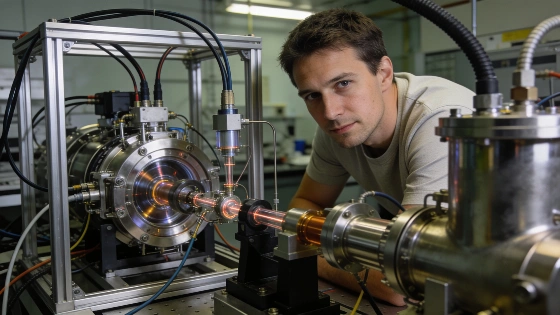
Matthias Troyer's assessment of quantum computing points to chemistry as the clearest near-term application while error correction, data movement, hardware architecture and end-to-end cost determine whether larger systems will become scientifically useful.
Quantum computing will not become useful simply by accumulating more qubits. In an interview with Global Quantum Intelligence's George Schwartz, Matthias Troyer of Microsoft argues that practical value depends on the full system cost and on whether a machine can solve a problem that classical computers cannot handle efficiently. That standard is increasingly shared across the field: a credible milestone should connect a quantum calculation to a measurable scientific result, validation against experiment or a sustained logical operation, rather than to a headline physical-qubit count.
That distinction also explains why comparisons with research programs at MIT and other major laboratories focus increasingly on logical performance, error rates and workload-level results. A physical qubit is an individual quantum system, whereas a logical qubit distributes information across multiple physical resources so that errors can be detected and corrected. The quantities are therefore not interchangeable, and a logical-qubit count alone does not establish computational utility.
Troyer identifies quantum chemistry as the clearest route to commercial value. Molecular simulation maps naturally onto quantum systems, but it still demands substantial classical computation around the quantum processor. Preparing the problem, measuring the result and checking its accuracy all require classical resources. Materials science and quantum chemistry are also among the application areas emphasized in recent neutral-atom research reviews, which describe the platform as progressing beyond simulation toward demonstrations involving error-corrected logical qubits.
That surrounding work is not a footnote. Classical embedding problems can determine whether a chemistry calculation is useful at all, and Troyer points to AI as one way to improve those interfaces. AI could help accelerate parts of the classical workflow that place molecular models into a form a quantum processor can handle, while classical validation remains necessary to determine whether a predicted molecular property is physically meaningful.
Other proposed application areas face a harder economic test. Big-data workloads must move information into and out of a quantum system, while machine learning and optimization may offer only quadratic speedups in relevant settings. Those gains can disappear when data loading, measurement, error mitigation and verification are included. For that reason, the practical benchmark resembles the standards used in experimental science at institutions such as CERN: the result must survive independent checks, not merely appear in an isolated device output.
Recent field assessments place near-term science milestones at roughly 50-100 logical qubits and 10,000-100,000 hard logical operations, but these figures are targets for useful workloads rather than evidence that current machines have already reached them. The more important question is whether a processor can execute a chemically or materially relevant calculation, maintain logical fidelity throughout it and compare the result with laboratory data.
Microsoft's hardware preferences reflect that systems challenge. Troyer discusses topological and neutral-atom technologies as favored approaches and contrasts them with alternatives such as transmons. The comparison is not about a single headline qubit count. It concerns how each architecture might support control, error correction and expansion without allowing the surrounding infrastructure to dominate the calculation.
Microsoft continues to promote a topological route through its Majorana 2 program. In September 2026, the company opened a research center in Maryland where DARPA received on-site access to a Majorana 2-based system for independent evaluation. According to Microsoft's account, the processor uses a materials stack that replaces aluminum with lead and combines indium arsenide with indium arsenide antimonide; the company says this more than doubled the topological gap relative to its previous generation.
Microsoft also claims that the new generation of topological qubits is approximately 1,000 times more reliable than the preceding generation, with an average qubit lifetime of about 20 seconds and individual measurements exceeding one minute. These are company-reported performance figures, not a substitute for a complete fault-tolerant demonstration. Their significance will depend on how the measurements were obtained, how reproducible they are across devices and whether the improvement survives the additional control and decoding overhead of a large processor.
Topological qubits are presented as a route toward reducing the burden of protecting quantum information, while neutral-atom systems offer a different path to building larger controllable arrangements. Microsoft's partnership with Atom Computing applies its error-correction technologies to neutral-atom hardware, framing the platform as an alternative scaling strategy that does not depend solely on increasing the number of physical qubits. Neither description amounts to a completed fault-tolerant machine; architecture must ultimately be judged by the resources required for a useful answer.
A recent error-correction report illustrates why that distinction matters: improvements in physical hardware do not by themselves establish a useful logical processor. Real-time feedback and correction must operate alongside the qubits rather than being added only after an experiment has finished.
A recent academic review of neutral-atom systems likewise describes progress from quantum simulation toward error-corrected logical qubits and identifies materials science and quantum chemistry as promising application domains. The review is a preprint rather than a final peer-reviewed record, so its claims should be interpreted as an evolving assessment of the field rather than as a settled performance benchmark. Its importance lies in the direction of evaluation: logical operations and experimentally testable science are replacing raw device size as the central questions. This transition is consistent with the broader measurement culture associated with journals such as Nature, where reproducibility and comparison with independent experiments are essential to a strong claim.
Troyer proposes evaluating quantum systems through end-to-end cost measured in "dollars per solution" rather than relying on vanity metrics. The proposed measure forces comparisons to include control hardware, classical computing, cooling or other infrastructure where relevant, and the cost of repeating an experiment until its answer is trustworthy.
He also describes a four-dimensional framework for logical-qubit capability based on fidelity, scale, performance and capability. These dimensions separate a logical qubit that is accurate from one that is numerous, and a system that runs quickly from one that can perform a meaningful task. Fidelity describes how closely an operation or state matches its target, but useful computation also requires scale, speed and continuous error management.
A more demanding definition of a scalable logical qubit has also been proposed in recent work co-authored by Troyer. Under that standard, a logical qubit must support long computations, a complete set of fault-tolerant operations and eventual scaling to hundreds or thousands of logical qubits. This is a substantially higher bar than demonstrating a single protected state or a short error-correction cycle.
The interview supplies few device-level figures because it is a strategic assessment rather than a processor demonstration. Its measurable anchors are the four evaluation dimensions, the dollar-per-solution metric and Microsoft's roadmap for post-quantum cryptography compliance by 2029. The roadmap is a planning target, not evidence that a fault-tolerant quantum computer will exist by that date. Likewise, the supplied industry reports do not provide a common sample size, confidence interval or p-value for the headline hardware comparisons, so the reported improvements should be treated as claims requiring independent technical validation.
Troyer argues that the move to post-quantum cryptography should be accelerated. That transition concerns cryptographic systems running on conventional computers and is separate from quantum cryptography. The stated 2029 compliance horizon therefore belongs to security planning, while the hardware discussion concerns the longer and technically uncertain task of building a useful quantum computer.
Responsible development is equally important because quantum computing has dual-use implications and may be combined with AI. Troyer's position links technical progress to governance: systems should be assessed not only by what they can calculate but also by how their capabilities are deployed and controlled. The interview does not claim that present quantum machines can deliver broad commercial advantage or break current encryption.
The strongest lesson is a rejection of raw qubit totals as a substitute for engineering evidence. Chemistry may provide a narrow but credible application target, while optimization, machine learning and big-data proposals must overcome data movement and limited speedups. Quantum computing therefore deserves investment as a demanding systems project, but its progress should be judged by verified solutions at defensible cost rather than by increasingly impressive hardware counts.
The practical test is consequently layered: physical components must remain coherent, logical qubits must suppress errors, classical control must keep pace, and the final calculation must answer a scientific question that can be checked independently. Until those conditions are met simultaneously, claims about scale remain promising engineering milestones rather than proof of general quantum advantage.