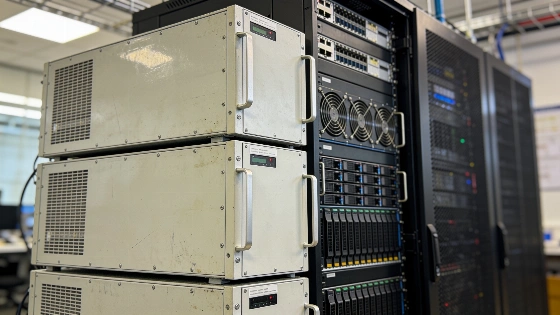
A room-temperature PT-3 system is running beside NVIDIA GPUs at a London innovation lab. ORCA reports results in protein design and energy scheduling, though its announcement leaves key benchmark methods and comparative details unspecified
A 25,755-variable energy-scheduling problem is the most concrete industrial test disclosed for ORCA Computing's new photonic system. The company says a hybrid workflow produced solution quality competitive with commercial optimization solvers, and ran 12 times faster than on its predecessor hardware. The workflow completed the benchmark in about an hour, according to ORCA. That comparison is with earlier ORCA hardware-not evidence that the system outperformed classical computers.
A photonic system in London
On October 15, 2026, ORCA announced the launch of PT-3, the third generation of its room-temperature photonic quantum architecture. Its first operational system is live at the Digital Realty Innovation Lab (DRIL) in London, alongside NVIDIA accelerated computing infrastructure. The arrangement is hybrid: classical GPUs and the photonic system contribute to workflows, rather than the quantum machine replacing conventional computing. NVIDIA described the system's London deployment in its announcement on UK investments.
ORCA specifies 64 photons across 128 qumodes, with the system drawing 6 kW and occupying two standard data-center racks. PT-3 encodes information in light rather than superconducting circuits. These are useful deployment details, but they do not describe the machine's computational performance by themselves. The announcement does not provide such measures as circuit depth, error rates, run time for the complete workflow or independent verification of the results.
Two reported workloads
In a life sciences test, PT-3 was used with 32 NVIDIA Hopper GPUs to extend NVIDIA Proteína, a generative protein-design model. NVIDIA reports that the hybrid extension improved the identification of useful proteins by 20% compared with a classical baseline; it also generated proteins with a different distribution of secondary structures. The announcement does not give numerical metric values or enough methodological detail to assess how the outputs were scored, how many designs were tested or how the comparison was controlled.
The industrial test focused on JIJ's hybrid workflow for a unit commitment problem: scheduling energy generation across 25,755 variables. The work was developed with bp and the UK National Quantum Computing Centre (NQCC). ORCA reports solution quality competitive with commercial optimization solvers, alongside the more-than-12-fold speedup against predecessor hardware. Those are separate comparisons; the announcement does not state that the PT-3 workflow ran faster than the commercial solvers. The benchmark and timing were also described by Computer Weekly.
The distinction matters. A speedup against an earlier version of a company's own system establishes a relative improvement on that baseline, not a quantum advantage over the best available classical methods. Assessing the solver comparison would require details such as total workflow timing, hardware and algorithms used, and the quality criteria applied. They are not included in the information provided here.
What remains unshown
ORCA describes PT-3 as modular and field-upgradeable, and targets it at scientific generative AI and large-scale industrial optimization. Those are design and intended-use claims. The announcement does not report independent replication, peer-reviewed results or the operational measurements needed to assess reliability over time. Nor does it provide enough detail to separate the photonic processor's contribution from the GPUs and other classical parts of each workflow.
The deployment also belongs to a broader quantum-infrastructure story, though its hardware differs from a planned New York facility focused on quantum chip fabrication. ORCA's earlier PT-2 launch and molecular AI benchmarks, its energy-grid optimization white paper with JIJ, and its ongoing cuQuantum simulation integration with NVIDIA provide context for the company's development work; they do not independently establish PT-3's performance.
Qumodes and qubits are different ways of describing quantum information. A qumode refers to a mode of an optical field, while a qubit is a two-level quantum system; counting one does not directly give the number of the other. The reported 128 qumodes therefore should not be read as 128 qubits or logical qubits. The PT-3 figures describe a photonic architecture, while the disclosed benchmark results describe hybrid workflows that also use classical computing.