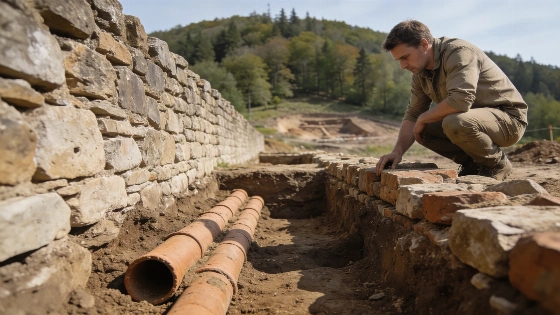
Excavations at Posa Hill have expanded the known monastery and exposed a possible early medieval tower, a monumental bishop's palace and a rare ceramic water-pipe system.
A rare medieval water pipeline is helping redraw the map of Posa Hill. Archaeologists have traced about five metres of fired-clay pipe through the former Benedictine monastery near Zeitz in Germany while also identifying a large palace and new early medieval defenses.
The 2026 excavation campaign is part of investigations that have continued since 2017. The State Office for Heritage Management and Archaeology of Saxony-Anhalt is working with the Zeitz Association for the Promotion of Archaeology and Historical Research to examine more than 700 years of activity on the site. The project combines architectural recording, stratigraphic excavation, artefact study and comparison with documentary evidence rather than relying on a single dating method.
A fortified hilltop
The earliest major phase is a fortified complex dating broadly to the ninth and tenth centuries. It covered more than eight hectares on a hill overlooking the floodplain of the White Elster. This position gave the stronghold both a defensible setting and control over a landscape shaped by the river.
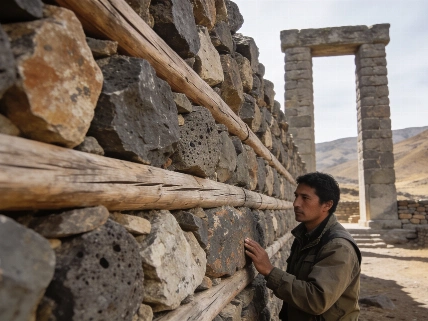
In the southern part of the inner bailey the excavation has now exposed a wall about 1.7 metres wide. Its dimensions are consistent with a possible castle tower from the ninth or tenth century, but the structure has not been identified with certainty. Archaeologists think it connected with a defensive wall along the bailey's southern boundary.
Fire altered the layout late in the tenth century. Afterward the defensive line appears to have moved farther south and houses were built across the earlier fortification zone. Large quantities of pottery from those buildings may provide a more precise chronology for the change, although the pottery has not yet converted the broad historical sequence into a single secure date.
Current work is concentrating on early medieval remains along the southern edge of the Carolingian-Ottonian fortification. The student field season is scheduled to end in mid-October, but excavation and analysis at Posaer Berg are continuing beyond that training campaign.
The episcopal complex
The castle's later importance is tied to the Bishopric of Zeitz. Emperor Otto I established the bishopric in 968 as part of the creation of the Archdiocese of Magdeburg, and the excavated architecture supports the interpretation that the stronghold became its seat during the tenth century.
The most imposing building is a bishop's palace. Archaeologists have exposed a structure about 18 metres wide with roughly 30 metres of its length uncovered so far. Its full dimensions remain unknown. The building is thought to have risen several storeys, and its scale places it in the same architectural conversation as medieval complexes at Paderborn, Goslar and Merseburg.
Inside the basement a north-to-south wall divided the space. One room preserved a screed floor laid over a deliberately prepared bed of pebbles, which points to substantial investment in construction. A broad opening in the southern wall adds further evidence for a carefully planned building rather than a minor administrative structure.
Fragments of stained glass provide another measure of status. Such windows were exceptional for the period and do not prove how the palace was used room by room, but they strengthen the case for an episcopal complex designed to project authority.
Monastery beyond the courtyard
The later Benedictine monastery was founded at Posa in 1114 by Bishop Dietrich I of Naumburg. Earlier interpretations placed its southern limit at a courtyard paved in the sixteenth century. New excavation has overturned that plan by showing that the monastery continued well beyond the courtyard and included a second courtyard surrounded by additional buildings.
A small Romanesque building in this southern area remains unexplained. Nearby evidence includes two fourteenth-century warm-air heating systems and a high-quality red screed floor. These features are not just architectural details. Together with the water infrastructure they indicate that parts of the complex required continuing maintenance and resources during the later Middle Ages.
The newly examined pipe consists of fired-clay tubes roughly 70 centimetres long and 12 centimetres in diameter. Their standardized ends allowed sections to be joined while clay sealed the connections. Early ceramic pipelines of this kind are rare and have previously been documented at only a small number of monasteries and castles in southern Germany.
Posa's water system was more extensive than this single find. Wooden pipes have been recovered elsewhere on the site, and written records document a water supply extending more than four kilometres by 1168. The pipeline therefore belongs to a wider infrastructure rather than representing an isolated repair or household fitting.
The heating installations and waterworks also challenge the idea that Posa simply declined during the later Middle Ages. The physical evidence instead points to sustained investment and considerable economic resources. That conclusion concerns the institution's infrastructure, not every aspect of life at the monastery, and it does not establish how those resources were distributed among the people who lived or worked there.
Archaeological interpretation at Posa follows a principle familiar from work published in journals such as Nature archaeology research: different forms of evidence should be kept analytically distinct before being combined. Stratigraphy can establish sequence, pottery can narrow a phase, architectural comparisons can suggest a date, and documents can anchor activity to a historical year. None of these methods alone supplies a complete social explanation.
The scale of the site is clearer when the measurements are kept together: the early stronghold covered more than eight hectares; the possible tower wall is about 1.7 metres wide; the palace is about 18 metres wide with around 30 metres exposed; and the ceramic pipeline has been traced for approximately five metres using tubes about 70 centimetres long and 12 centimetres across. The written record places a water supply of more than four kilometres at the site by 1168.
What the evidence supports
Posa is now among the most extensively investigated monastic sites in Central Germany, according to the research team's assessment after years of fieldwork. The project's emphasis on measured plans, stratigraphic relationships and material classification is consistent with the documentation standards used across major archaeological research networks, including projects associated with the Max Planck Society.
Excavations are continuing beyond the student training campaign that ends in mid-October, with researchers concentrating on early medieval remains along the southern edge of the Carolingian-Ottonian stronghold. The comparison with another mapped settlement is useful only in a limited sense: both cases show why architectural interpretation depends on distinguishing identified structures from proposed functions.
At Posa the strongest claim is not that every building has been explained. It is that successive excavation areas have connected military architecture, episcopal authority, monastic expansion and engineered water supply within one long-lived site. Pottery, architectural parallels, stained glass, heating systems, pipes and written records reinforce one another, while the precise purpose of some buildings and the complete plan of the palace remain open.
That distinction matters because archaeology rarely recovers an institution as a single intact system. Walls can be rebuilt after fire, courtyards can conceal later additions and objects can outlast the buildings that first used them. At Posa the evidence is already strong enough to reject a simple story of late medieval decline, but not strong enough to reconstruct every social or political change behind the construction work.
Archaeological chronology often depends on several kinds of association rather than one decisive measurement. Pottery can narrow the date of a building phase, architectural comparison can identify a likely period and written records can anchor activity to a historical year, yet each line of evidence has limits. At Posa those limits are part of the result: the excavations show sustained building and infrastructure across centuries, while the exact sequence and function of some remains still require further work.