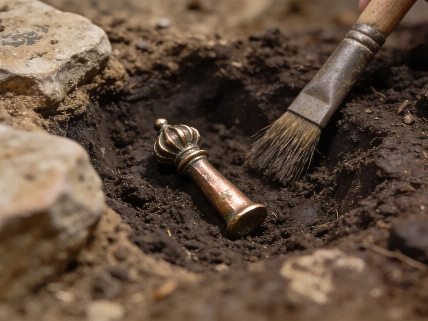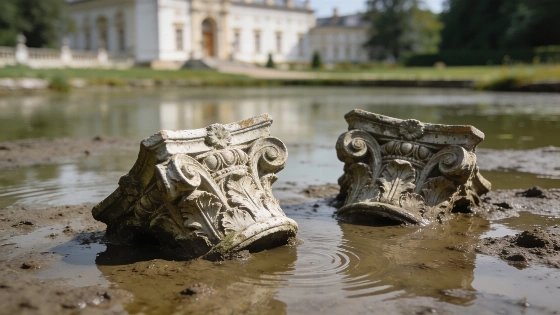
Two ornate fittings recovered from the moat at Pielaszkowice may be among palace objects discarded around 1945, according to local accounts. Their precise history and original function remain uncertain
Local accounts place the palace's discarded furnishings amid the movement of Soviet forces through the region in 1945. Archaeological work at Pielaszkowice in southwestern Poland has now recovered two decorated fittings from the moat surrounding the historic building.
The DRACO Żmigród Association of History Explorers describes the objects as decorative reflectors associated with the former palace. They may have remained in the waterlogged moat since around 1945, though their exact deposition date has not been established.
Finds in the moat
Despite decades in wet, muddy conditions, substantial portions of the fittings' decorative surfaces survive. The investigation also recovered other fragments and objects linked to the palace, but details of those finds have not been released.
The National Support Centre for Agriculture's regional branch in Wrocław permitted the investigation to continue. Researchers believe additional material may remain beneath the moat's sediment.
Accounts of 1945
According to local testimony, soldiers entering the palace as Soviet forces moved through the region threw furnishings and other objects through its windows. Some are said to have landed in the moat. The recovered fittings could be among them, but that connection has not been independently verified.
Their archaeological position and further examination may help establish when they entered the water. A comparable gap between identifying an object and establishing its wider historical attribution appears in the bishop's seal report, where the name Stefan has not been linked to a known diocese.
Further examination
The moat's waterlogged conditions have helped preserve parts of the objects. An earlier investigation of the same area also recovered material, suggesting that further palace-related finds may remain beneath the sediment. Archaeological recovery documents an object's location and condition before conservation and study.
The fittings are expected eventually to join the collection of the Museum of the Silesian House in Ziębice. Further study may clarify their original function and date; conservation could reveal details obscured by corrosion.